Dr. Lacy Hunt’s Hoisington Quarterly Review has been one of my must-reads for years. In this rare video interview, he explains how Quantitative Easing has undermined economic growth and financial stability while increasing downside risk in asset markets. Here is a direct video link.
Posted inMain Page|Comments Off on Hunt explains how Fed monetary policy has destabilized the economy
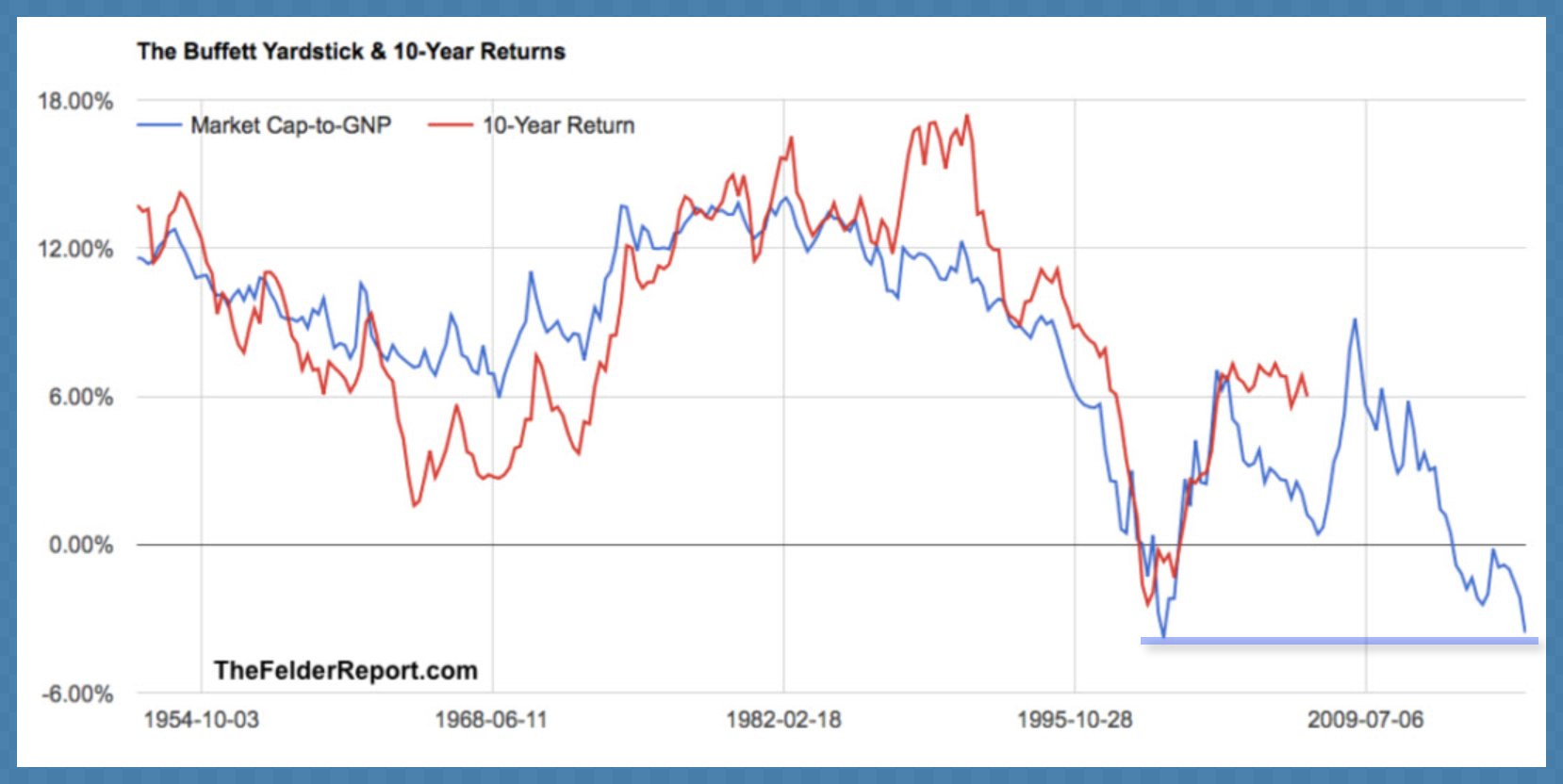
This chart shows one of the most historically useful valuation gauges for equities–market capitalization to gross national product (inverted scale in blue) since 1954, along with subsequent 10-year investment returns from each point (in red).
What we can see is that at the market peak in 2000 (inverted), 10-year equity return prospects were negative (and stocks did in fact have negative returns between 2000-2010), and once again today, valuations are back at a similar all-time high, with return prospects also negative out to at least 2027 from here. Believe it or not. This is the math. We must find the courage to see it even as central banks and most financial gurus do not.
Yet, as explained by Grant Williams in this interview, counter-intuitively most investors (individuals and institutions) have responded to low fixed income yields over the past 8 years by increasing their exposure to the most dangerously over-valued, negative-return-prospect assets. This is a bad trade, for which they are likely to pay heavily once mean reversion completes this cycle. Here is a direct video link.
Most financial ‘advisors’ and pension boards have aided and abetted these disastrous decisions in order to keep collecting their fees and keep the dream of easy money alive. But this dream is likely to prove a nightmare for all concerned.
For present holders, coming losses are likely to endure for years to come, just as an aging population is wanting and needing cash to live. The only way to protect savings from this costly conclusion is to stand clear of the highest risk equities and debt assets now and wait for the inevitable liquidation sale to resume. Yes we can.
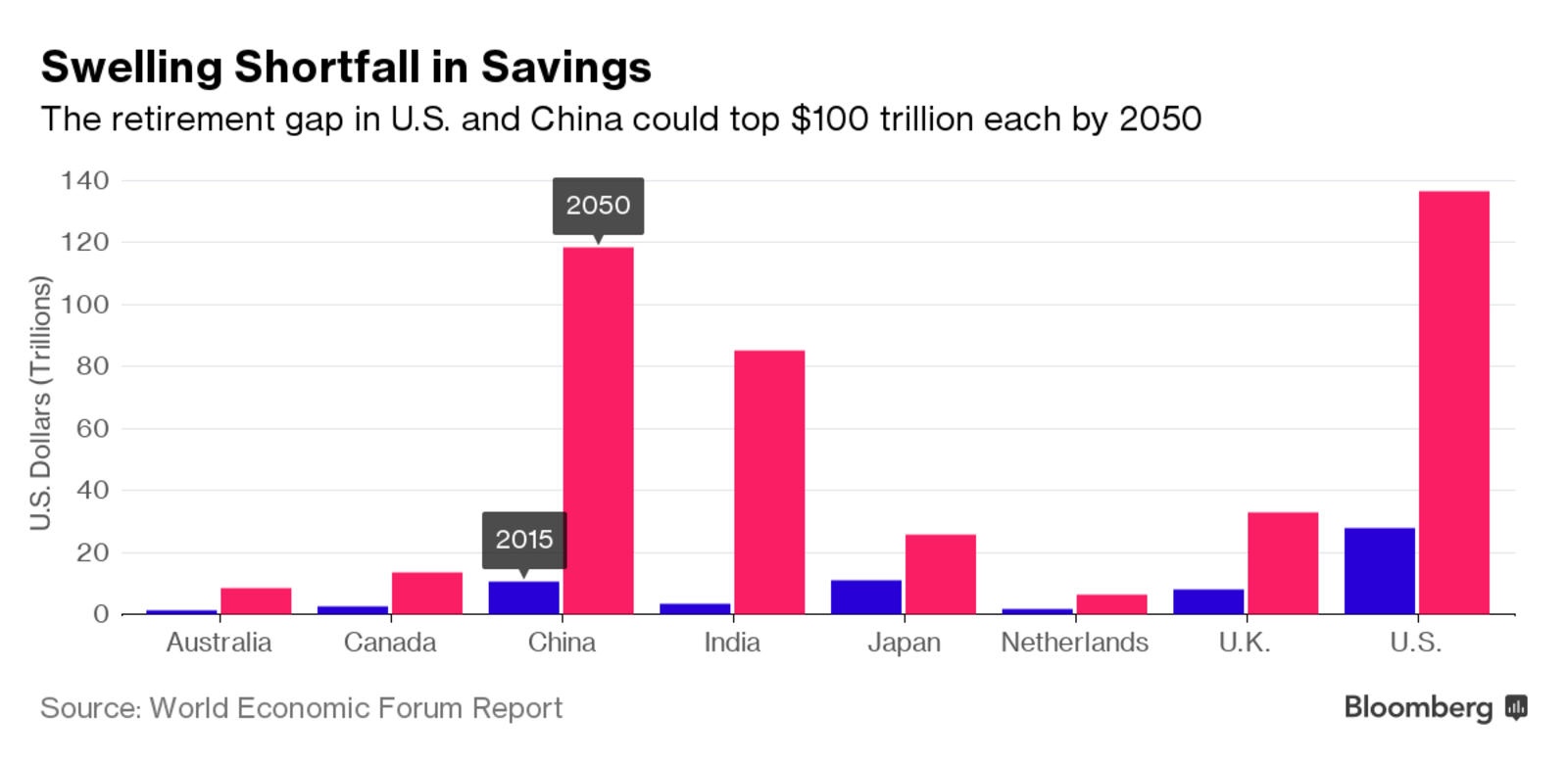
Longer life spans and disappointing investment returns will help create a $400 trillion retirement-savings shortfall in about three decades, a figure more than five times the size of the global economy, according to a World Economic Forum report.
That includes a $224 trillion gap among six large pension-savings systems: the U.S., U.K., Japan, Netherlands, Canada and Australia, according to the report issued Friday. China and India account for the rest.
Posted inMain Page|Comments Off on Reaching for yield is time-worn path to losses
The Global Calculator is a free and interactive tool that helps you to understand the link between our lifestyles, the energy we use, and the consequences for our climate. It is aimed at anyone interested in exploring what a low-carbon world could look like in 2050. The Calculator shows that it is possible to prevent dangerous climate change and ensure people’s living standards continue to improve if we act now. See it here.
The bottom line: all the alternative energies in the world are great, but won’t be enough, if we don’t evolve our eating habits away from animals to a plant-based diet. Healthier for our bodies anyway. Win, win.
Meat production is, on average, associated with significantly higher greenhouse gas emissions than the production of grains, fruit and vegetables per unit of energy output. It also requires more land, as meat production is much less land efficient than growing crops. For example, in 2011 an area the size of a football pitch would typically yield around 25,000 kcal per year of pasture fed beef, 1,450,000 kcal per year of poultry, or 5,410,000 kcal per year of crops (for example, grains). A shift to lower levels of meat consumption could therefore help to reduce the greenhouse gas footprint of our diets, as well as produce surplus land that could be used for other purposes, such as growing bioenergy crops and establishing new forests.
Posted inMain Page|Comments Off on Global impact calculator: reducing animal consumption critical
“An explosive critique about the investment industry: provocative and well worth reading.”
Financial Post
“Juggling Dynamite, #1 pick for best new books about money and markets.”
Money Sense
“Park manages to not only explain finances well for the average person, she also manages to entertain and educate while cutting through the clutter of information she knows every investor faces.”
Toronto Sun