Fire alarm deafening, masses not listening yet

This morning as the financial sales force dominates the airwaves with all the usual assurances that there are no reasons to be defensive of our savings and no signs of a bear market or recession coming [ever again], some factual antidotes are always valuable.

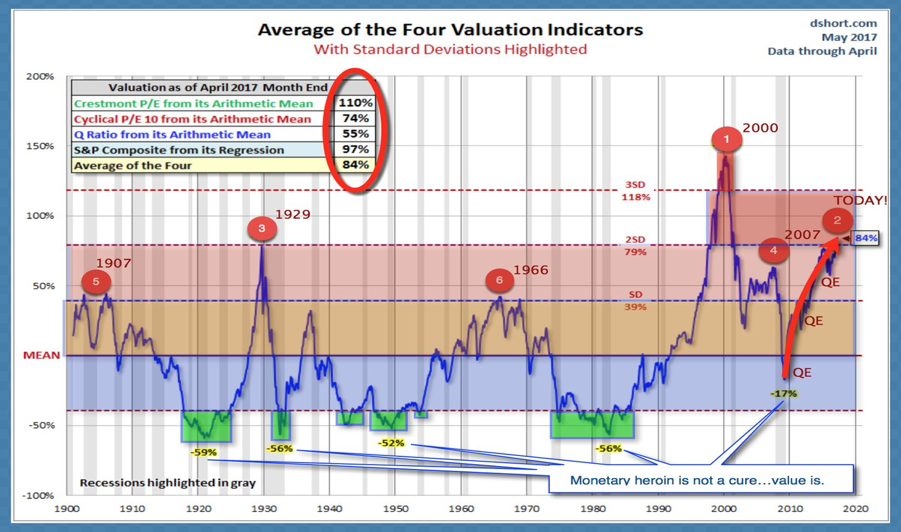
First we have this updated chart showing today’s levels on four of the most historically reliable stock market valuation readings, compared with all the other cycle tops and bottoms since 1900.

Next we have this chart showing the total US stock market capitalization (total price) as a percentage of gross national product (Buffett’s so-called favorite measure) since 1954.  Present levels have now reclaimed the all time secular peak of March 2000.
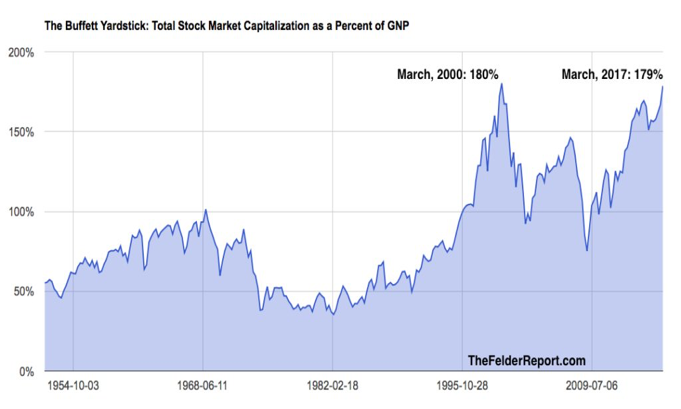
All that’s needed now is a sudden turn in participant sentiment, from irrational-exuberance to panic. At present levels of extreme debt and leverage, sentiment can turn on a dime.

Unfortunately, the masses never realize they are in a burning building until the ceiling starts falling on top of their heads.  Then they all try to exit at once.

Posted in Main Page | Comments Off on Fire alarm deafening, masses not listening yet

Human behavior very reliable

Happy June!  Words to reflect on as we enter the new month:  be careful what trends you are banking on.  See  Why every housing bubble looks like the new normal:

“The Toronto housing market was in a precarious place in the late 1980s. Prices had doubled in a short period, households were piling on debt and the market showed no signs of slowing down. That period represented a peak for Toronto (prices crashed in 1989) but by today’s standards, it looks absolutely quaint. The average home price was a mere $469,000, amounting to 5.4 times the average income. These days, the average home price is between seven and eight times income. To return to the ratio of the 1980s, the average household income has to jump to $160,000, or home prices have to fall back to $460,000.

There is a third possibility: this time is different. Maybe prices in Toronto and the surrounding suburbs really have reached a new normal, and a wide swath of people are permanently shut out of the market….”

Posted in Main Page | Comments Off on Human behavior very reliable

Bubbles and the boomers-running out of runway

This discussion is obvious…but still, worth repeating in the hope that some ‘little folks’ might yet get the memo and take steps to protect themselves before it’s too late again.  See: Why fund managers may be right about the Fed:

“What a lot of hedge fund managers are worried about is the inflation in asset prices, not cost and wages,” said James Chanos, a noted hedge fund manager who is left of center. “This is leading to recurring booms and busts, which in addition are exacerbating income inequality.”

The Fed has explicitly welcomed rising asset prices as a sign that its monetary policies are working, as lower rates push investors to put their money to work. But something is wrong. Companies are sitting on their profits. Businesses aren’t investing and hiring enough.

In fact, the Fed may be inadvertently making things worse. What if it succeeds in bringing average people back into the markets right at the top? Is the Fed setting these poor suckers up to come in to buy from the hedge fund managers?

“The people you are trying to help don’t get the message till the end of move,” Mr. Chanos said. “You keep impoverishing them.”

Making matters more grave today than 2000 or 2008, is that the people who have accumulated the bulk of the savings and financial assets in the economy today are boomers now ages 53 to 71–9 years older than the last bear market–with that much less life time to try and make back losses.

Posted in Main Page | Comments Off on Bubbles and the boomers-running out of runway