Leverage liquidation swamping metals

From record leverage comes rapid repricing one way and then the other.  Levered traders are liquidating as excess supply of most commodities continues to swamp global demand.  This is dominant theme likely to persist for some time in the aftermath of the greatest debt bubble ever in human history.  If the producers are not yet concerned, they are in denial or– like the Saudis and their Aramco deal–trying to talk up values long enough to help them cash out.

Iron ore futures are under pressure again in Asia — signaling a possible return to the $50s for the benchmark spot price — as concern builds about the outlook for rising supply and China’s clampdown on leverage ripples through markets, possibly triggering forced sales.  Here is a direct video link.

Here is the price performance since March 2, 2017 of iron ore, steel, rubber and copper (chart zerohedge), down across the board from 9 to 46% in just 2 months.

Posted in Main Page | Comments Off on Leverage liquidation swamping metals

New study issues ‘code red’ on Canadian housing affordability

Shelter prices are so over-valued relative to income levels today, that saving just a 10% downpayment now takes 12 years on average, compared with just 5 years to save a 20% deposit twenty years ago. In many cases, people are trying to circumvent the waiting and saving period by borrowing even the downpayments. Whatever the approach, inflated shelter costs are keeping people from being able to meaningfully save for other critical necessities like education and retirement, and this is leaving the society increasingly vulnerable.

It now takes about 7.5 years to save up for a down payment on a house in Toronto. In Vancouver, that number is over 10.5 years.

The data comes from the National Bank of Canada, which calculated how much it would take a median-income earner in several cities across Canada to save up enough for the minimum down payment on a median-priced home assuming they saved  10 per cent of their income.  Here is a direct video link.


More than half of Canadians are living within $200 per month of not being able to pay all their bills or meet their debt obligations, according to a recent Ipsos survey conducted on behalf of accounting firm MNP. A whopping 31 per cent of respondents said they already don’t make enough to meet all their financial obligations and two-thirds of survey takers said they are “less than very confident” about their ability to create an emergency fund.  Here is a direct video link.

Posted in Main Page | Comments Off on New study issues ‘code red’ on Canadian housing affordability

Why ‘flip’ thinking is flopping

Don’t plunder that protected green space to squeeze in more housing just yet!  A new report out of Ryerson’s Urban Planning department concludes that Toronto is over-housed, with a majority of 140 city neighbourhoods suffering from a stagnant or declining population over the last 30 years.  See:  Toronto has too much housing despite overall population growth. This map shows the change in population density for each neighbourhood between 1986 and 2016.
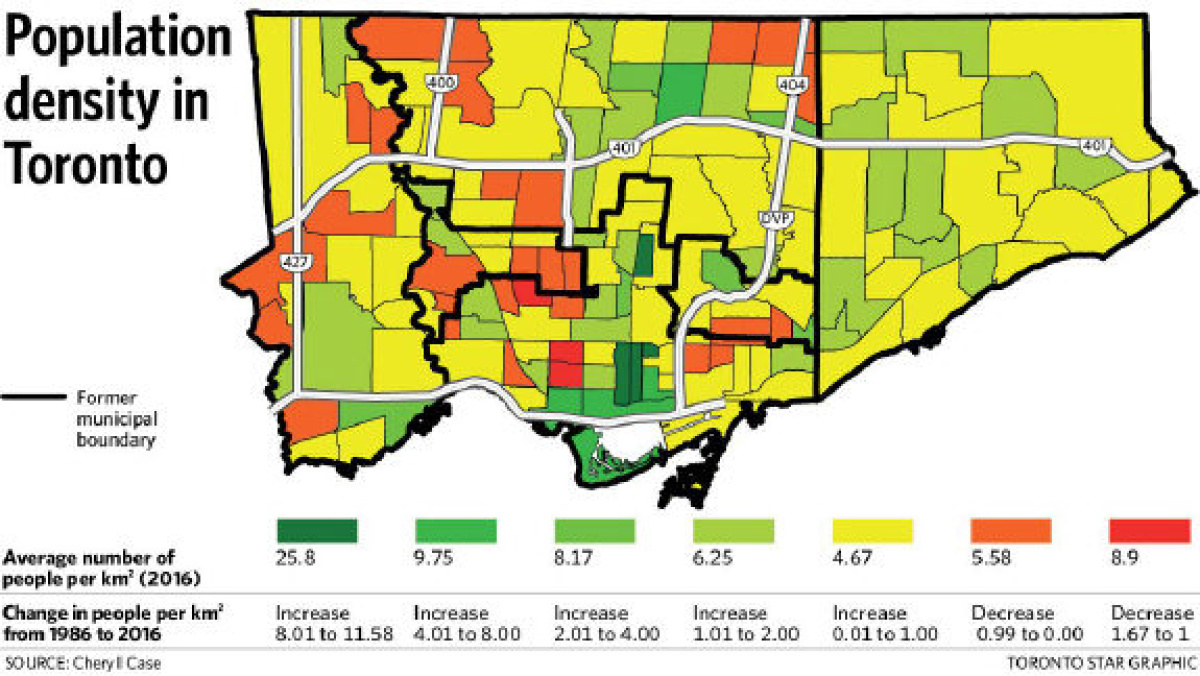
What we have here is the product of 15 years of the largest debt-driven housing bubble in human history coupled with an increasingly aged population.

“We’re surrounded by seniors. They’re either widowed or the kids have moved out. These are detached bungalows . . . Two families could live in these houses essentially.”

Like most developed economies, Toronto has been misallocating finite resources to inflate asset prices (and property taxes!) to create an oversupply in the wrong kind of shelter:  oversized, single-dwelling, energy inefficient, old tech, outrageously priced and a fortune to maintain. As shown below, the majority–nearly 54%–of Canada’s housing supply is single-detached and virtually all dwellings having antiquated, inefficient energy systems.

Meanwhile the pool of able buyers continues to shrink under the weight of stagnant wages and already toxic consumer and government debt levels.  Something has to give, and that something is impossible living costs.

The opportunity here is to stop implementing policies that continue to increase debt and magnify waste and imbalances, while incenting smart shelters that will help families live more efficiently.  After the debt rush, solutions lie in re-purposing old tech spaces into net zero multi-dwelling housing, where people can live comfortably with a fraction of the cost and environmental footprint.  To get there, we have to give back inflated asset bubbles, but we gain a sustainable economy and society–where workers can afford to minimize debt, live, save, and pay taxes to support both the old and the young.

Posted in Main Page | Comments Off on Why ‘flip’ thinking is flopping