Mounting pension deficits threaten solvency of cities and states

According to a new study by Stanford Research no US city or state is running a balanced budget for their pension schemes and the collective funding deficit–of just US public pensions–grew to $4 trillion in fiscal 2016.  The cause of this has been erroneous and negligent financial planning which is targeting average annual returns of 7%, more than twice the actual average return generated of 2.9% in 2015.  See US faces crisis as pension funding hole hit $3.85 trillion in 2016:

Big pension deficits have already contributed to the bankruptcy of several US cities, including Detroit. Puerto Rico, the US territory, this month declared a form of bankruptcy after amassing debt and pension obligations of $123bn.

The answer?  Not taking on more risk and outrageous fees to miracle-promising banks and hedge funds, but rather basic math and restructuring: reduced benefits and increased contributions.  Time to face facts.  The longer this goes on unchecked, the greater the cost to taxpayers, the economy and our social fabric.

Mr Rauh said politicians will have to make unpopular decisions if they are to ward off future financial problems. This could include cutting pension benefits or raising taxes in order to contribute larger sums to public retirement plans.

 

Posted in Main Page | Comments Off on Mounting pension deficits threaten solvency of cities and states

Death of a cartel: cuts = higher prices= more production= lower prices

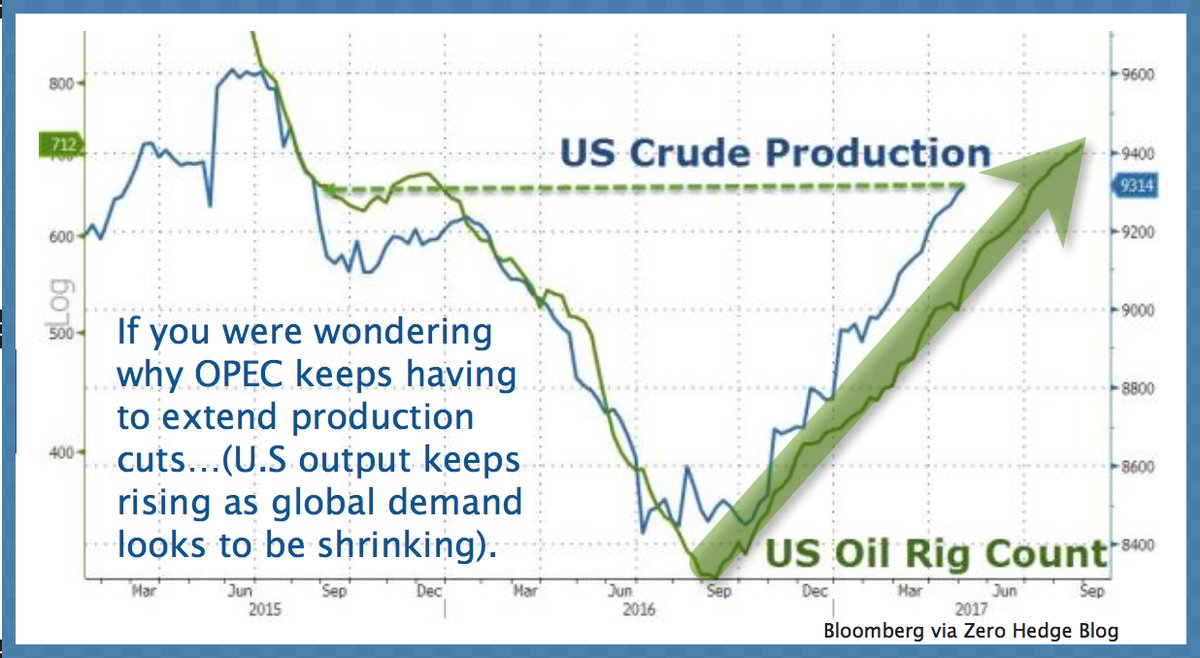
Extending the OPEC plus Russia cuts should help bring commercial petroleum inventories down and boost crude prices by a few dollars a barrel in the short-term. But in the bigger picture:  OPEC (Canada and other dependent exporters) are likely to lose revenue while the US becomes the world’s top oil producer.  All the while, slower global growth, increasing efficiency and booming alternative energies will continue to erode the world’s oil demand.  Less demand and more supply lead to lower prices and a transformation of  the power structure that has dominated the world for the past 60+ years.  Messy but necessary for evolution.  See:  The real winner from oil supply cuts:

The ultimate free-rider on Saudi sacrifice is nimble U.S. shale. So much capital is now being deployed that the U.S. may become the world’s top oil producer by 2018, topping Russia and Saudi Arabia.

Posted in Main Page | Comments Off on Death of a cartel: cuts = higher prices= more production= lower prices

After the oil-rush, Canadian economy un-diversified and fragile

While some 25% of Canadian GDP has come from realty and related services over the past 7 years, nearly all–s0me 84%–of Canadian economic growth since 2010 has come from abnormally high activity in this sector.  As a result, it does not require a price collapse, just a moderation in this activity, for the Canadian economy to flat line.  Even the congenitally nearsighted Bank of Canada has admitted that the pace of growth in realty and related spending is ‘not sustainable’.  So um, ya… Plan B?

After Home Capital, Canada’s Economy Suddenly Looks Frail. Here is a direct video link
.

Posted in Main Page | Comments Off on After the oil-rush, Canadian economy un-diversified and fragile