Soothing sounds and deep sleeps

A year ago we downloaded a free app that plays nature soundtracks on a timed loop.  The one I use is called White Noise. It changed my life.  I used to have difficulty falling asleep and would wake several times a night.  Now I go down with ocean waves for 8 hours straight, and look forward to a spa like rejuvenation every time.  (Your spouse has to like it too of course).  It turns out, it may also be good for an aging memory. Bonus!  See,  Pink noise synced to brain waves deepens sleep and boosts memory in older adults:

Gentle sound stimulation—such as the rush of a waterfall—synchronized to the rhythm of brain waves significantly enhanced deep sleep in older adults and improved their ability to recall words, reports a new Northwestern Medicine study.

Deep sleep is critical for memory consolidation. But beginning in middle age, decreases substantially, which scientists believe contributes to memory loss in aging.

The sound stimulation significantly enhanced deep sleep in participants and their scores on a memory test.

“This is an innovative, simple and safe non-medication approach that may help improve brain health,” said senior author Dr. Phyllis Zee, professor of neurology at Northwestern University Feinberg School of Medicine and a Northwestern Medicine sleep specialist. “This is a potential tool for enhancing memory in older populations and attenuating normal age-related memory decline.”

The study was published March 8 in Frontiers in Human Neuroscience.

Posted in Main Page | Comments Off on Soothing sounds and deep sleeps

Bulls come and go, valuations remain prescient

The simple, ego-free, mathematical valuation measurements that have had a near perfect 97% correlation in predicting actual investment returns over subsequent 7 to 12 year periods (such as forward operating price to earnings multiples, Shiller CAPE, price to cash flow, price to dividend, Tobin’s Q, the Fed Model, and market capitalization to GDP) are all forecasting flat to negative returns for North American stocks from present levels.  See:  Valuation Breakevens, The truth about earnings and stock values,  and here is GMO’s latest Q1 2017 asset class return forecasts based on similar valuation measurements they have been tracking for decades.  Why ever should we care?

Because these same measurements suggested similar forward returns at euphoric cycle peaks in 1998-2000 and 2005-2007, and they were proven accurate courtesy of massive price declines (-55 to -78%) and the many years it took thereafter to make back losses.

Here is a nominal price chart of the NASDAQ Index since 1998, showing the 17 years it has spent making back the 2000-2003 losses before finally breaking through to some tiny nominal progress (in green) over the past few months.  Still think it’s fine to ignore asset valuation readings?  Think this time is different?

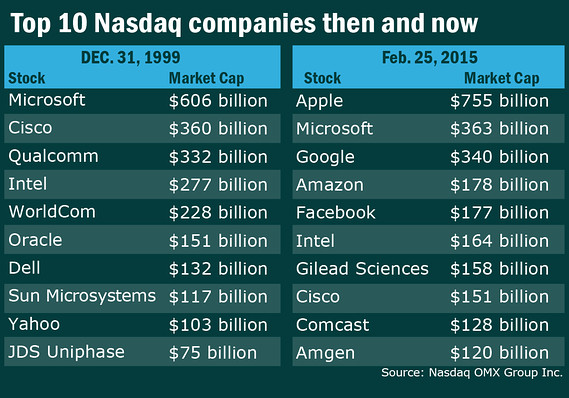
Some of the index components have changed since 2000:  bankruptcy, mergers,  consolidations and some new upstarts have all changed the mix.  Here is a comparison of the top ten constituents in 1999 and 2015.


Companies and their promoters come and go, while investors win and lose. But historical valuation metrics have always been prescient. The fact that it takes indefinite periods of time for mean reversion to complete a full cycle, doesn’t make the measurements wrong but it can try patience.

Sticking to a valuation discipline doesn’t offer precision timing nor a cure for mental weakness, but it is more useful than anything else we have.  In the words of Matthew McLennan, head of global value, First Eagle Investment Management:

“As a value investor, you have to be willing to be short on social acceptance for long periods of time. Individual ideas about how to assess value will always evolve, but fundamentally value capitalizes on the fact that investors are extraordinarily talented when it comes to making bad decisions at the worst possible time. That won’t change.”

Posted in Main Page | Comments Off on Bulls come and go, valuations remain prescient

Ted: Intuitive Artificial Intelligence

Twenty years ago most of us began signing into the world wide web for the first time via dial up connections. Compounding innovation over the next twenty years, is certain to bring  change and solutions that most can’t imagine today.

What do you get when you give a design tool a digital nervous system? Computers that improve our ability to think and imagine, and robotic systems that come up with (and build) radical new designs for bridges, cars, drones and much more — all by themselves. Take a tour of the Augmented Age with futurist Maurice Conti and preview a time when robots and humans will work side-by-side to accomplish things neither could do alone. Here is a direct video link.

Posted in Main Page | Comments Off on Ted: Intuitive Artificial Intelligence