All the Plenary’s Men: another look at the banking cartel still ruling the world

A look at how and why bankers have continued to get away with crimes against humanity with nothing more than pay-to-play fines paid by their corporations…

The question at bar is why the U.S. Department of Justice has failed to prosecute any too-big-to-fail banks or—more importantly—their bankers, even for admitted crimes.

It’s a crucial question, because after eight straight years of unremitting prosecutorial failure, it looks very much as if a select group of top banks can, in fact, do no wrong. If that’s the case, then our constitutional republic isn’t merely in trouble. It’s dead.

A person or group of people who satisfy Blackstone’s criterion for ultimate sovereign power—the power to commit crimes with impunity—can’t exist in a nation where the law reigns supreme. And yet here we are a decade after the financial crisis began in earnest, and not one TBTF bank executive has gone to jail.

Legally, the TBTF banks are indistinguishable from the King, since the power to commit crimes with impunity swallows all other sovereign powers; such a power isn’t even supposed to exist in the U.S., and yet it does. Here is a direct video link.

Posted in Main Page | Comments Off on All the Plenary’s Men: another look at the banking cartel still ruling the world

If credit cycle has peaked, stocks should have too

Auto makers are releasing April sales numbers today and so far, all are reporting a fourth monthly decline, sending their share prices lower. See Every major carmaker whiffs on sales.

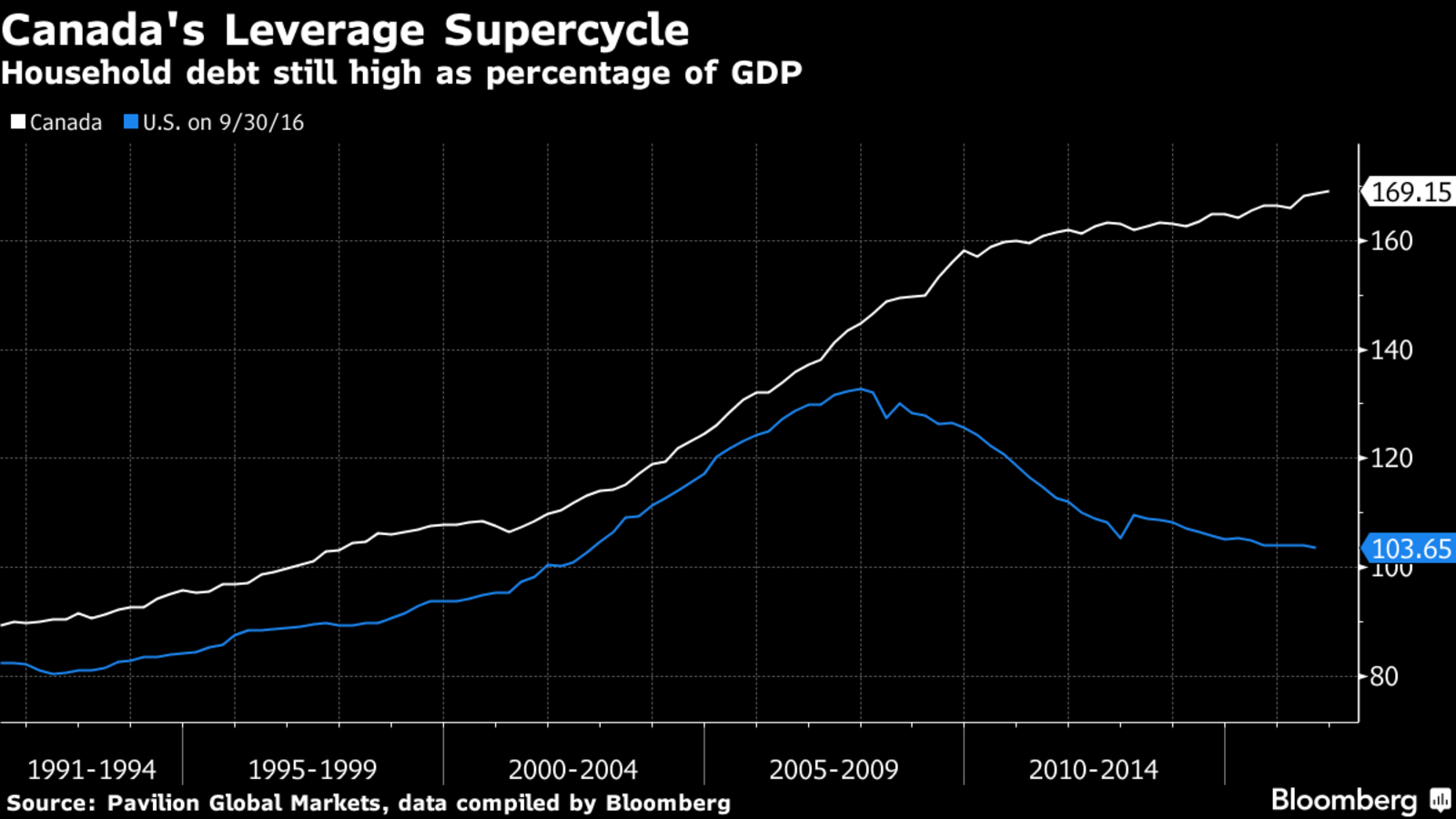
After seven straight years of prodding purchases with increasingly lax lending and uber-generous incentives, disappointment and mean reversion are due. No expansion can last forever, especially one this inherently self-destructive. Canada for one, has never had higher household leverage as shown here since 1990.


Weak auto sales weighed down consumer spending and hurt GDP growth in the first quarter. A year over year decline in 2017, would mark the first since the last recession.

At the same time, the other debt-enabled piston of the consumer-led economy–real estate and related services–is looking more precarious as mortgage magicians meltdown. This chart shows the spread from industry leader Home Capital to the shares of the other non-bank lenders who helped to fund Canada’s consumer debt bubble the past 8 years.


So far the broader Canadian financial sector index (XFN) is only down some 2% since March 1, 2017. But we should make no mistake, bank lenders are also heavily exposed to both household credit and the commercial realty sector.

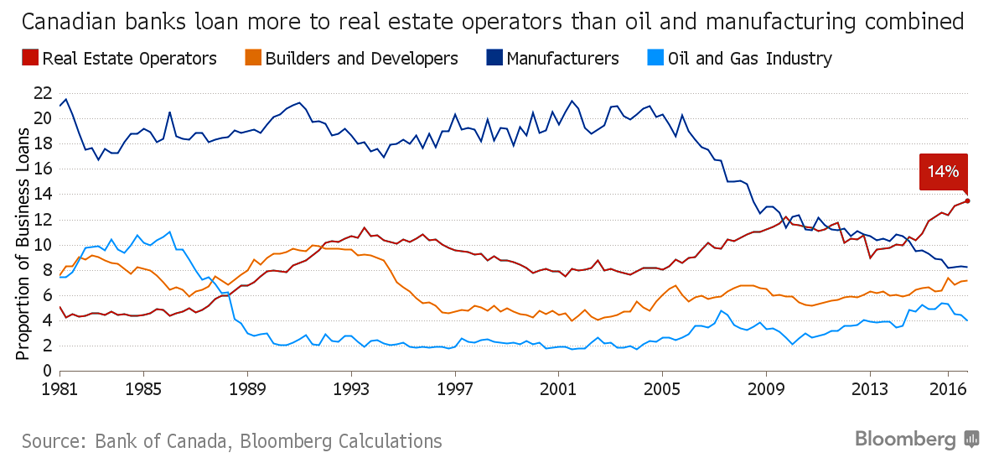
As shown below, realty operators are now a full 14% of the business loans held by Canadian banks–more than oil and manufacturing loans combined.  Note that real estate operator loans have led since the oil and manufacturing sectors turned down in 2014.

If the concerns here were contained to just a few borrowers at the margin, that would be easier to overlook. But debt burdens and shrinking revenues are the rule today, not the exception. And knock-off effects connect from the economy through the stock market, which in Canada is about 70% concentrated in just energy and financial shares.

This means that all of the mutual funds, ETFs and asset allocators who are all set up to track the broader index, are also over-exposed to the financial and energy sectors, as both move through a secular consolidation likely to persist for several years.

Tracking markets up is great, it’s tracking them back down that sets holders back years in wasted time and money.  And yet, that’s precisely what most advisors, managers and products, are designed to do.

Posted in Main Page | Comments Off on If credit cycle has peaked, stocks should have too

Beware of your accountant?

Every year at tax time many of us submit our income receipts to accountants and trust that they will prepare our financial statements and tax returns in accordance with the latest laws and our best interests.  That’s inherent in the professional service, right?

Except increasingly we have noticed a disturbing trend of accountants in the investment advice business.  In a world dangerously obsessed with ‘cross-selling’ to increase revenues, many accounting firms have formed ‘wealth management advisory’ divisions and are making unsolicited recommendations of products and services to their clients.

This is problematic on many fronts.  First all because tax advisors are using their privileged position and information as our accountants to increase their own fees by selling investment management services.  Second, accountants know lots about tax efficiency and nothing about managing capital risk of publicly traded security portfolios.

The most classic example, is accountants saying we should buy and hold, but not sell assets, where doing so triggers capital gains tax.  What about the fact that market cycles drive asset prices up and then the gains are given back in the down cycle?  Sure taxable gains disappear when prices mean-revert, but how is that progress? Remember Nortel anyone?  Bad things happen to capital, when tax planning dictates investment timing decisions.

Another classic example, is the recommendation that we should put cash into dividend paying securities rather than bonds and guaranteed deposits because dividends are given a preferential tax rate.  Sure, but what about the downside risk, where companies go bankrupt and shares can go to zero, or over-valued common and preferred shares drop 50% in a market downturn as they did in 2000-3 and 2008-09?  How does a lower tax rate on income help, when capital losses evaporate years of it and chunks of our principle each market cycle.

Finally, the ‘genius’ of tax shelters recommended by accountants or tax lawyers have frequently harmed those who bought them over the years.  When tax authorities reassess these securities or ‘strategies’, the taxes owing, penalties and compound interest falls on the clients not the tax experts or fees they collected for their recommendations.  I have personally known of several people who were reassessed with devastating financial impacts, years after the fact, in some cases after they had already retired and could not afford to make the repayments.  I know of two people who actually committed suicide thereafter.  This is no joking matter.

As investment counsel, portfolio managers, we spend all our time focused on the best, unbiased financial advice for our clients and what will grow their net equity, while minimizing losses, in a world full of harmful advice, huge capital risk and lots of product salespeople.  We have quite extensive tax planning education and understanding, but we never try to overstep our expertise and hand out the accounting advice to our clients.  Nor do we try and channel them to a different accounting firm that has offered to pay us referral fees for the favor.  We should all be very wary of accountants and tax lawyers who seek to overstep their own expertise and make investment management recommendations and referrals.

Posted in Main Page | Comments Off on Beware of your accountant?