Personal prosecution of finance executives and directors necessary

News yesterday that the Wells Fargo board voted to clawback a further $75 million in bonus awards from two former senior executives who it says were largely to blame for driving a culture of fraudulent sales activities.  Still, it is clear that long-running fraud at this bank was aided and abetted my many parties within and around Wells Fargo, including the Board of Directors (see the esteemed list of members here) who collected rich compensation while failing in their duty of oversight.

Some 5000 employees lost their jobs and a few executives lost bonuses, but while the company has issued an official apology it has also blocked the efforts of affected customers to sue for the resulting damage inflicted on their credit record, housing and employment opportunities.  The bank asserts that the small print of mandatory arbitration clauses signed by customers when they opened accounts at Wells Fargo, also applies to fraudulent accounts opened in their names, without their consent.

This type of bank behavior is outrageous, but common.  See my recent discussion of entrapment and misrepresentation being used by Canada’s CIBC, where salesmen dressed in Tim Horton’s uniforms hang out in student centers tricking university kids into signing up for credit cards–by saying they are offering free Tim Horton’s gift cards as a present to help kids get through exams.

It also reminds of a recent CBC Go Public investigation which revealed the fraudulent tactics used by representatives of PC Financial to get customers shopping in Loblaws-owned stores tricked into applying for its MasterCard products.  See:  “Whatever means necessary”, how these insiders tricked Loblaws shoppers into signing up for credit cards with a special focus on poor and illiterate customers who offered the easiest marks.

At the end of all of this and so much more, one thing is abundantly clear:  fines, firings and public apologies to date, have been woefully inadequate to curtail a runaway finance cartel gone wild.  Personal prosecutions against actors and directing minds–those responsible for oversight–are our only hope of getting a message of intolerance and reform into this socially destructive sector.  See:  Plenty More Villains at Wells Fargo:

Finally — and this is a lesson learned over and over after the financial crisis — prosecutors at the Justice Department and the Securities and Exchange Commission need to pursue individual wrongdoers, civilly or criminally, as the situation warrants. Unless and until clawbacks are combined with private litigation and public prosecutions, misconduct and negligence will endure.
Posted in Main Page | Comments Off on Personal prosecution of finance executives and directors necessary

Kevin O’Leary’s investing fund misadventure

Kevin O’Leary is a successful salesman: but buyers should beware of what he’s selling.

A MacLean’s article this week offers the latest update on the hype that was O’Leary funds. O’Leary used his media personality and platform in 2009 to attract more than $1 billion into funds of his name in just 2 years.  Then in 2011, performance for investors went south.  Read: Inside Kevin O’Leary’s investing fund misadventure:

“O’Leary served as the company spokesman and raised funds. The products were aimed primarily at baby boomers and retirees who desired stability and yield. As such, O’Leary said the funds would invest in safe, dividend-paying securities, and never touch the principal. (The Globe and Mail found in 2012 that the company had, on occasion, paid distributions from the investors’ principal.) O’Leary put some of his own cash into the funds, too, giving Canadians the chance to invest alongside the wealthy businessman they saw on television. How much of his net worth landed in the funds was never made clear.

O’Leary was a tireless promoter, travelling the country to meet with financial advisers and brokers. At one point, O’Leary hosted advisers for lunch at CBC headquarters in Toronto while he was taping Dragons’ Den. The visitors even got to watch “Mr. Wonderful” in action on the set. O’Leary raised hundreds of millions of dollars from Canadians over the first couple of years.”

By 2015, the asset base had shrunk by 46% to $800 million.  As assets under management declined O’Leary Funds charged new expenses called “administration fees” and “directors fees” to buoy firm revenues.  Then late that year, he sold the remaining client assets under management to another company named “Canoe” for an undisclosed sum.

MacLean’s reports that the acquiring company agreed to pay $13.7 million with the possibility of up to $8 million in equity—provided the funds’ assets could grow by another $200 million over the following year.  An audio recording of an internal O’Leary Funds conference call obtained by Maclean’s, (you can listen to the audio link of O’Leary talking, embedded in the MacLean’s article) speaks volumes:

O’Leary vowed on the call to deploy his television fame—by this point, he’d left the Den but was working as a commentator for BNN— to help make that happen. “I’m signing for another year with CTV for one reason: just to keep their brand bannered on BNN everyday,” O’Leary said, referring to Canoe. (As part of the deal, he signed an 18-month part-time consulting contract with Canoe to provide marketing assistance.) O’Leary rallied his sales force on the call. “We want to go get $200 million, and everybody benefits from that,” he said. “We are indifferent on which products we’re selling.”

One more chapter in the self-aggrandizing and self-enriching history of Kevin O’Leary.  As he sets his sights on running for Prime Minister, Canadian voters have many good reasons to be wary.  See: Why you should be wary when O’Leary promises big GDP growth

Posted in Main Page | Comments Off on Kevin O’Leary’s investing fund misadventure

Savings deficits cannot be hoped and dreamed away

Behind the increasing stress and mismanagement of our natural world, financial mismanagement is the next most pressing issue of our times. A new C.D. Howe report urges the need to address Canada’s government pension deficits with an extension of the age before eligibility. But that is just the tip of the iceberg on the reforms needed in this area.

A new report from the C.D. Howe Institute is arguing demographic challenges necessitate slowly raising the age of eligibility for old-age benefits. In the report, released Tuesday, the think tank’s Robert Brown and Shantel Aris write that the increasing proportion of senior citizens relative to the overall workforce means Canada will have to act.
Here is a direct video link.

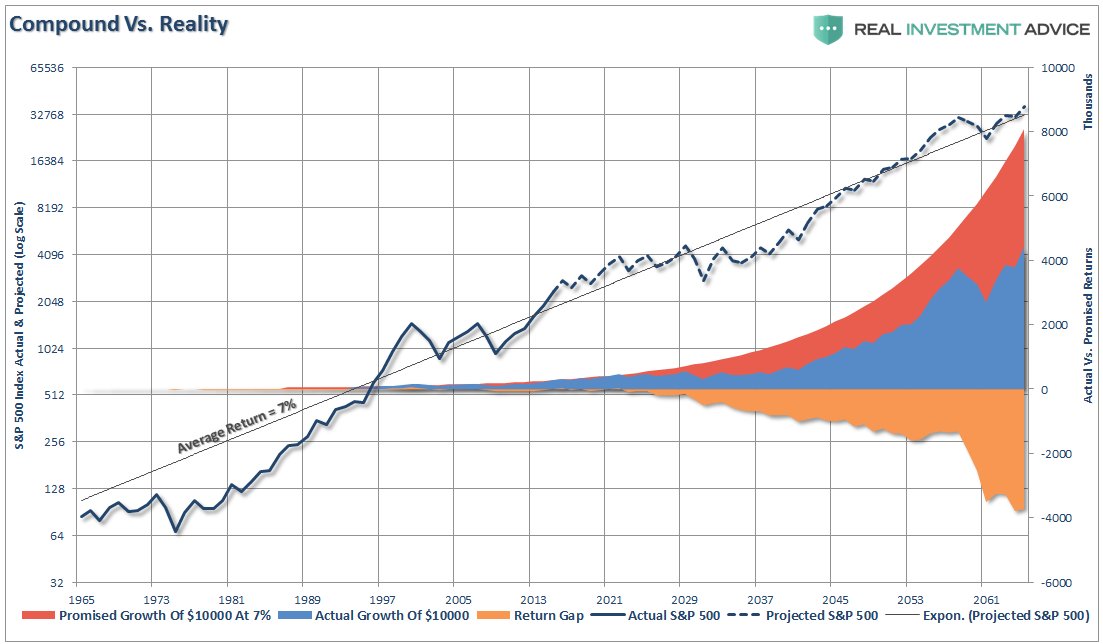
The below chart courtesy of Lance Roberts offers context for this discussion.  This shows the ominous gap between the ‘official’ 7% average return target (black line) being used by US pension funds today (similar to most other countries as well as the majority of individual retirement plans that continue to target returns of 7%+) and the actual returns generated (in blue) since the current secular bear in financial markets began in 2000.  We can see that actual returns have dramatically undershot targets since the 2008 financial crisis.  And that is notwithstanding, trillions in government-backed capital reflating financial assets back to record valuation levels in record time.

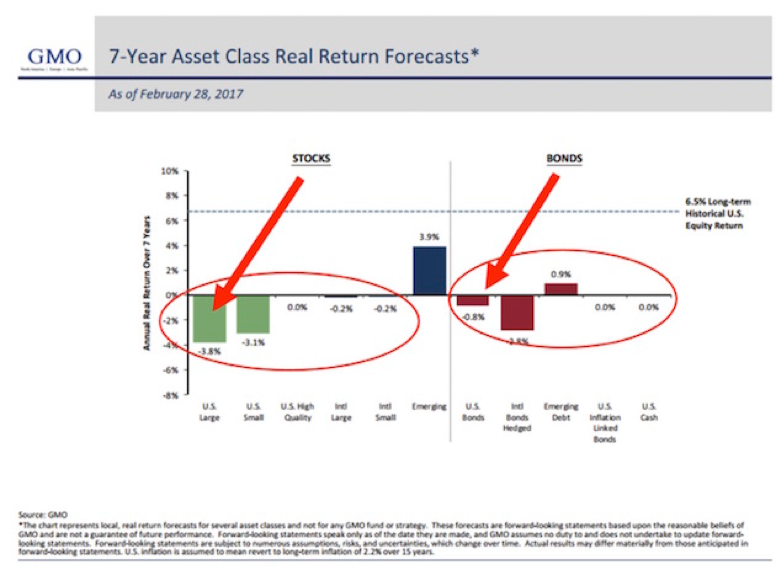
But worse, now that we are already back at nose-bleed highs for financial assets, going forward the return prospects are even lower.  In fact history attests that starting from 10-year-average equity PE’s above 20 for stocks, the average annual total return over the next 20 years has been less than 3%.   Over the next 7 years, real returns are likely to be negative as shown here in GMO’s 7-year asset class real return forecasts.  Imagine what these results will do to pension and savings deficits which are already many trillions today, just in North America.  At the same time, the trend of herding into passive indexes and ETFs at present price levels, will not help, but rather only compound the downside from here.  This is no time to be passively holding on to overvalued assets and hoping for miracles.

The mess that central banks and 20 years of destructive financial ‘engineering’ has wrought, cannot be hoped and dreamed away. The best chance anyone has in this environment is to not mindlessly take the bait and hold unattractively priced assets, but rather to focus instead on reducing leverage, while building principle and liquidity in order to purchase higher yielding assets in the next bear market.  That takes patience and counter-cyclical thinking to be sure, but the alternatives of accepting untenable capital risks for insufficient yields, and indefinite financial frustration and hardship, are much more unappealing.

Posted in Main Page | Comments Off on Savings deficits cannot be hoped and dreamed away