
The next ‘big short’: malls

The consumer credit bubble encouraged a massive overbuild in retail and commercial realty over the past decade.  This was especially the case in North America, which already boasts the greatest retail square footage per capita in the world, with countless new projects still building.  A perfect storm:  record supply is now lining up with a general population paralyzed by record debt, aging boomers that are naturally consuming less with age, and a growing preference for on line commerce.  The imbalance has been evident in the frequency of 70-80% off sales that have become increasingly common through malls in recent years.   Still thanks to years of QE and low rates, publicly traded chains have been able to issue debt to keep afloat, as well as buyback their shares to boost reported profits, notwithstanding steadily shrinking sales.  But that was always a short-term strategy.  With the consumer still in secular retreat, the moment of math is dawning.  No company can burn cash indefinitely.  Waves of stores have been shuttering month after month, driving commercial vacancies and finally, loan defaults.

This underlines the capital risk for the investors-individuals and pensions–who turned to REITS and other commercial mortgage-backed securities the past few years–desperate for yield.   It is also attracting short-sellers now smelling the blood of another ‘big short’.

Wall Street speculators are zeroing in on the next U.S. credit crisis: the mall. It’s no secret many mall complexes have been struggling for years as Americans do more of their shopping online. But now, they’re catching the eye of hedge-fund types who think some may soon buckle under their debts, much the way many homeowners did nearly a decade ago.

Here is a direct video link.
Posted in Main Page | Comments Off on The next ‘big short’: malls

Swapping savings for unreasonable risk: not a good trade

Someone recently told me that they worked hard for their money and they would like to see their money work hard for them. This reminded me of Michael Lewis’ analogy that financial sales propaganda has conditioned people to think of their savings as a dog team that must be whipped and abused to make it move faster. The truth is the opposite: only discipline and care in building savings and then defined standards and patience in selecting how and when to invest it, are likely to grow financial strength over our lifetime.

Since most asset prices in the world are egregiously overpriced today, the income yields available on them are low with a high risk of capital loss. The best course given these facts, is not to care less and risk more, but to raise liquidity and strategically wait for better opportunities to present. Instead many people are doing the opposite. “I need more income”, is a common complaint today, but the truth is, most need more capital. Holding on to overvalued assets to try and squeeze out extra income is a time worn path to financial hardship. This week’s letter from John Hussman is worth reading. See Blue Skies:

In April 2000, I described the psychology that investors could expect to play out over the completion of the market cycle:

“This is my retirement money. I can’t afford to be out of the market anymore!”
“I don’t care about the price, just Get Me In!!”
“It’s a healthy correction”
“See, it’s already coming back, better buy more before the new highs”
“Alright, a retest. Add to the position – buy the dip”
“What a great move! Am I a genius or what?”
“Uh oh, another selloff. Well, we’re probably close to a bottom”
“New low? What’s going on?!!”
“Alright, it’s too late to sell here, I’ll get out on the next rally”
“Hey!! It’s coming back. Glad that’s over!”
“Another new low. But how much lower can it go?”
“No, really, how much lower can it go?”
“Good grief! How much lower can it go?!?”
“There’s no way I’ll ever make this back!”
“This is my retirement money. I can’t afford to be in the market anymore!”
“I don’t care about the price, just Get Me Out!!”

My view today is the same I expressed in December 1999: “One thing is certain. This market cycle will be completed by a bear market, and a potentially violent one. Of course, nobody thinks about market cycles anymore. Nobody imagines that stocks can do anything but advance. And in the mania of the present, it is easy to forget the nearly identical ones of the past, and their very, very bitter aftermaths.”

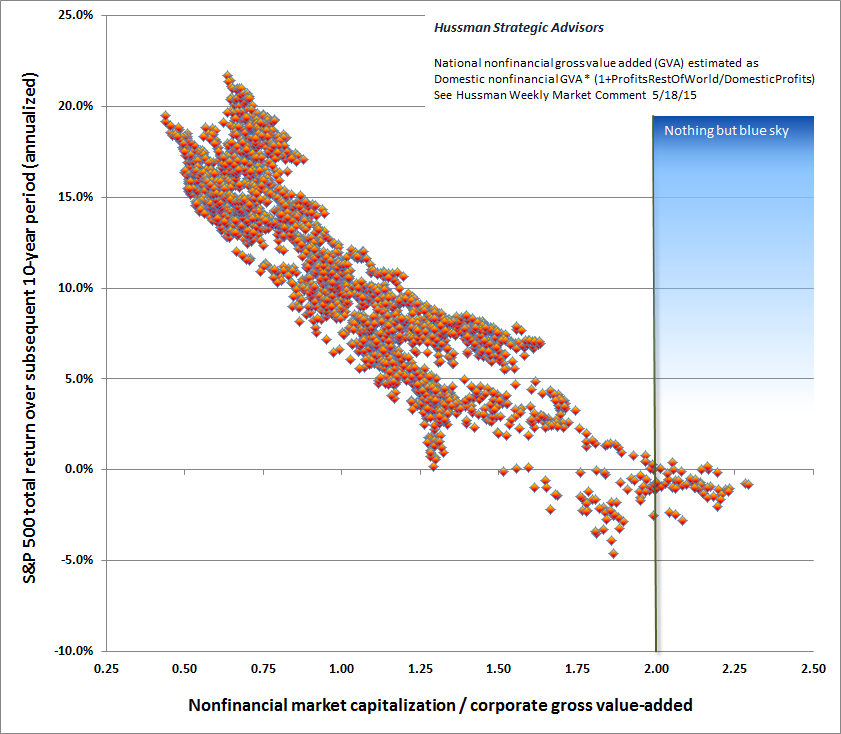
Hope is not a strategy.  The facts are that since 1947, no incidence of equity valuations near present levels has ever produced positive investment returns over the following 18 months, 3, 5 or even 10 year holding period.  The green line below, marks the current market valuation of S&P 500 companies compared with other historic periods and the subsequent return 10 years later (left axis): zero and negative in every instance.

“Every investment approach has its season, and my impression is that passive investment strategies are approaching the start of a very long, hard winter. We fully expect patient, diligent passive investment in the S&P 500 to be rewarded with nothing over the coming decade.”

Not a good trade.

Posted in Main Page | Comments Off on Swapping savings for unreasonable risk: not a good trade

Urban Outfitters CEO rings the bell: “retail bubble has burst”

Urban Outfitters Chief Executive Officer Richard Hayne is said to have ‘shocked’ analysts in his 4th quarter earnings call last week, when he admitted that the holiday season was disappointing even with heavy discounting, and that the broader problem is that there are just way, way too many stores.  Urban Outfitters CEO says retail bubble has burst:

“The U.S. market is oversaturated with retail space and far too much of that space is occupied by stores selling apparel,” he said. “Retail square feet per capita in the United States is more than six times that of Europe or Japan. And this doesn’t count digital commerce.”

Too much square footage was added in the 1990s and early 2000s, with thousands of stores opening.

“This created a bubble, and like housing, that bubble has now burst…We are seeing the results: Doors shuttering and rents retreating. This trend will continue for the foreseeable future and may even accelerate.”

Years of Quantitative Easing enabled public companies to raise round after round of cheap financing, and extend the illusion of viability in the retail sector.  But it was never sustainable.  Now the world is awash in consumer goods amid an aging and heavily indebted population that wants less debt, more savings, better health and less things.

When retail executives are finally admitting the truth about this cycle, we should know that even extreme financial engineering can no longer paper over the holes here.  The trick now is to figure out smart ways to recycle and re-purpose superfluous goods and buildings into productive activities like green energy and food farming, maybe some roller rinks for fun and fitness?  Maybe we can regrow some of that green space we plundered to build all this wasteful nonsense.  Time to get creative and resourceful.

Posted in Main Page | Comments Off on Urban Outfitters CEO rings the bell: “retail bubble has burst”





