This is an interesting discussion from November 1992 with a 46 year-old Donald Trump talking, among other things, about the real estate bust of the late 80’s (which he blames on “stupid” government tax changes that reigned in speculative madness. He doesn’t blame the insane lending and borrowing habits that fueled great hubris, reckless risk-taking and an inherently unstable asset bubble. No of course, that wasn’t the problem!) So typical!!
Donald Trump talks about his recent “comeback” after flirting with bankruptcy, his support of Mike Tyson after his imprisonment for rape, his divorce from Ivana Trump, and the rumors that he would run for president. Here is a direct video link.
Posted inMain Page|Comments Off on Charlie Rose flashback: Trump in 1992
It’s unbelievable what a mess has been made globally by ‘free’ money and policy largess to the financial sector. This is madness of truly epic proportions, and there is no doubt, we’ll be paying to clean up the mess for years to come.
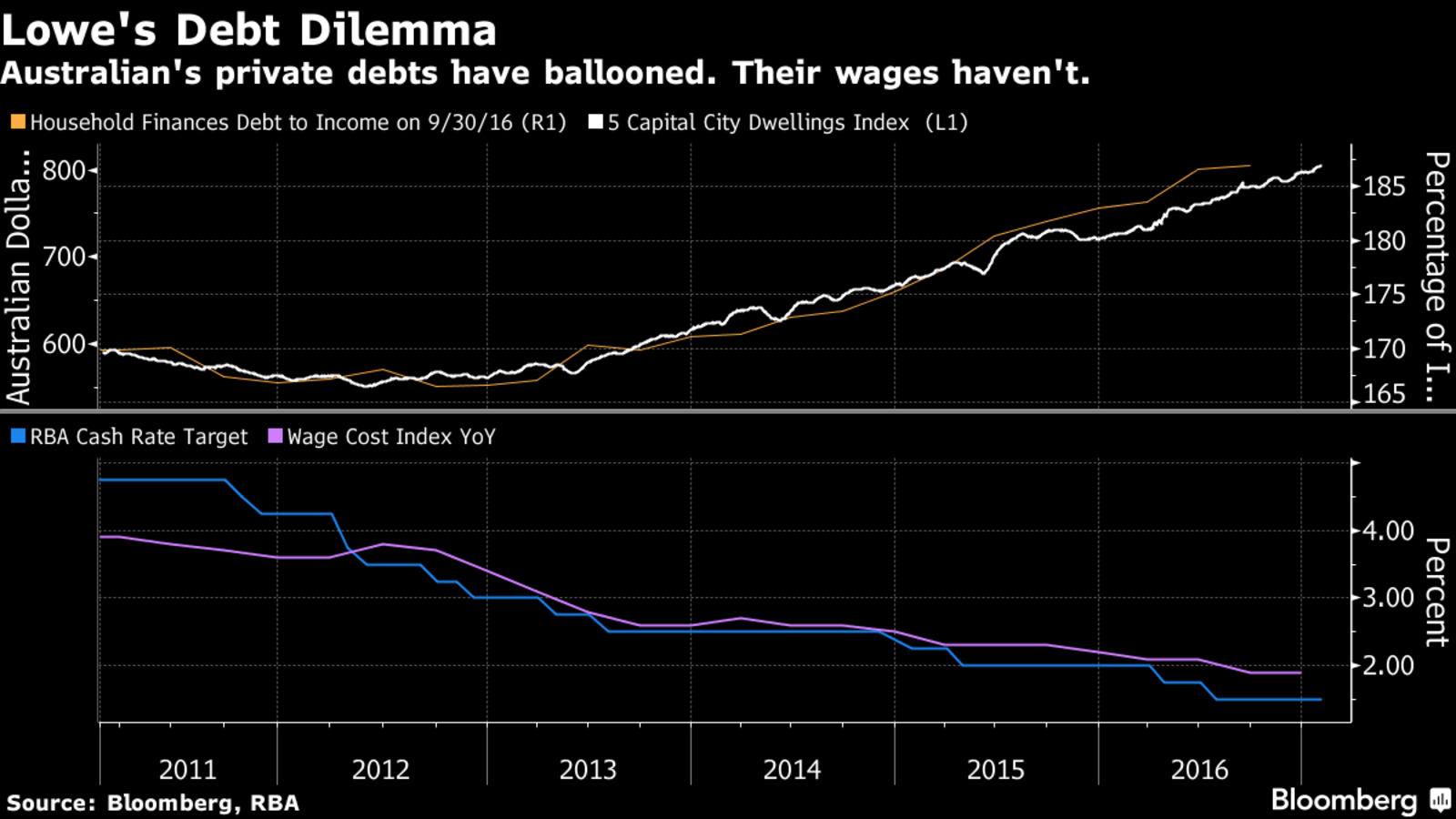
I have written repeatedly about the debt bomb building in Canada and many other countries, but I did not realize until today that Australian household debt has now surpassed Canada’s lunatic fringe of 169%, with the Aussies reaching household debt of 187% of income. Meanwhile, wage growth in both countries has been falling since the commodity bubble peaked in 2011. Today, Australian data confirms private wage growth there at an all-time low of 1.8%. See: Aussie debt binge meets anemic wages as conundrum for RBA’s Lowe. Here is the chart.
“In January, the benchmark price and the average price were both up 22% year-over-year, with the average price of detached homes up 26%, of semi-detached homes 28%, of townhouses 27%, and of condos 15%. Double-digit price increases have become the rule in recent years.
But this jump was “the fastest increase since the late 1980s – a period pretty much everyone can agree was a true bubble – and a cool 21 percentage points faster than inflation and/or wage growth.”
I remember the late ’80’s well, I was living in Toronto during the dying throes of that property bubble. I moved away for law school in ’88, and by the time I had moved back in 1992, the realty market had crashed 25% (more for many condos), government budgets were in ruin, households and companies in bankruptcy and foreclosure, while several realtors, lenders and construction folks were being sent off to jail. Prices did not recover peak price levels for about a decade. By then, many of the previous, heavily indebted owners had long been foreclosed or sold their properties at losses. All pretty text book stuff. Those with cash were able to pick up great investment opportunities at discounted prices, but because few had anticipated the bust and taken defensive steps, few were able to take advantage.
After voting to increase municipal spending by 4.4% in 2017, Toronto Councillors have agreed to increase property and land transfer taxes this week. They have to. Spending continues to rise.
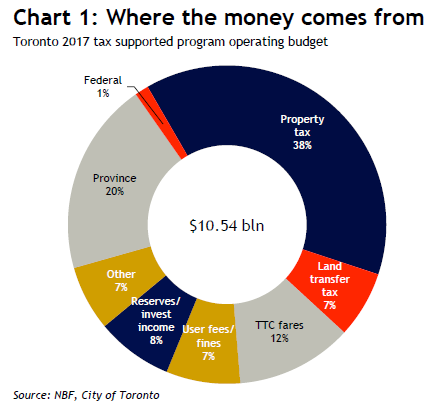
A full 45% of Toronto’s C$10.5 billion budget is now dependent on property and land transfer taxes. Here is the revenue chart. Most other municipalities are also overly dependent. When property prices decline again, so will municipal revenues, and that will leave big deficits.
But the downside is actually worse today than in the early 1990’s. In the early 90’s stock and bond markets were undervalued and yielding more than 8%. Today both are at valuation extremes and yielding less than 3%. Here we have some valuable perspective in the Price to Sales/revenue ratio for the Dow Index since 1995. Today we are right back at the tech wreck pinnacle of madness. When realty revenues plunge, so will security prices and this will leave further holes in the balance sheets of institutions, pensions and savers. Everyone will be looking for revenue, cash infusions and people to blame for the carnage.
For those who have not read “The High-Beta Rich” by Robert Frank (or have not read it for a while), now is a great time to revisit, and understand why asset bubbles are counter-productive, wasteful, self-destructive plagues for households and governments. For a quicker update, you can also listen to this 10 minute interview with Frank from 2011. The song remains the same!
“The rich are not only getting richer — they are becoming more dangerous.” That’s according to Robert Frank’s new book — The High-Beta Rich: How the Manic Wealthy Will Take Us to the Next Boom, Bubble and Bust — which argues that the spending binges of the top 1 percent have become “the most unstable force in the economy.” Here is the audio link.
Posted inMain Page|Comments Off on Madness reigns and the clean up will be expensive
Yale University Senior Fellow Stephen Roach discusses the biggest worries for the Federal Reserve as the central bank attempts to return to normal monetary policy. Here is a direct video link.
“An explosive critique about the investment industry: provocative and well worth reading.”
Financial Post
“Juggling Dynamite, #1 pick for best new books about money and markets.”
Money Sense
“Park manages to not only explain finances well for the average person, she also manages to entertain and educate while cutting through the clutter of information she knows every investor faces.”
Toronto Sun