
Sobriety coming to Canadian realty markets

As we have seen repeatedly throughout history, highly levered housing is full of downside for buyers/borrowers, the economy and taxpayers (thanks to government-backed mortgage insurance).  Finally the Canadian government has announced that it wants to introduce ‘risk-sharing” with lenders.  What a novel concept–re-connecting the risk of capital loss on bad loans to those who have extracted front-end profits initiating them! As mortgage lenders and realtors cry foul at the prospect of slowing sales, it is outrageous that it has taken so long for this commonsense nexus to be put back into the lending decision.  See: What Ottawa’s new mortgage rules could mean for Canada’s banks:

Ottawa also announced that it will launch a public consultation in the coming months to examine the possibility of introducing “lender risk-sharing.” This means banks would have to pay a deductible on mortgage insurance provided by Canada Mortgage and Housing Corp. and its private counterparts, and effectively shoulder more of the risk for mortgage defaults.

Banks would also be forced to retain more capital and raise their funding costs, which would likely be passed on to consumers with higher mortgage rates.

“We’ve had some concerns with regards to the Canadian banks in terms of their growth prospects. And when you’ve got Canadian consumers as leveraged as they are, you do have the risk of credit losses mounting, but maybe more immediately is the difficulty in achieving the same rates of growth,” Horan said.

Yes this will necessitate higher down-payments, and less buyers, and that is precisely what is needed to reintroduce some realistic pricing into the real estate equation in Canada.  It should have been this way from the outset.  The mess irresponsible lending policies have made, is all around us, and we will all be paying for the clean up.  See Toronto Life, Mortgages for all:

“…Toronto is where all the euphemisms converge: non-prime mortgage lending to bruised-credit borrowers by less-regulated entities—better known as “shadow lending”—has existed for ages, but it has been on the rise over the last few months in this city, and elsewhere in Canada as well. The Bank of Canada is nervously keeping tabs on the non-prime trend and in the past year has begun sounding alarm bells. “A sizable proportion of new, uninsured mortgages are being issued to riskier borrowers,” it announced last December, calling the situation “worrisome.”

To repeat:  booking sales on things like autos and real estate to buyers who cannot actually afford to pay for them is not business genius, it’s a Ponzi operation that enriches a few for a while and then comes back to exact a painful cost from our economy, household stability and social fabric.  Higher lending standards and lower prices are needed to restore some fiscal sanity and sustainability.  Both appear to be happening now, at long, long last.  See: More evidence Vancouver housing bubble is bursting.

Same goes for the companies that invest in Canadian real estate and are now up to their max in over-valued assets.  This chart courtesy of my partner Cory Venable, shows the Canadian Real estate investment trust ETF (XRE) since 2006 on an ex-dividend basis, and what happened to share prices in 2008-09 (-57%) as well as the loss risk facing holders today.  Down nearly 9% since July, much greater mean reversion is very likely still to come as Canadian realty prices continue to roll over, loan defaults spike and vacancies mount.  Far from the ‘conservative’ income investments, so many thought they were enjoying, REIT holders today have a dangerous tiger by the tail.
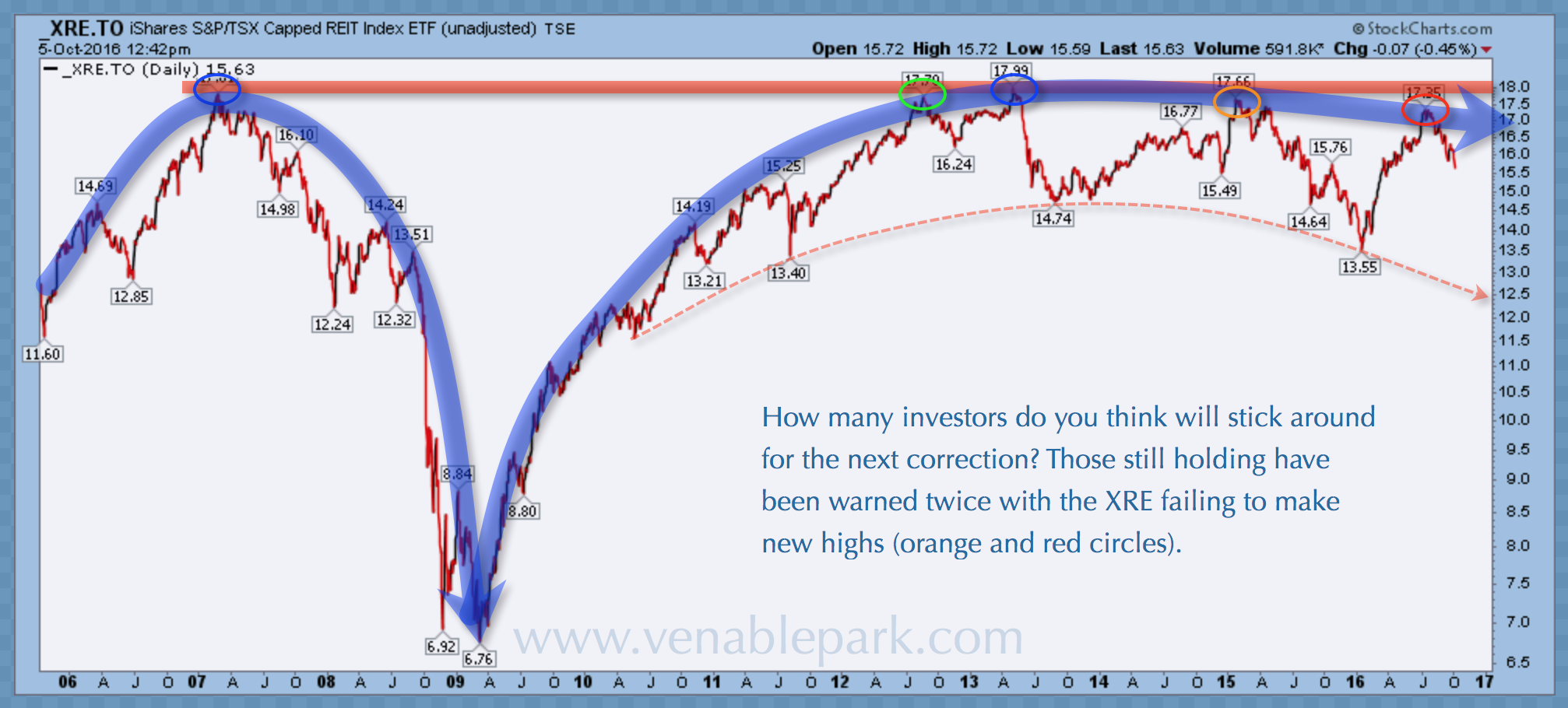
XRE Oct 5 2016
As REITs follow real estate into a much deserved repricing cycle, the over-bought Canadian banks (here the XFN in purple) are surely not far behind.  The easy money, lax lending hallucinogens that levitated both sectors over the past 5 years, are due to retreat.
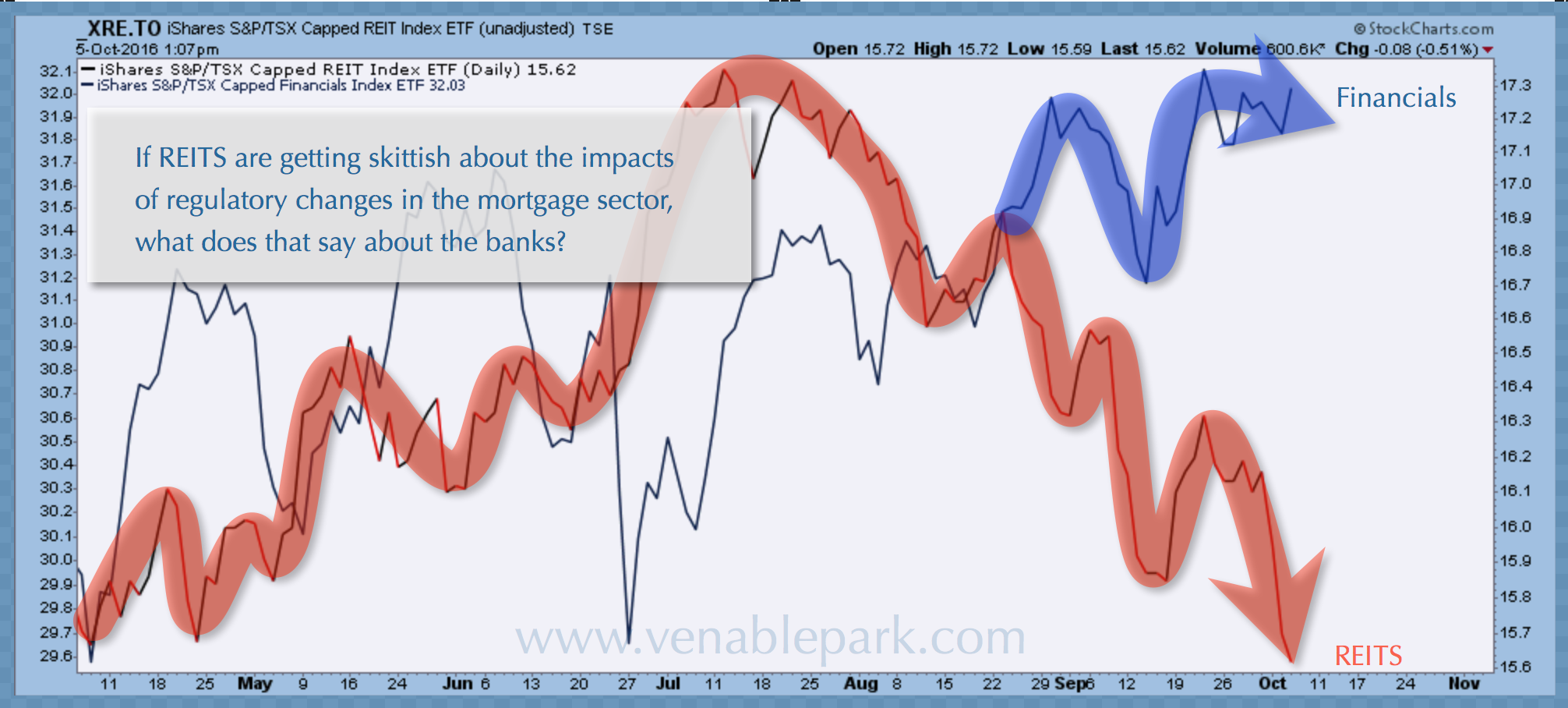

XRE and XFN Oct 5 2016

Posted in Main Page | Comments Off on Sobriety coming to Canadian realty markets

Cross-selling model under scrutiny across finance sector

It’s not just Wells or Morgan Stanley…the entire sales-insaitable finance sector is rotten.  See:  “Many other banks around the country will have to review their own sales practices if they want to avoid regulatory scrutiny.” Some further insight into this culture is offered here:

Becky Grimes had trouble enough hitting sales targets as the manager of a busy branch of  Wells Fargo in Austin, Texas. But when she moved to run a Wells branch in a much smaller farming town about two hours to the south in 2011, the same targets — 8.5 products per day, per banker — became too much to bear.It was the sign of an aggressive and pervasive cross-selling culture that forced her into early retirement in 2013, she says — and which has come back to bite Wells, the bank at the centre of a bogus account scandal.

Ms Grimes had four conference calls every day — at 9am, 11am, 2pm and 5pm — during which she was grilled by a district manager on the sales her team had generated. Staff would come to her in the interim, saying they had done a full profiling exercise on a particular customer, but she would have to turn them back to sell more.

“It was pretty ridiculous,” she says. “It bordered on harassment, quite honestly.”

Posted in Main Page | Comments Off on Cross-selling model under scrutiny across finance sector

Abusing our trust is the business model of modern finance

Following on the story of how aggressive cross selling requirements spurred employees to abuse customers and commit fraud at Wells Fargo, this week the Massachusetts Secretary of the Commonwealth William Galvin accused Morgan Stanley of “dishonest and unethical conduct” within the state and Rhode Island relating to employee contests that were run to  push securities-based loans onto customers from January 2014 to April 2015. See Morgan Stanley unit accused of high pressure sales tactics:

“This complaint lays bare the culture at Morgan Stanley that bred the high-pressure effort to cross-sell banking products to its brokerage customers without regard for the fiduciary duty owed to the investor,” Galvin said in a statement. “This contest was relatively local, but the aggressive push to cross-sell was company wide.”

There should be no shock in any of this.  Anyone who has dealt with an investment bank the past few years will have experienced cross-selling first hand. Employees are trained to recommend customers with any apparent resources (assets or income) to one of the bank’s army of ‘advisors’.

Cross-selling is the business model of today’s finance sector. It has been the motivation for merging different product and advisory firms since the 1990’s when Glass Steagall (1933) divisions between deposit taking and product sales were eroded and then rescinded in 1999. This chart shows the massive consolidation since 1995 which has created the 4 largest US banks today: Citi, JP Morgan, Bank of America and Wells Fargo.

As we explained in our September 30 client letter available here, the recent cross-selling stories bear a strong resemblance to the tactics that were common in investment banks leading up to the crash of 1929.  As in the Wells case, it also took a senate hearing years after the event before the public came to understand the systemic way in which the finance sector had used and abused their trust–and the devastating costs society had paid.

In 1933, after years of political inertia, state prosecutor Ferdinand Pecora was asked to take over as chief counsel in the floundering U.S. Senate’s Committee on Banking and Currency hearing charged to illuminate the causes of the 1929 crash. Though bondholders, shareholders and depositors had lost life savings, and thousands of business owners and employees lost their livelihood, the heads of the big investment banks had escaped personal reproach. Pecora subpoenaed the still wealthy head of National City Bank (now Citibank) to answer questions on sales practice he and his management team had demanded of their workers.  One former National City employee had described the bank’s culture this way:

“All day long the message was the same—hurry up, hurry up, hurry up, send some orders…When things slowed up a little, some genius would hatch up a contest of some kind and then we would be under extra pressure from every direction sometimes for weeks.”(Julian Sherrod, Scapegoats (1931).

A sample sales memo to bank staff from Mitchell’s office in 1928 offers the flavour:

“I should hate to think there is any man in our sales crowd who would confess to his inability to sell at least some of any issue of either bonds or preferred stocks that we think good enough to offer. In fact, this would be an impossible situation and, in the interest of all concerned, one which we would not permit to continue.”

In other memos and meetings, management reminded workers that even the ‘smallest crumbs’ of customer savings could be ‘rolled into loaves’ of bank profits if employees were sufficiently diligent in their efforts.

Under Pecora’s cross-examination, Mitchell admitted that he and his top officers had set aside millions in cash from the bank in interest-free loans to themselves before the collapse and had pawned off bad loans by packaging them into securities and recommending them to their customers as investments.  In the end, despite collecting a $1 million+ bonus in 1929, Mitchell had paid no income taxes thanks to tax planning strategies he had done with his wife. (Any of this sound familiar?) 

There were no live broadcasts or YouTube clips of Senate hearings in 1933.  But as newspapers reported the revelations to the American public, outrage spread and public ire turned on the banking elites.  In the end, politicians who had remained deferent and preferential to the bankers after the crash, finally passed The Banking Act of 1933 (aka The Glass-Steagall Act) which prohibited commercial banks from engaging in the cross-selling of investment products to bank depositors.

For the last 25 years, we have born witness once more to the devolution of big finance into a protected class emboldened to break laws, purchase political favor, minimize tax, lie, steal, cheat and mislead its customers.  In the process, they have made a mockery of long-standing standards of professional advice and fiduciary responsibility. As law makers, regulators and central banks were enlisted to this cause, finance profits boomed in the greatest leveraging supercycle in human history. While asset prices soared, so did the commissions, fees and interest extracted by finance, while the financial stability of their customers and the real economy weakened.

Since the 1980’s the amount of financial products sold to bank customers has more than doubled.  Today finance captures 25% of S&P 500 profits while providing just 4% of the jobs.  The concentration of fortunes has allowed this one sector to buy influence and control over everything from academics to media, public relations, education, accounting, reporting and regulation as well as enforcement, procedure and penalties. Here in particular, the limited liability corporation has been used as a near impenetrable armor from personal accountability for the directing minds within it.  In the process, the rule of law (that no individual is above the law)—a founding principle of democracy since the Magna Carta—has been mocked and undermined.

We must demand better. As the New York Times points out, if war can have a code of ethics, then investment banks certainly can be required to as well. Fresh models and thinking are needed to help workers and savers build and retain the proceeds of their labor into capital loaves that feed themselves, their beneficiaries and the real economy ahead of the bankers.

We have ample long-standing anti-trust, racketeering, money laundering, tax and fraud laws on the books to curb and punish finance malfeasance. In addition, the 21ST Century Glass Steagall Act has already been proposed by bipartisan US Senators in 2013, to once more end cross-selling of financial products to bank customers. This division is critical: security underwriting and speculation must be cordoned off from taxpayer guaranteed deposits and returned to stand alone firms and partnerships that live and die on their own risk management, as they all did before 1999.

Our financial system is a critical utility and history proves that it is too important and vulnerable to allow a self-serving, sales driven culture to dominate it.  Allowing finance to run wild has bankrupted the free world.  If the real economy is to finally rebuild, we must stop worshiping and protecting these false prophets, sever their access to tax-payer funds, and revoke the ‘Get out of Jail Free’ card so widely enjoyed by offenders.

Posted in Main Page | Comments Off on Abusing our trust is the business model of modern finance




