In understanding the origins and nature of the present financial crisis, we should appreciate that subprime debt and its ‘securitization'(selling junk as investments to indiscriminate and duped buyers) were deployed to revive animal spirits after the 2000-03 tech wreck, and enabled the largest consumer credit boom ever in human history. This swept from the US (the world’s largest economy) to the rest of the globe in a tsunami of record, unsustainable consumption between 2003-07. When that first wave of the bubble broke in 2007, it halved lofty asset values for a second time, and pummeled spending, revenue and economic output everywhere. It also left a mountain of excess capacity and goods worldwide. No more so, than in the world’s second largest economy–China.
The second wave of the crisis came in 2008-10 when many governments increased spending to try and counteract economic contraction. No more so than in China, where excess reserves (built during the west’s spending bubble) were recycled into even more superfluous infrastructure and supply at home as a stop gap hope until western consumers could bounce back.
The third wave of the crisis began in 2011, when spending and revenues were weakening once more, industrial production turned down, asset markets slumped and central banks jumped on the slippery slope of increasingly desperate monetary measures: QE- asset buying, zero and now negative rates.
The fourth wave of the crisis is the present revelation that global consumer demand has not revived, savings levels have not rebuilt and debt levels are many trillion dollars higher now than they were when the bubble first burst in 2007. No more so, than in China, which is now stumbling under the weight of the largest debt bubble ever in history. As pointed out by Vitaliy N. Katsenel this week:
From 2007 to 2014, its debt quadrupled from $7 to $28 trillion (according to McKinsey). Over the same time period its economy tripled, growing from $3.5 to $10.5 trillion. These numbers are staggering, and they point to one indisputable fact: all Chinese growth since 2007 came from borrowing. There was no miracle in it.
To reform and finally recover from our generation’s financial demise: facts must be faced. All of the price gains in risky assets since at least 2010 have been unwarranted, irrational and unsustainable. And just as China is finding today, running full speed off a cliff in hopes that the ground will miraculously rise up to catch you, is a self-destructive plan.
My partner Cory Venable‘s long term chart of the S&P 500 shows the precarious level at which stocks now hover, blindly hoping (as they did in 2000 and 2008) that the ground –falling consumer demand and economic growth–will reverse course and rise up to prevent their fall.
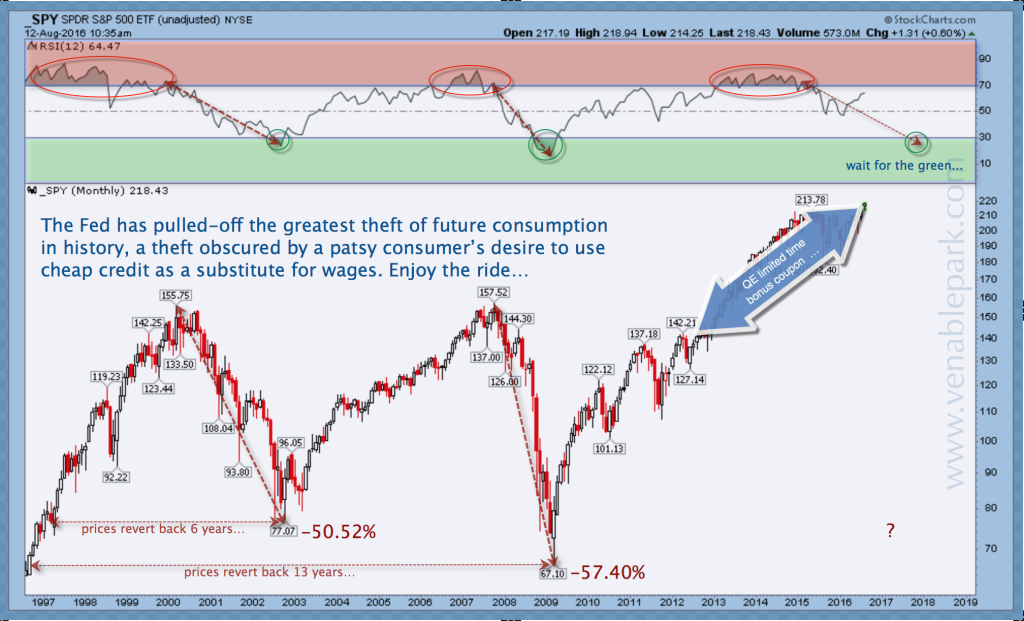 So entranced and desperate are participants today, that they have strapped on record amounts of margin/debt to accelerate their speed off this cliff–the very opposite of parachutes.
The next phase of this crisis is the monetary-faith-bubble bursting, and asset prices succumbing to laws of math and the business cycle once more. The secular bear lives and has been incited to maul for the third time since 2000. Reckless policies have earned its wrath.











