
Finance whistleblower turns down reward from complicit SEC

This is truly a remarkable example to set:  a former risk officer,  Eric Ben-Artzi, turned Deutsche Bank whistleblower, has refused to collect his $8.5 million reward from the SEC.  He points out that levying a $55 million fine for illegal activities on the corporation has only served to penalize shareholders and employees while letting the firms executives and lawyers (the directing minds) keep all their status and proceeds of crime (bonuses and fees).  Bravo Mr. Ben-Artzi.  See We must protect shareholders from executive wrongdoing:

“Although I need the money now more than ever, I will not join the looting of the very people I was hired to protect. I never intended to turn a job in risk management into a crusade, but after suffering at the hands of the Deutsche executives I will not join them simply because I cannot beat them.

I request that my share of the award be given to Deutsche and its stakeholders, and the award money clawed back from the bonuses paid to the Deutsche executives, especially the former top SEC attorneys.

I would then be happy to collect any award for which I am eligible.”

Why does the SEC routinely choose to only fine offending corporations while letting the directing executives off scot-free?  Because the public allows outrageous nepotism and conflicts of interest to continue unchecked between finance/regulators/politicians. What will it take for we, the people, to force change?  Ben-Artzi lays it out it in plain language:

Deutsche’s top lawyers “revolved” in and out of the SEC before, during and after the illegal activity at the bank. Robert Rice, the chief lawyer in charge of the internal investigation at Deutsche in 2011, became the SEC’s chief counsel in 2013. Robert Khuzami, Deutsche’s top lawyer in North America, became head of the SEC’s enforcement division after the financial crisis. Their boss, Richard Walker, the bank’s longtime general counsel (he left the bank this year) was once head of enforcement at the SEC.

This goes beyond the typical revolving door story. In this case, top SEC lawyers had held senior posts at the bank, moving in and out of top positions at the regulator even as the investigations into malfeasance at Deutsche were ongoing.

This took place on the watch of Mary Jo White, the current chair of the SEC, whose relationship with Mr Khuzami and Mr Rice dates back 20 years. She bears ultimate responsibility for the Deutsche fine.

Posted in Main Page | Comments Off on Finance whistleblower turns down reward from complicit SEC

Excessive shelter costs weigh on consumer spending

Oh Canada…who would’a thought that using huge loans to pay a fortune for housing, cars and everything else would usher in an extended consumer spending slump? Why everyone who is not paid to ignore the math, of course!

Watch this BNN video update with the Assistant Chief Economist for Laurentian Bank found in Weak retail data sends Loonie down.

And don’t look now but realty prices in ‘hot’ BC markets seem to be cooling rather quickly over the past 3 months (starting well before the new 15% foreign buyer tax was implemented on July 25).  Home prices in VancouverAs painful as the mean reversion process will be for the highly levered, ignorant or overly aggressive participants who have not seen this coming, a return to rational asset pricing is critical to restoring productivity and consumer demand in the real economy.   And the correction is overdue, if to a lesser extent, in property markets well beyond just Vancouver and Toronto.  We have well earned the downturn.  It was always a question of when, not if.

Years of low interest rates have been the problem not the savior.  There are only so many income dollars to go around, and if too many of them have been diverted to shelter costs (savings for down-payments, longer running loan payments of interest and principle, taxes, utilities, insurance, maintenance, services) then the cash flow for spending now and saving for the future is necessarily eroded.

In the process, this has all purchased an extended period of slow growth and financial losses for many individuals, companies and financial institutions, along with of course, Canada Mortgage and Housing.  See:  Is the metro Vancouver real estate market in freefall?

“The median household income in the region was $84,345 in 2011, according to the District of West Vancouver.

“The market in West Van is up 450 per cent since 2001. So is everyone making 600 per cent more income than they were so they can pay their taxes and buy their houses? Of course not. So how has this inflation been financed? By offshore money and record debt.”

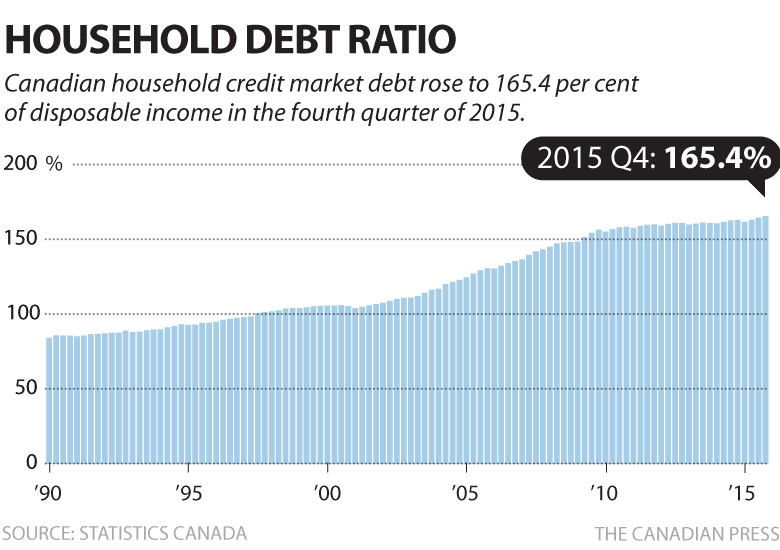
The math is obvious:  Canadian income gains have fallen far behind the rise in household debt levels.  The ratio reached a ludicrous 165% debt/ disposable income as at Q4 2015. See:  Canada’s debt to income ratio sets new record high.

Let the deleveraging catharsis teach us to repent and learn wiser habits.

Canada household-debt-ratio-2015-q4

Posted in Main Page | Comments Off on Excessive shelter costs weigh on consumer spending

Fed stuck with its policy errors as credibility sinks

Komal Sri-Kumar, president at Sri-Kumar Global Strategies, explains why he sees the FOMC minutes as a dovish sign on interest rates and looks at how a surprise rate hike may impact markets and the U.S. economy. Here is a direct video link.

Posted in Main Page | Comments Off on Fed stuck with its policy errors as credibility sinks





