Ugly math in Canada’s over-valued property market

Get your head around these numbers:  Canada’s average national home price rose to $470k in January, and is over $1,000,000 in hot spots like Toronto and Vancouver.

In Canada you can buy a $1,000,000 home with just 75K down and a $925,000 mortgage.  The $925K loan is then insured by Canadian taxpayers (via CMHC). And this is after the government tightened mortgage rules this month.  See:  New mortgage rules for homes over 500K go into effect.

At 3% on a 25 year amortization, a 925K home loan costs ‘just’ $4,378 a month in after tax income, without any other provision for utilities, taxes, maintenance, repairs or any other debt payments or living costs of any kind.   In Canada, that means one would need to earn   about $70,000 a year of before tax income just to pay the mortgage payments alone.  And that’s at the lowest interest rates in history.

At even 5%, the same mortgage would require a 22% increase in payments to $5,380 a month or about 90K a year in before tax income.

Sound reasonable to anyone?  Think boomers will have an easy time finding able buyers for their scores of $1m+ properties?

Having grown large during the credit/commodities/property bubble (2005-15), governments are now looking (needing) to raise taxes in every way possible as revenues decline.  We should expect a particular focus on raising property tax revenues since non-property owners are generally broke.  More of this to come:

The Ontario government is threatening to go as far back as 1989 to target commercial entities, including two of Canada’s largest companies, that have been avoiding land-transfer taxes through what is now a disputed legal loophole.  See this  direct video link.
Posted in Main Page | Comments Off on Ugly math in Canada’s over-valued property market

Electric cars to keep eating oil’s lunch

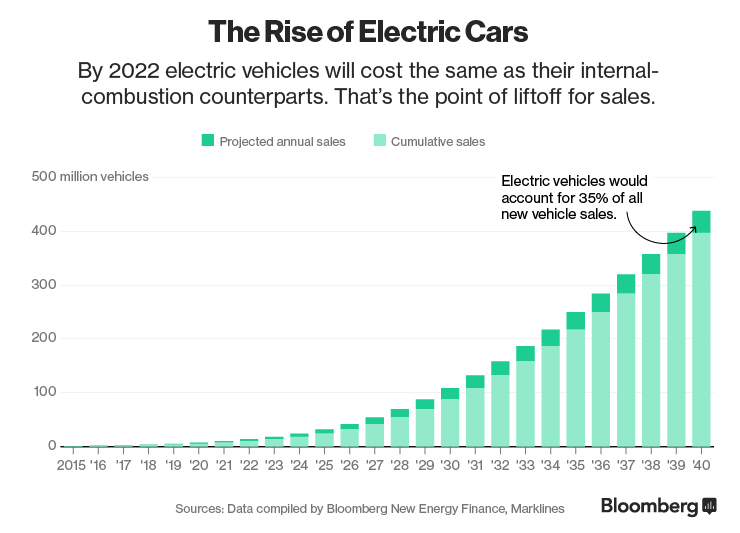
Naysayers and oil proponents have wildly underestimated the electric car evolution. This evolution is happening.  Believe it or not.  See: Here’s how electric cars will cause the next oil crisis.  Cause? or just continue the crisis?

With all good technologies, there comes a time when buying the alternative no longer makes sense. Think smartphones in the past decade, color TVs in the 1970s, or even gasoline cars in the early 20th century. Predicting the timing of these shifts is difficult, but when it happens, the whole world changes.

…But here’s what we know: In the next few years, Tesla, Chevy, and Nissan plan to start selling long-range electric cars in the $30,000 range. Other carmakers and tech companies are investing billions on dozens of new models. By 2020, some of these will cost less and perform better than their gasoline counterparts. The aim would be to match the success of Tesla’s Model S, which now outsells its competitors in the large luxury class in the U.S. The question then is how much oil demand will these cars displace? And when will the reduced demand be enough to tip the scales and cause the next oil crisis?

Rise of electric carsbattery-cost

Posted in Main Page | Comments Off on Electric cars to keep eating oil’s lunch

Executives become uber drivers: ‘easy come is easy gone’

High beta richFor anyone that has not yet read Robert Frank’s important book “The high beta rich”, now is another great time to do so.  It is critical to understand how a focus on inflating asset prices at all costs has worked to undermine financial stability, our economy, government revenues and long term investment prospects.  It also helps to explain why political upheaval is spreading around the world.  While people often assume that the “1%” are financially stable, the truth is that ‘easy come’ income is often wasted on elaborate expenditures and mal-investment, leaving them with massive debts and little savings when asset bubbles collapse. And they always do collapse in the end.

This story about Houston is a classic example see,  Mansion sales and discount dining: oil rout hits Houston rich:

The unfinished home of former oil executive Kolja Rockov is seen at 12 Crestwood Drive in Houston, Texas February 18, 2016. REUTERS/Terry Wade

The unfinished home of former oil executive Kolja Rockov is seen at 12 Crestwood Drive in Houston, Texas February 18, 2016. REUTERS/Terry Wade

Twenty months into the worst oil price crash since the 1980s, well-heeled residents of the world’s oil capital are among the hardest hit largely because tanking energy firm shares make up much of oil and gas executives’ compensation.

…To be sure, oil executives are not alone in feeling the pain. Many blue collar jobs in oilfield equipment production have disappeared. So have thousands of middle management jobs in oil exploration and production. A regular Uber customer is likely at some point to ride with a former energy industry professional.

“It pays for the mortgage,” said Matthew Clemonds, who once did mapping for pipeline companies and now works for the ride-sharing company.

Posted in Main Page | Comments Off on Executives become uber drivers: ‘easy come is easy gone’