
Canada’s new mortgage rules offer teachable moment

For pity sake, please do not buy $700,000 homes with 45K down and 655K mortgages, even if your mortgage/financial adviser, specialist, architect, sales person says that you qualify. Please run away…If you don’t have a healthy down payment to use, it means that you are buying something you cannot actually afford and are taking on grave life risk to do so.

The federal government introduces some changes to down payment requirements for federally regulated lenders. This video breaks down the “old” rules versus the “new” rules.  Here is a direct video link.

(put your head in the vice here…)

There is a reason the ‘good old days’ required people to save 20% and more before they tried to buy a house. It’s called financial stability.

This recent chart courtesy of McLean’s Magazine offers some useful perspective on how  all this buying homes with record amounts of debt has enabled excessive pricing and mal-investment in the Canadian realty market (in blue) since 2005. 
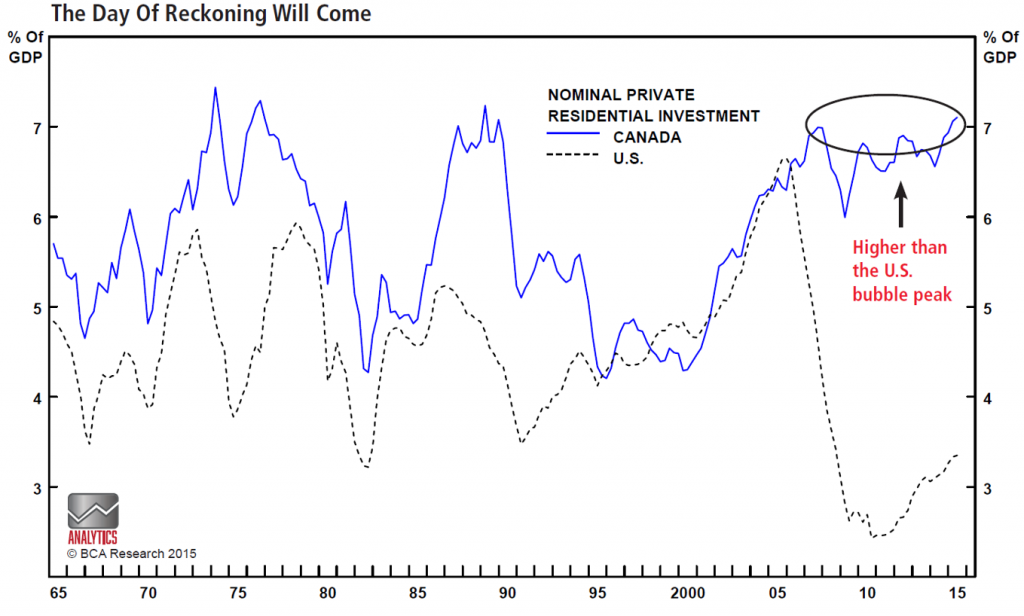
Canada residential investment vs US
No other country in the world has ever been able to hold extremely valued home prices at a permanently high plateau indefinitely, especially while real income levels have stagnated and are now crashing lower with the oil sector. Time to be defensive not insanely levered. As for ‘we’ taxpayers, who have underwritten the bulk of this reckless borrowing through government back mortgage insurance…not likely to end well for us either.


Posted in Main Page | Comments Off on Canada’s new mortgage rules offer teachable moment

Paris climate accord: vapid in content?

Professor Chris Williams says 21 years of treaties and negotiations have all been stepping around the main problem: the production of fossil fuels. Here is a direct video link.

Posted in Main Page | Comments Off on Paris climate accord: vapid in content?

Credit contagion returns

In order to see meltdowns coming, you have to be looking for risk. Most financial types are paid to sell risk, not manage it.

Warnings of a high-yield bust were plentiful: The shale driller that missed its first payment. The clothing manufacturer and the software maker among the many companies that issued debt, payable in more debt, earmarked to reward managers who’d already loaded them up with debt.

They had willing buyers, all of them. Investors have poured $240 billion into junk-bond funds since 2008, tripling the total commitment, in a desperate hunt for decent returns while the Federal Reserve pumped $3.5 trillion into the financial system and kept interest rates near zero for seven years. Junk-bond traders helped fund America’s shale boom and gave the cheapest money ever, even to companies deemed by Moody’s Investors Service to be “very high credit risk, poor standing.” Now they’re finding out what happens when the fling is over and everyone wants their money back at once. See: Investors ignored risk of junk-bond rout.  Here is a direct video link.

Posted in Main Page | Comments Off on Credit contagion returns



