Investment business sales puff exacts heavy cost

Hedge funds [and mainstream asset management services] extract huge fees in exchange for the promise of sophisticated investment strategies to capture above market returns that are uncorrelated with broad market declines.  In practice nearly all of them fail to deliver on both. You might think people would stop believing the sales puff and stop handing them funds to mangle.  You might think that pension trustees, at least, would sober up.  You would be wrong.  Read  A Hedge Fund Sales Pitch casts a spell on public pensions:

One reason pensions turn to hedge fund managers is to try to close the expansive gap between what the pensions owe their beneficiaries and the amount of funds that they have to meet those obligations.  According to a report by the Pew Charitable Trusts, that gap was around $1 trillion in 2013, the most recent year available.

To stop believing in the highly improbable promises of financial magicians, demands that one acknowledge capital shortfalls and funding deficits head on in order to formulate practical plans.  Apparently it is easier to believe in fairies.

Unfortunately the costs of these misguided beliefs are frequently devastating for individuals.  And in the case of pensions, for we the taxpayers, who are then pledged to make up funding deficits through increased capital contributions to both public pensions and social programs.
Posted in Main Page | Comments Off on Investment business sales puff exacts heavy cost

America rejects Keystone XL reaffirms commitment to renewable energy

President Barack Obama rejected TransCanada Corp.’s bid to build the Keystone XL pipeline, ending seven years of debate over an infrastructure project that swelled into one of the most contentious environmental issues of his presidency.

A lengthy review by the State Department concluded that the pipeline “would not serve the national interest of the United States,” Obama said Friday at the White House. “I agree with that decision.”

Obama said the project wouldn’t make a meaningful contribution to the U.S. economy, lower gasoline prices or enhance the nation’s energy security. It also would have undercut U.S. global leadership on climate change, he said. Here is a direct video link.

Rejection of the Keystone XL pipeline solidifies what the market has been saying for months — there’s less appetite for expensive Canadian oil sands in an era of $45 crude.See: What rejection of Keystone XL means for Canada

Posted in Main Page | Comments Off on America rejects Keystone XL reaffirms commitment to renewable energy

Greenback pumps and the rest slumps

As expectations for a Fed rate hike jump to 70%+ following this morning’s strong jobs report the US dollar index has surged more than a percent against the basket of global currencies. This is good for US dollar cash holders.  But mostly bad for other risky assets including commodities, other currencies, corporate debt, equities (those ‘defensive’ utility stocks are down more than 4% today) and of course, corporate sales and earnings. A soaring US dollar makes US goods less affordable for trading partners. It also makes the trillions in debt which was issued in US dollars (when the dollar was weaker) more expensive to service for international borrowers.

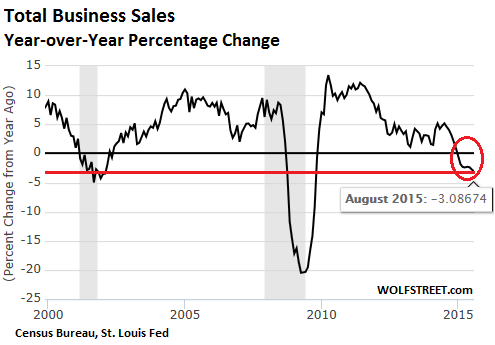
As shown here since 2000, by the end of August, US corporate sales had already fallen to levels seen in the last two US recessions and that was before the greenback’s 3% surge in the 2 months since.
US-total-business-sales-2000_2015-08

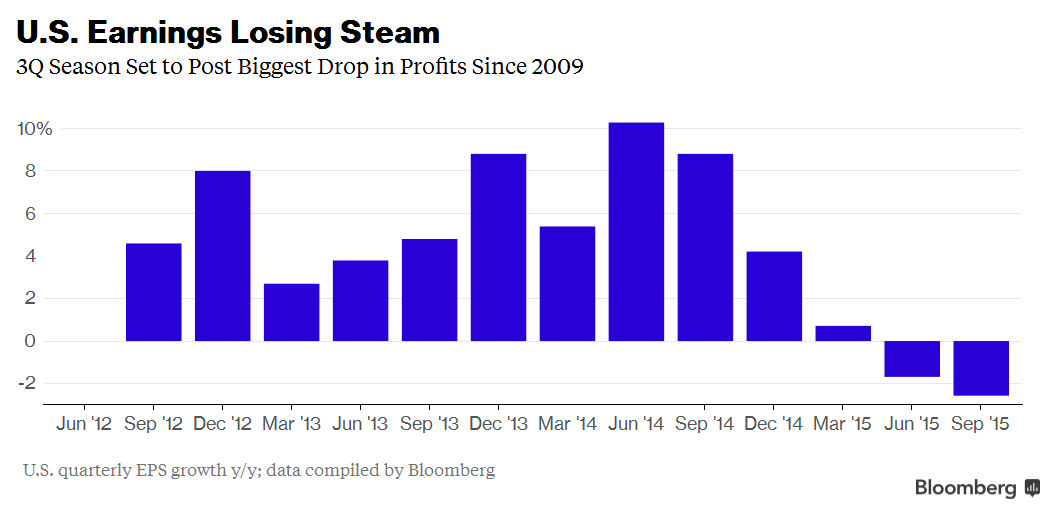
And it’s not just US sales that are recessing. Some 60% of US multinational earnings are booked overseas and then translated back for US denominated financial reports. A surging dollar means that corporate earnings have been falling since Q2 of 2014, and went negative in 2015, record share buyback schemes notwithstanding.  None of which is supportive of US valuations that are today trading near historic high multiples of those same plunging earnings. It is also negative for US GDP as US exports weaken.
US earnings

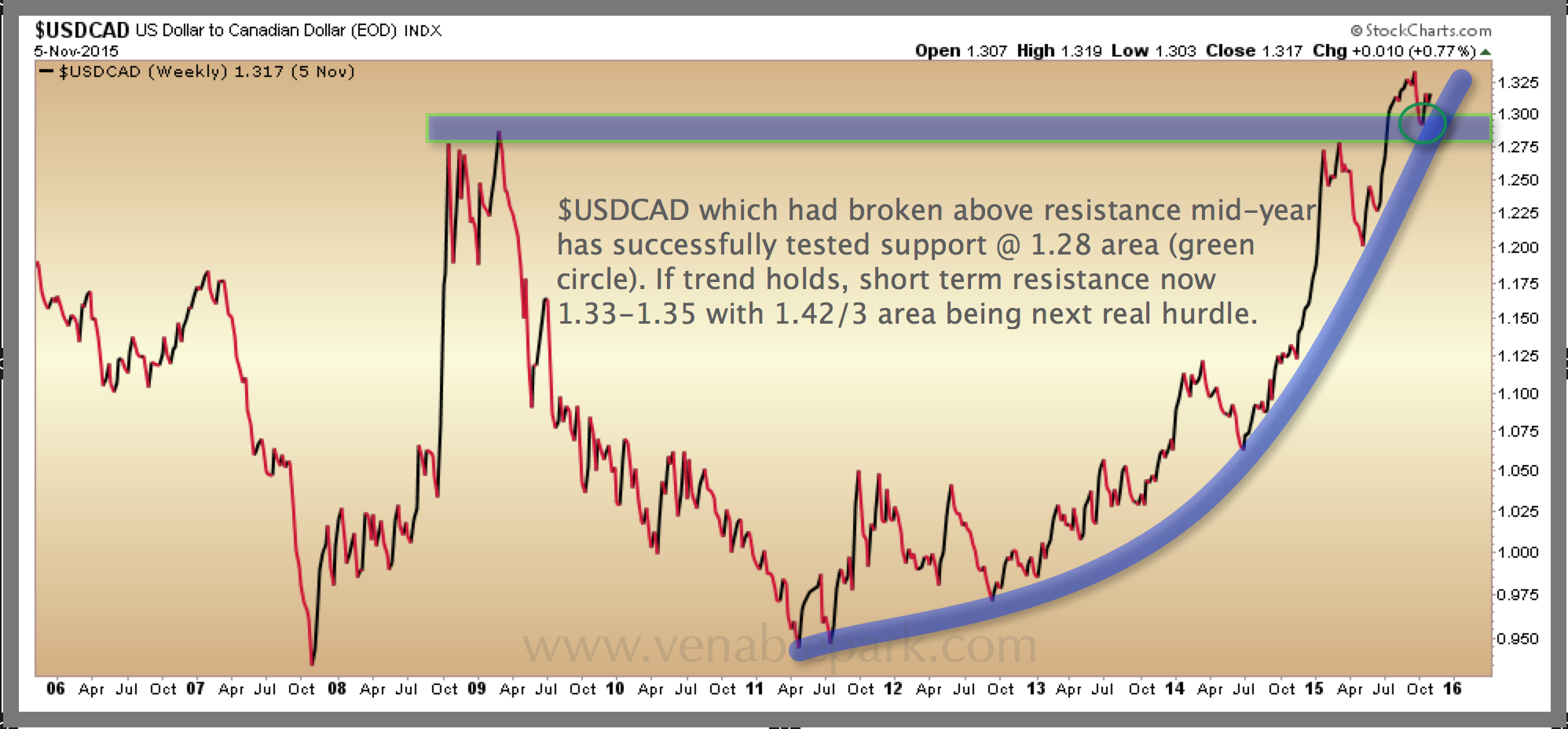
Canada is one major trading partner with the US, with some 20% of US exports headed to the great white north.  Having now broken through resistance around 1.28 on the US dollar/CAD ratio (below since 2006), U$ strength is above its 2008 recession highs with the 1.42 area the next major test in sight.

US vs CAD Nov 6 2015
The US dollar is on a multi-year (secular) up trend that began in 2008, retested in 2011, and has scarce looked back since. If historic patterns persist, it is likely to continue for some time yet, and in the process exert further downward pressure on GDP and other asset markets.

Posted in Main Page | Comments Off on Greenback pumps and the rest slumps