Economic limbo contest continues: how low can they go?

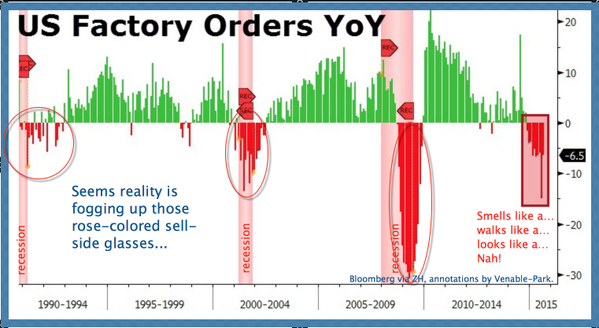
While sell-side automatons explain why this morning’s big miss in payrolls is no big deal and the economic expansion (already one of the longest–although weakest–in history) is about to accelerate every day now, we offer a couple of big picture charts for sober consideration.  US factory orders here since 1990, comparing the downturn year to date (far right) with readings over the last 3 business cycles.

New orders Oct 2 2016

And this one of US and German 10 year government bond yields over the past 6 years.
US and German bond yields

Tightly correlated for many years, the yields of both countries rejected inflationary expectations since 2011 and fell throughout economic ‘recovery’.  After a short rebound when the US Fed rolled out QE3 experiments in 2012 (blue dot), yields resumed their downward trend in 2013.

Yawning at the inflation forecasts of bankers everywhere, the bond market continues to price for further economic weakness and deflationary pressures ahead.  With the US 10-year breaking below 2% again this morning, US yields still have significant downside if they are to rejoin Germany’s in the months ahead. How low can they go?  Commodity prices are answering:  a lot lower for longer than most imagine possible.

Posted in Main Page | Comments Off on Economic limbo contest continues: how low can they go?

Further thoughts on the emissions scandal

Emissions fraud is hitting highly leveraged VW car dealers like a ton of bricks. Not only is there now a deserved public stigma against the cars, but VW’s ‘Stop Sales Orders’ have forced dealers to pull previously popular models from their lots, tying up frozen inventory as the car values plunge.  Thanks to the surge in ‘easy’ loans and lease terms the past 7 years, dealers were encouraged to build out lavish showrooms and operations to meet demand that always was unsustainable.  As cash flow dries up, financial vulnerability glares on all sides.  Law suits are just beginning, see:  Volkswagen dealers on the ropes.

Most dealerships have a low threshold for adversity; liquidity and cash positions are affected very quickly. For example, having $200,000.00 in cash tied up in ten to twelve recalled vehicles that can’t be sold can cripple a dealership.

Dealers that rely on debt (floor plan) to finance their operations have even less ability to withstand hardship because payments must be made on the balance of the unsold inventory. A dealership should not have any more money tied-up in inventory than is absolutely necessary. This is why dealers sell vehicles to other dealers, even if the sale is at a loss. Doing so eases cash considerations. Excess inventory levels have negative consequences on cash flow and, consequently, on the ability to meet the cash demands of an ongoing business [ie., pay employees, sales people, vendors and service providers, taxes etc.]

And there are much broader insights to be noted here as well.  See,  Volkswagen scandal a sorry sign of the times:

“Illegally rigging vehicles to pass emissions tests hurts everyone, but legal loopholes create similar problems. Just look at SUVs…SUVs are classified as “light-duty trucks” and are subject to less strict emissions standards than cars. Yet, most people treat them the same as cars.

This creates incentives for manufacturers to produce more heavy vehicles or even to design cars as trucks, such as Chrysler’s PT Cruiser. According to the Economist, “As vehicles above 3.8 tonnes were long exempted from the American regulation, manufacturers started producing enormous vehicles such as the Hummer to avoid any fuel-economy rules.”

Even with fuel-efficiency improvements, vehicle emissions have more than doubled since 1970 and will increase as demand rises in countries like China, India and Brazil, according to the Intergovernmental Panel on Climate Change. Studies show that because fuel efficiency makes it less expensive to drive, people drive more.”

Emission’s Gate provides just another teaching/learning, behavior-evolving epiphany for thinking people. Perfect for an election year in North America where the fossil fuel economy is already imploding. All the reasons and needs and technological advancements to evolve to electric vehicles and renewable energy grids, have all come together at last.

Posted in Main Page | Comments Off on Further thoughts on the emissions scandal

The end of the credit line

A sign of our times: news today that Russia is letting many of its impossibly indebted citizens declare personal bankruptcy for the first time, see Russia prepares for wave of bankruptcy filings.

The epidemic of debt is global and holding back consumption everywhere. Write-offs are part of the way back to fiscal health but this also will mean write-downs to asset values that were presuming full principle repayment.  Corporate bonds have begun repricing.  So called ‘high yield’ bonds (HYG in green) have been falling for 15 months, but are so far off just 12% on average, even as many individual issues are down much more.  A price correction of greater than 20% would be historically normal at the end of credit cycles as defaults surge.  At the end of what has been the most extreme, secular, credit cycle in history, the price declines could easily be more in the 20 to 50% range.
High yield debt
And its not just ‘junk’ bonds.  Higher grade corporate bonds (LQD index in blue below) have been falling too.  Off 3% year to date, there is most likely further price declines for corporate bonds coming, as they too have been trading at rich premiums the past couple of years on QE-inspired over-confidence.  As shown here, stocks (S&P 500 in red) and corporate bonds have been following their traditional correlation since June, as stocks finally recoupled with corporate bond prices once more.
S&P catches down to hi yield Sept 29 2015
The majority of businesses and households will not go bankrupt but will have to restructure and reduce spending in order to work their way back to much lower debt levels over the many months ahead.  Making the income statement work with lower cash flows is critical in this brave new world of spending less in order to pay down debt and rebuild savings.

The Atlanta Fed’s GDPNow update seems to concur, with today’s US annual GDP forecast dropping below 1% once more, even as the deliriously optimistic consensus continues to call for 2.4%.
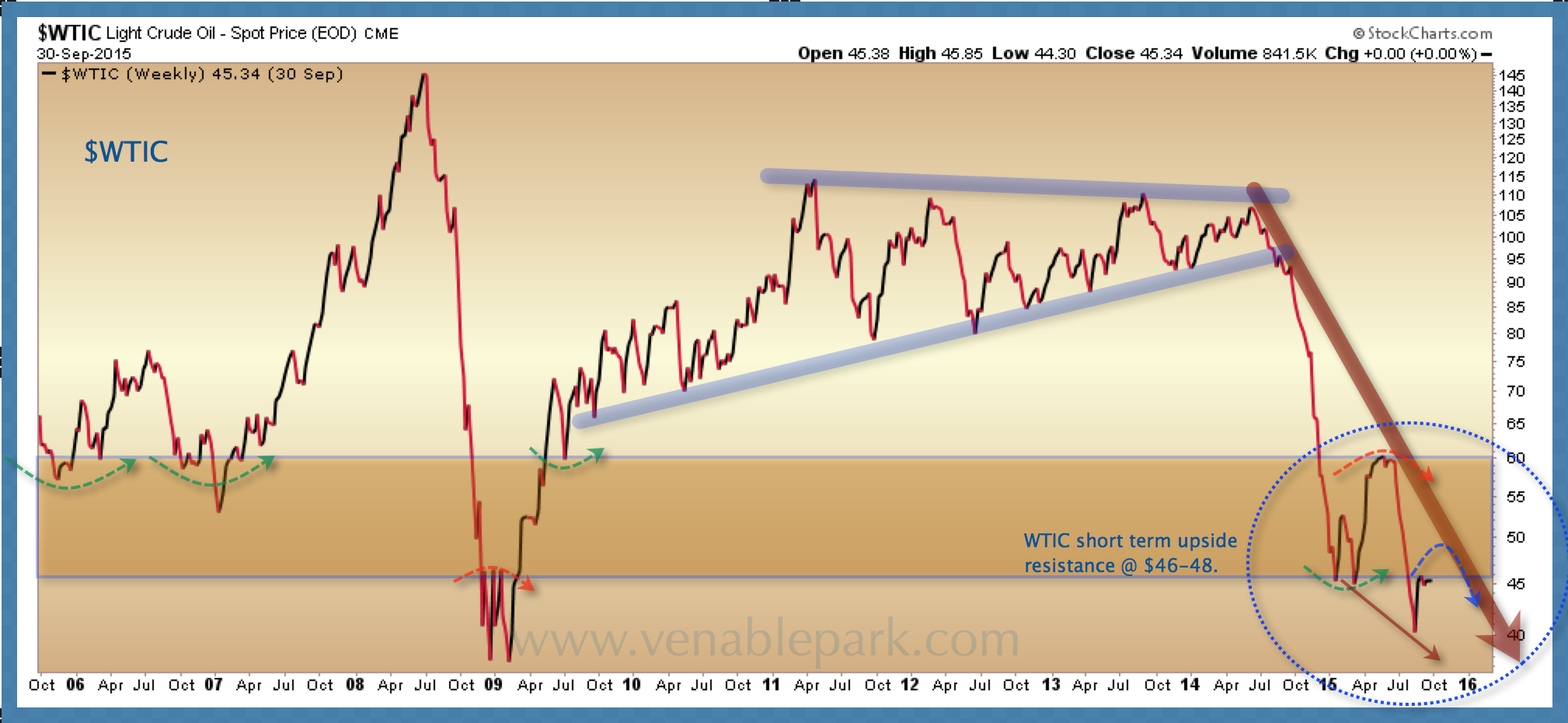
gdpnow-forecast-evolutionOil too appears to be processing the slower growth memo. (We thought that it would.) Now below technical resistance (band marked below), coupled with still weakening fundamentals, lower lows seem likely ahead.
WTIC Oct 1 2015

Posted in Main Page | Comments Off on The end of the credit line