
Hi yield bond prices decoupled from stocks

High yield corporate bond prices have traditionally traded in a lagged correlation with the equity market. Since June of 2014, US high yield bonds have sold off an average of about 10% to date, while the S&P 500 continued to rise. One of the two seems to be mis-pricing present financial risks. Time will reveal which is prescient.

Of course inspired by QE faith, buyers have been overpaying for high yield bonds (along with most assets) since 2011. So these higher risk bonds that have traditionally yielded greater than 8% (hence ‘high yield’) had been priced to yield an all time low of just over 5%, setting risk-blind holders up for a capital drubbing. The past year or so has so far taken about 2 years of the expected income off the capital value. In past bear markets, high yield bonds have fallen 25 to 50% in price before the sector is sufficiently revalued to attract sober investors.  The 50% plunge during the 2007-09 bear market is shown in the below chart of the Barclay’s High Yield Bond ETF (JNK).
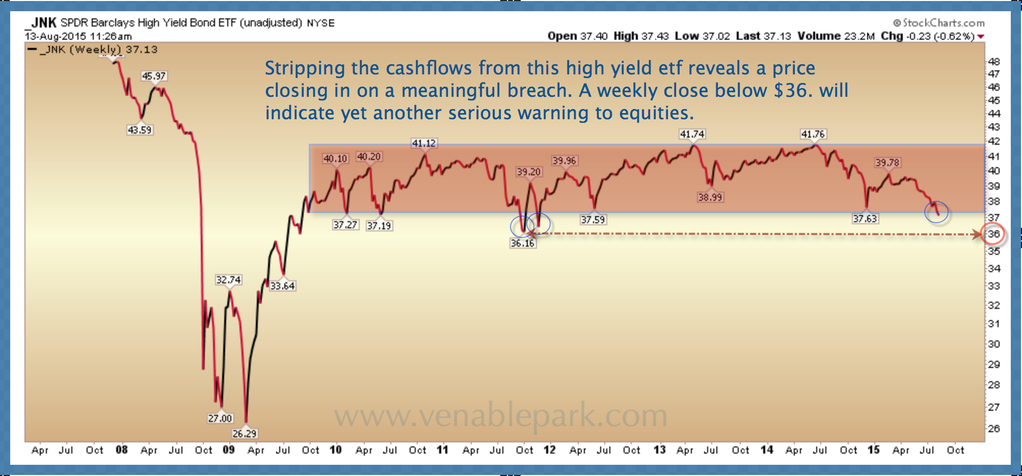
JNK Aug 13 2015

Junk bond ETFs are trading at their lowest levels since 2011. Should investors be worried? Larry McDonald of Societe Generale and Todd Gordon with TradingAnalysis.com discuss.  Here is a direct video link.

Posted in Main Page | Comments Off on Hi yield bond prices decoupled from stocks

Global recession spreading

Raoul Pal, Global Macro Investor, discusses what investors should be concerned with in regard to the latest global markets. Here is a direct video link.

Posted in Main Page | Comments Off on Global recession spreading

Thinking global on energy grids

Many renewable energies like sun, wind, hydro and tidal flow freely over the globe with some areas having more exposure to some types than others. Rather than each area or country thinking local and developing separate regional power systems to produce, consume and store just energy captured within their own borders, interconnecting regions and pumping the growing plethora of the earth’s clean energy sources into continental and even inter-continental supergrids (akin to the global internet into which we all plug) is the next wave of big picture solutions.

Individuals can still have personal systems (ie Powerwalls) to capture and store energy for their own homes and electric vehicle recharge, but for the bigger communal, infrastructure needs, or to service areas that are under-powered, inter-regional systems make enormous sense.  In fact many inter-regional sharing grids are in place in North America and Europe already.  For examples, and to learn more, read:  First steps to a global supergrid here.

Reports abound of homeowners and businesses unplugging from the power grid and opting instead to generate and store their own electricity. Such grid defections may make sense in places where electricity rates are sky-high or service is spotty. But for just about everywhere else, it’s far more sensible to do the very opposite: interconnect regional electricity networks to form a globe-spanning supergrid.

What makes this idea so compelling are the major strains on today’s power grids: soaring energy demand in fast-growing megacities; rapid expansion of carbon-free but intermittent wind and solar power; and the ever-increasing need to secure grids against electronic and physical attacks. The smaller and more isolated a power network is, the more difficult it is to maintain the nearly instantaneous balance between electricity supply and demand.

But the technology now exists to transmit massive amounts of electricity over long distances without significant losses, thereby allowing operators to balance consumption and generation across an entire continent—or, potentially, the globe.

Posted in Main Page | Comments Off on Thinking global on energy grids




