Sri Kumar, Sri-Kumar Global Strategies, shares his thoughts on current market conditions. Here is a direct video link.
Follow






_________________________
Sri Kumar, Sri-Kumar Global Strategies, shares his thoughts on current market conditions. Here is a direct video link.
While Canada enjoyed a holiday Monday today, world markets continued to reel on the waves of excessive leverage deflating everywhere: China’s manufacturing dumped as new orders slumped back to the lows of 2011; commodities gave up quick rebound hopes, while Greek stocks closed down 16% after a 5 week closure; and Puerto Rico finally admitted insolvency and defaulted on $58 million bond payment. The wheels are coming off the facade of central bank ‘controls’ at last, and truth about slowing global growth and outrageously over-priced financial markets is spreading once more.
As John Hussman so ably explains today, see A bad equilibrium and how speculative distortion ends:
The difficulty with creating a bubble of speculative distortion is that there is always hell to pay, and once valuations have already been driven to extreme levels, that hell is baked in the cake. It can’t be avoided, and once investors have shifted toward risk-aversion, history indicates it can’t even be managed well. Recall that the Fed was easing persistently and continuously throughout the 2000-2002 and 2007-2009 market collapses.
… the fundamental reason for economic stagnation and growing income disparity is straightforward: Our current set of economic policies supports and encourages a low level equilibrium by encouraging debt-financed consumption and discouraging saving and productive investment. We permit an insular group of professors and bankers to fling trillions of dollars about like Frisbees in the simplistic, misguided, and repeatedly destructive attempt to buy prosperity by maximally distorting the financial markets. We offer cheap capital and safety nets to too-big-to-fail banks by allowing them to speculate with the same balance sheets that we protect with deposit insurance. We pursue easy monetary fixes aimed at making people “feel” wealthier on paper, far beyond the fundamental value that has historically backed up that wealth. We view saving as dangerous and consumption as desirable, failing to recognize a basic accounting identity: there can only be a “savings glut” in countries that fail to stimulate investment. We leave central bankers in charge of our economic future because we’re too timid to directly initiate or encourage productive investment through fiscal policy. When zero interest rates don’t do the trick, we begin to imagine that maybe negative interest rates and penalties on saving might coerce people to spend now. Look around the world, and that same basic policy set is the hallmark of economic failure on every continent.
On a positive note, left in the dust by Tesla, global auto leaders Audi and Mercedes are finally starting to understand the stupidity of their failure to embrace electric engines to date. This is truly good news. See: These are the first images of Audi’s answer to Tesla’s Model X SUV.
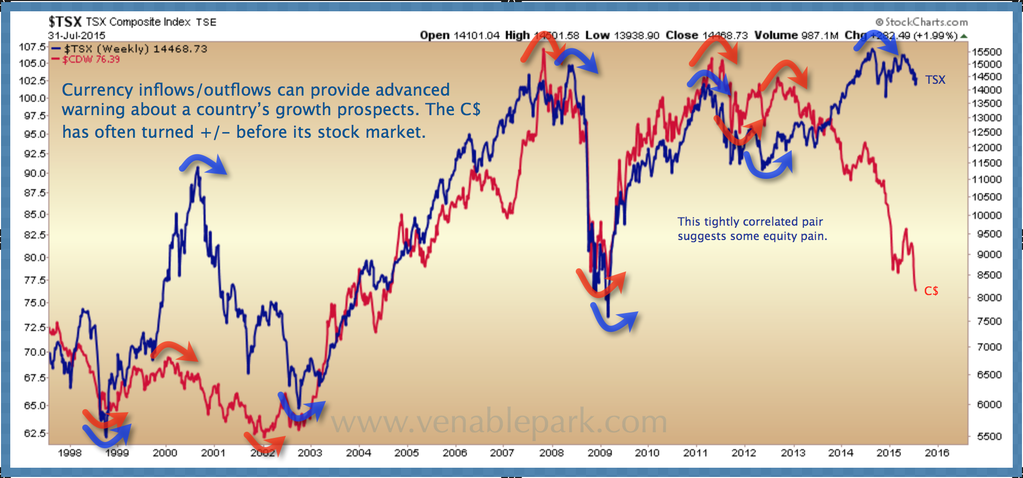
This chart of the Canadian dollar (CDW in red) and the Canadian stock market (TSX in blue) since 1997 captures the historically tight correlation between the country’s petro-currency and stock market. There was a brief disconnect in 2000, when the loonie began to swoon at the start of the year and the broad market rallied into September on blind love for dividend paying shares like the banks and pipelines, along with misguided faith and creative accounting at Nortel. Nortel went bust of course, and the dividend paying stocks crashed more than 40% in 2001-03, and again in 2007-09.
We can see another major gap between the loonie and the TSX today and the same financial gurus are assuring us all that this time is different. ‘Course, they always say that.