
Economic consensus still far, far above realistic marks

The more historically realistic US GDPNow model forecast for Q3 2015 real GDP growth (seasonally adjusted annual rate) was 1.0 percent on August 6 (green dot below) compared with the still much higher 2.6 to 3.6% range of consensus forecasts (blue band below). The consensus range, shared by Central Bankers and investment sales firms everywhere, continues to be senselessly, relentlessly optimistic only to be revised much lower in retrospect.  (And let’s not forget that the meager August 6 GDPNow estimate was days before this week’s ‘surprise’ currency devaluation from China, which will now make US (and European) goods and services that much less affordable for Chinese buyers).  You can see more on how GDPNow estimates are calculated here.
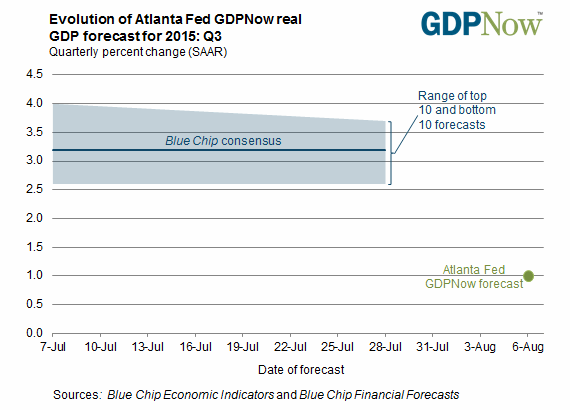
gdpnow-forecast-evolutionThis huge gap between realism and consensus matters because the majority of financial types are justifying today’s lofty asset valuations in large degree, on the misguided consensus growth assumptions--a significant amount of which was penciled in as coming from China.  Nominal GDP growth is roughly correlated with corporate revenue growth; and so faulty assumptions on top line growth and inflation, become precarious foundations on which to construct valuation beliefs.

It is only when asset markets crash enough to scare consensus-following-sheep off bullish marks, that truly valuable investment opportunities present for the few sober realists ready to capitalize on them.  That time of role reversal–where today’s careful bears become tomorrow’s only bulls–is coming sure as winter, somewhere in the months ahead.


Posted in Main Page | Comments Off on Economic consensus still far, far above realistic marks

Venezuela learns the hard way: gold not the currency it needs

Every financial crunch teaches a universal truth: ‘liquidity’ is denominated in the currency of one’s living expenses and debt payments. As savings burn through, and cash flow declines, other asset classes become luxuries one can no longer afford. The natural response is to then look to sell (exchange) other assets for needed cash.

The trouble is humans tend to run in herds when it comes to asset collection and notions of value. We have lived through a decade where falling interest rates made people increasingly convinced that cash was trash and other financial assets and tangible/collectable/commodities were most valuable. Product sellers grew fat on the fad.

History assures us that following such periods, notions of value tend to reverse– equal and opposite in the other direction– as a drop in cash flow and/or confidence prompts a desire to raise liquidity.  As tensions spread, a full blown liquidation phase frequently takes hold:  where sellers overwhelm interested buyers, and prices collapse in the process.  Even holders not needing or wanting to sell, are hammered with losses.

The ongoing plunge in commodity prices since 2011, is a classic example of this cycle in motion. The sharp drop in the price of oil is leaving previously over-confident producers in financial shock. Venezuela is one striking example.  With 95% of its export revenue dependent on oil, cash flow is in sharp retreat. But having placed 68% of its international reserves in gold bullion–which has also been falling in value for 4 years and 15% since January alone— Venezuela is learning the hard way that gold is not the currency it needs to pay living expenses and debtors. See: Ravaged by Oil’s collapse, Venezuela now has a big gold problem.

The decline threatens to erode reserves the cash-strapped country relies on to pay its foreign debt…

Venezuela’s dollar-denominated bonds have lost 19.2 percent in the past three months, the most in emerging markets, as the collapse in oil exacerbates concern the nation will run out of money to pay debt. Yields on its benchmark notes climbed past 26 percent on Aug. 6, the highest since February…

Venezuela’s reserves could fall below $15 billion if gold prices fall further or if the government decides to liquidate some of its holdings, according to Sarah Glendon, the head of sovereign research at Gramercy Funds Management.

In April, Caracas-based newspaper El Nacional reported that the central bank swapped $1 billion of its gold reserves for a cash injection. And in 2012, then President Hugo Chavez repatriated most of the country’s gold reserves.

Venezuela has drawn down reserves about $1 billion a month this year to counter the drop in oil prices, Morgan Stanley said in a note to clients last month.

“It’s a question of what weighs more in their mind: servicing their debt or holding their gold in Caracas?” Gramercy’s Glendon said from Greenwich, Connecticut. “It’s going to be extremely challenging for Venezuela to get another source of dollars.”

Posted in Main Page | Comments Off on Venezuela learns the hard way: gold not the currency it needs

Lower prices continuing to spread deflation

Just as crashing oil prices are inducing cash-crunched producers to pump even more product, weaker global demand and falling export prices are flooding even more cheap goods throughout the world. Better for buyers, but bad for corporate sales, profits, recklessly levered financial markets, tax revenues and GDP. Also bad for those banking on a rebound in commodity prices. See: Yuan devaluation digs a hole for commodities.

China devalued the yuan in a move that rippled through global markets, as policy makers stepped up efforts to support exporters and boost the role of market pricing in Asia’s largest economy.

The central bank cut its daily reference rate by 1.9 percent, triggering the yuan’s biggest one-day drop since China ended a dual-currency system in January 1994. The People’s Bank of China called the change a one-time adjustment and said its fixing will become more aligned with supply and demand.

China devalues

Here is a direct video link.

Posted in Main Page | Comments Off on Lower prices continuing to spread deflation




