
Captured House urges DOL to keep best interests of finance first

You know you have a completely broken system when politicians supposedly elected to serve the people send letters urging the Department of Labor to stop insisting that financial advisers put the best interests of retirees ahead of their own profits.  See: House panel calls on DOL to withdraw proposed fiduciary rule. At the same time, the Senate Appropriations Committee has included more Wall Street deregulation provisions as part of the FY 2016 Financial Services and General Government Appropriations bill.

Meanwhile a new report estimates that the 2008 financial crash cost American families alone more than $20 trillion (and counting) in lost jobs, homes, savings, and retirement options, never mind peace and health.

This is what a finance-purchased congress looks like. It should sicken the guts and reinvigorate fair-minded people to demand critical reforms and break ups of the financial cartel now dominating democratic governments everywhere. Those who think this is overstating the issue, are missing the staggering cost we are paying for allowing the finance parasite to continue sapping the strength of households and our economy.

As Better Markets CEO, Dennis Kelleher explained in his testimony before the House Education and the Workforce Committee on June 17, 2015:

“The industry’s complaints boil down to a false choice: either brokers’ get to put their interests above their clients’ best interests, or they won’t serve those clients at all. But the real choice is this: Let the DOL act to protect 100 million workers and retirees across this country, or side with the brokers and other advisers who want to continue putting their interests ahead of their clients’. That’s the real choice. “

Posted in Main Page | Comments Off on Captured House urges DOL to keep best interests of finance first

Income ETFs, funds and MLPs: tide going out

Low interest rates, relentless central bank confidence pumps and a runaway investment sales machine have all served to herd income-searching investors into income-producing assets over the past 3 years. In the process, unit valuations that were already high in 2012 moved to outrageous by 2014. The trouble is that capital risk rises in lock step with price, even as income products have been sold to those who can least tolerate losses. The marketing mantra is that income/dividend paying securities are ‘defensive’,’stable’ places to park savings.

Just as in previous investment cycles, fund cos and issuers ramped up sales campaigns as prices rose, rolling out an ungodly barrage of artfully wrapped products. Sadly many customers who had bitten similar baits in 2005-08, lost heavily and swore off the risk-sellers for a few years after that. Then in the past couple of years as finance trolled for suckers, many hopefuls have been lured back in, just as the price cycle crested once more.

Some of the most reckless financial advisers and firms (unfortunately there’s lots of them) have been looking after their own sales targets by recommending that their customers borrow to “invest”. With loan rates so low, they argue it’s a no-brainer to use a lender’s money to increase buying power. In truth the strategy is more typically a recipe for financial disaster.

The fall out this cycle is just starting to show as high yield debt, preferred shares and MLP’s (Master Limited Partnerships) concentrated on the energy sector, have been selling off over the past 9 months.  See:  MLPs yield headaches for advisers who bought them for income.

The capital tide is retreating. As usual it starts slowly at first; then all at once, as losses shock the hearts and minds of holders.  See: Is this the beginning of the end for dividend funds?

Dividend ETFs are on fire, and not in a good way.

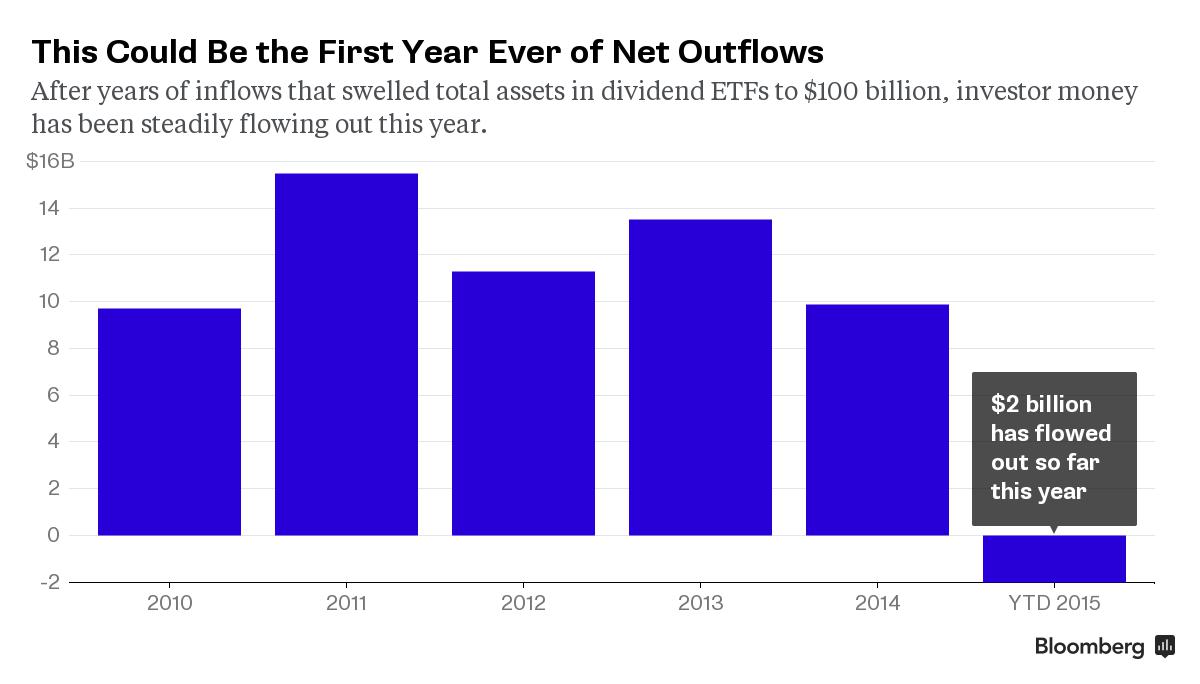
Exchange-traded funds that employ a variety of strategies to invest in dividend-paying stocks have been a no-brainer since the financial crisis, as income investors have confronted artificially low interest rates. But after years of inflows that swelled assets to $100 billion, dividend ETFs have seen an outflow of $2 billion this year.1 If that isn’t quite apocalyptic, it is scary, and if it keeps up, this will be the first year of outflows ever.

The outflows aren’t from just one ETF or the result of one massive trade. It’s a slow and steady burn from most of the largest and most beloved dividend ETFs.

investors flowing out of dividends


When dividend products from the Big Three in ETFs—Vanguard, BlackRock, and State Street—are hurting, it shows that no product is safe when investors anticipate a big change in the markets. Not even dividend ETFs.

Posted in Main Page | Comments Off on Income ETFs, funds and MLPs: tide going out

Which countries are at risk in commodities rout?

Which countries stand to hurt the most from plunging commodity prices? That’s easy: the same countries who benefited the most as prices rose 2001-2011. Unfortunately most of them, like Canadians, became over-confident during the boom and went deeply into debt. Now they will struggle over the next several years during the ‘payback’ period. ‘Twas ever thus. Universal life lesson to be learned for future cycles: use boom periods to pay down debt and build up savings. Not the opposite.

Deltec Chief Investment Officer Atul Lele discusses his outlook for commodities. Here is a direct video link.

For those who would like a recap on the reasons behind current trends, I explained it in detail in this interview last January.  The Canadian financial index is the next part of the story to reprice, and that seems to be now underway. Look out below. Canadian bank shares and REITS fell more than 50% in both of the last two US recessions. This time could potentially be worse. Believe it or not…

Posted in Main Page | Comments Off on Which countries are at risk in commodities rout?




