
Wheels coming off in Canada

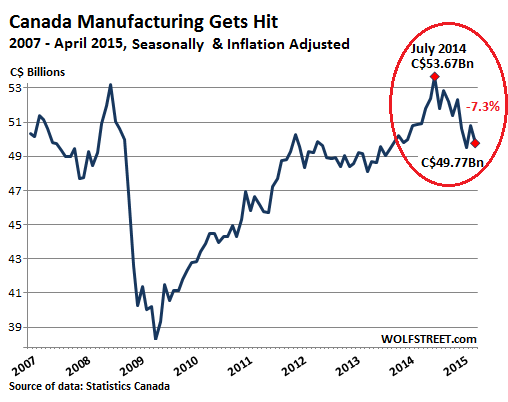
The hype and promise of Canadian growth and stock market bulls has been that lower oil prices would be offset by a surge in export demand spurred by the weakening Canadian dollar. Unfortunately this was a pipe dream.  Canada’s manufacturing sales are now down more than 7% since last July–weakness not seen since the beginning months of the 2008 recession.  See:  Weak loonie not enough to boost Canadian Manufacturing.
Canada-manufacturing2007_2015-04
Also perennially optimistic, Canadian corporate executives have similarly overestimated Canada’s prospects, and now sit with the highest inventory levels (green line below) on record in the midst of falling sales.  This bodes poorly both for future new orders and prices (revenues).  See:  Manufacturing in Canada sags, triggers chilling references to financial crisis.
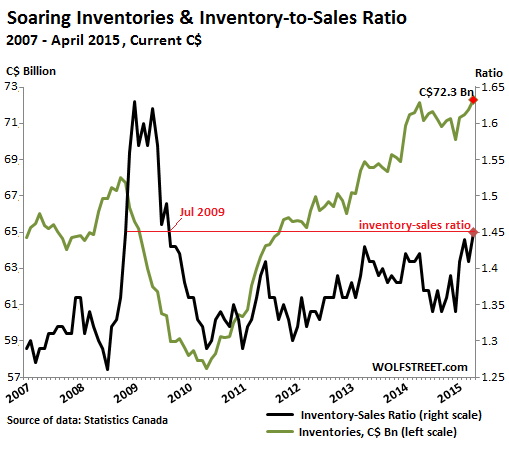
Canada-inventories-inventory-sales-ratio-2007_2015-04Weak factory sales also suggest that Canadian GDP may have shrunk yet again in April for the 5th time in the past 6 months, foiling hopes that contracting growth in Q1 will significantly improve in Q2.

Posted in Main Page | Comments Off on Wheels coming off in Canada

How Iceland broke precedent and reined in its runaway financial sector

While Japan, then North America and Europe repeatedly bailed out and held their banking cartel harmless the past 30 years, in 2008 Iceland took another path. The rest of the world must do likewise.

Concluding Remarks from Gudrun Johnsen of the University of Iceland at Finance & Society 2015, explains how and why they did it. Here is a direct video link.

Posted in Main Page | Comments Off on How Iceland broke precedent and reined in its runaway financial sector

Fossil fuel subsidies paying polluters to continue

Perverse financial incentives are undermining essential human progress in the energy revolution.

For sustainability of life on earth, we need to evolve out of the fossil fuels age and towards the cornucopia of renewable, clean, low cost and free energies that are ours for the using. The status quo meanwhile, remains heavily invested against this necessary renaissance and our own limited taxpayer funds, are being pledged against us.

The latest report from the Paris-based International Energy Agency — which provides independent energy analysis and has 29 member countries, including the United States, admits that present financial incentives are heavily favoring the use of fossil fuels over other more efficient energies.  In simple math, it costs an average of $7 per ton to buy a certificate offsetting carbon emissions today, while total government subsidies and tax breaks favoring creation of carbon amount to an average $115 per ton.  In this messed up dark ages-model, continuing to emit carbon is 16x more profitable than not, even while at the expense of literally everything else,  see,  Subsidies at 16 times carbon prices stymie pollution curbs:

Tax-breaks, subsidized fuel prices and other government support amount to an incentive to pollute worth $115 per metric ton of carbon-dioxide, the agency said Monday in its Energy and Climate Change report. That compares with an average $7 cost to buy emission permits in carbon markets, according to the Paris-based group.

In North America, carbon prices and subsidies each cover about 4 percent of emissions, the agency said. The subsidies amount to $36 a ton on average, while the carbon price is $9 a ton. Latin American subsidies are $208 a ton, compared with $173 a ton in the Middle East, $168 in Africa, $104 in India and $29 in China, the IEA said.

Posted in Main Page | Comments Off on Fossil fuel subsidies paying polluters to continue





