
Chinese economy contracts in March

An initial reading the Chinese manufacturing sector saw activity drop to an 11-month low in March, but analysts may be more worried about the government’s push for much-needed structural reforms. Here is a direct video.


Listen to the long always Fidelity salesperson in this clip explain how they are not concerned (ie. reducing their equity exposure on this news–because they need to keep the equity dream alive for people to keep buying their funds), or as she says they remain confident that Chinese consumers will start spending any day now to drive the economy so that the government firehouse of debt-spending (that has quadrupled total credit in the Chinese economy since 2008 to now some 282% of GDP) can back out as the primary growth engine it has been over the past 8 years.  Best wishes.

In reality, consumer spending in China has declined with employment since the 2008 recession. Chinese people are still largely responsible for their own social security and healthcare and save about 35% of their income as a result (compared with maybe a 5% savings rate in North America). The Chinese saving rate is going up not down.  Moreover while many were trying to improve their net worth by using free-flowing credit to speculate on housing the past few years, home prices are now in retreat and in February, registered 6 straight months of decline in 69 of 70 Chinese cities.

The trouble with investing speculating on credit is that when prices fall you are left with not just capital losses on the property but negative equity and often negative cash flow after making the debt payments.  This is what prompts people who thought they were ‘investors’ to suddenly start liquidating.  If they can find a buyer.  Which drives prices down further and compounds losses…and so on.  The world over, it is always the same.
Posted in Main Page | Comments Off on Chinese economy contracts in March

No quick fix to save oil prices this time

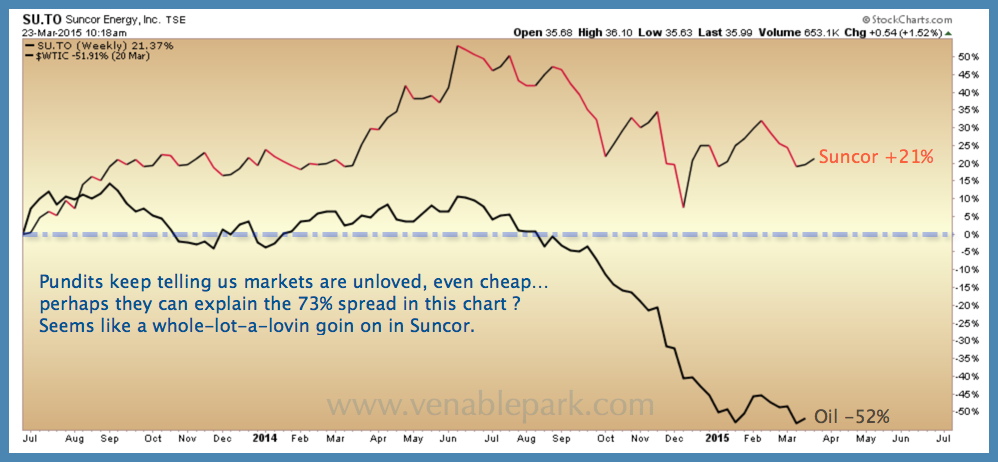
After a short-lived rebound in energy shares between January and February, the energy sector index (XEG) remains down 35% from its June 2014 high. Interim bounces notwithstanding, it is likely that energy shares have further to fall as investors lose patience and prices couple with the reality of falling oil. Unlike the March 2009 ‘V’-shaped rebound, this time there is little prospect of ‘monetary magic’ to reignite animal spirits. With energy cos still 21% of the Canadian stock market (S&P/TSX), the downside for the broader market looms ominous.

This chart of sector heavyweight Suncor (red) versus the price of crude (WTI in black) offers some insight on the price risk still inherent to date.

Suncor March 23 2015

The collapse in the market for Canada’s heavy crude below $30 a barrel last week is hammering home a harsh reality for the nation’s oil-sands producers: There’s no one to save them this time.

Unlike previous market crashes that were relatively short- lived, the combination of persistent oversupplies and weakening demand are dealing a severe setback to what’s been one of the biggest growth stories in global energy markets. Oil-sands companies such as Suncor Energy Inc. already have been rethinking major developments that can require more than $10 billion in investment. Now even existing projects are barely covering costs or in a losing position…

When the price of Canadian crude fell to similar depths in 2009, U.S. monetary policy helped prevent a financial crisis from deepening and boosted demand for oil, setting the stage for a relatively swift recovery. This time around, there’s no end in sight to the oil glut, leaving companies no choice but to drastically cut costs to survive.

The rule of thumb for new projects in Canada’s oil sands is that a West Texas Intermediate crude price of about $80 a barrel is needed to earn a return. The paste-like fossil fuel from northern Alberta is selling at a discount of about $13 a barrel compared to U.S. crude, which is now well under $50. See: Oil sands tested as rout hammers home harsh reality

Posted in Main Page | Comments Off on No quick fix to save oil prices this time

Canadian economy looking recessionary

2015 is off to a weak start in Canada: both manufacturing and retail sales fell 1.7% in January while exports fell 2.8%–so far a much weaker loonie is not having the boosting effect that bulls had forecast.

The Bank of Canada had projected annualized growth of 1.5% in the first quarter, but with one week to go, that target is looking overly optimistic again. Q1 growth is setting up to be flat to negative. And job losses for Canada’s highly indebted consumers, are only just started. Plunging revenues are spreading from the energy patch to the other interconnected sectors.

Canadian employers are reluctant to hire, and it’s not just because of low oil prices.

Year-over-year employment growth in Canada has been below 1 per cent for 15 months in a row, the longest stretch below that mark for annual job gains, outside of recessions, in almost 40 years of record-keeping.

This slow growth reflects caution among employers who are reluctant to add staff in an uncertain economic climate, now compounded by currency and commodity price volatility. Without clarity that business conditions will improve, many employers are aiming to keep costs down by avoiding adding to permanent payrolls.

Companies “want to take advantage of better business activity by improving productivity,” said Rowan O’Grady, president of recruiting firm Hays Canada. “But there’s still a lack of confidence … to be in a position where they’re doing a lot of hiring.”

Rather than risk adding to head counts, he said, many are instead asking one person to take on two roles, hiring only on a temporary or contract basis and holding off on big decisions to expand.

Employers shed 1,000 positions last month, according to Statistics Canada, and the jobless rate rose two notches to a five-month high of 6.8 per cent as more people looked for work. Annual employment growth has hovered at about 0.6 per cent in the 15 months since December, 2013.

The last period of least 15 months of growth below 1 per cent was during the 2008-2009 recession…

See: Anemic job growth streak earns place in the record book

Posted in Main Page | Comments Off on Canadian economy looking recessionary





