Democratizing energy

For all those who hated the advent of horseless buggies, cell phones, computers, the internet et al…don’t read this one!   See:  Battery hackers are building the future in the garage…cannibalizing a Tesla to go off the grid.  The primary motivation here is not to ‘save the world’, but rather for individuals to save cash flow and become self-sustaining:

In a cluttered four-car garage in suburban Deptford, New Jersey, Hughes spent the better part of last year hacking a 1,400-pound battery recovered from a wrecked Tesla Model S and reworking it into a stacked array that can store energy from his solar-power system. His battery tinkering resolves the issue of intermittency since his green power will be available whenever he needs it, night or day, rain or shine…

Electricity markets will be turned upside down within the next 10-20 years, driven by solar and batteries,” says an August 2014 report from investment bank UBS. So might the auto industry and the oil companies….

The fossil-fuel grid has been a marvel but its time has come and technologically savvy people — rapidly becoming the majority of us — are seeking to connect to the new thing. “I’m not going to drill for oil and refine gasoline in my basement,” says Hughes, “but I can hook up solar panels and run my car.”

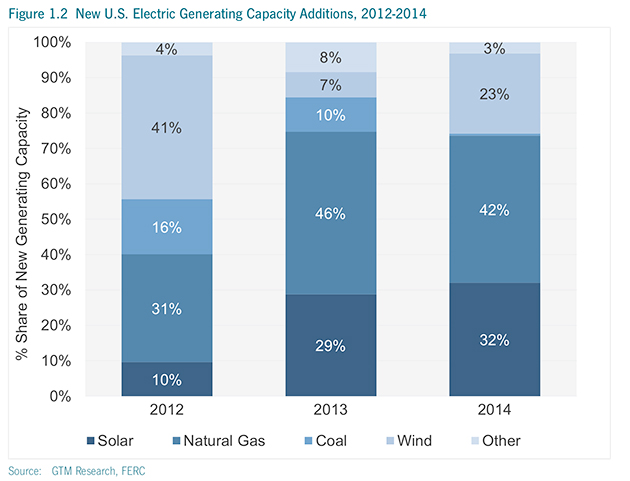
Solar power growth is on fire. 2014 was the biggest year for solar power ever:

“…solar power is blowing up in the United States: Adding tons of jobs, driving progressive policies, and attracting millions of dollars in investment from major corporations. It’s not slowing down anytime soon: New data from market analysis firm GTM Research finds that 2014 was solar’s biggest year ever, with 30 percent more photovoltaic installations installed than in 2013.”

While to date, solar accounts for a small share of North American electricity generation, it is rapidly expanding and, as shown below, last year added nearly as many new megawatts to the grid as natural gas.  This is a trend that is here to stay.  Power to the people. An idea whose time has come.
solar-2-chart.

Posted in Main Page | Comments Off on Democratizing energy

Fed in deflation penalty box

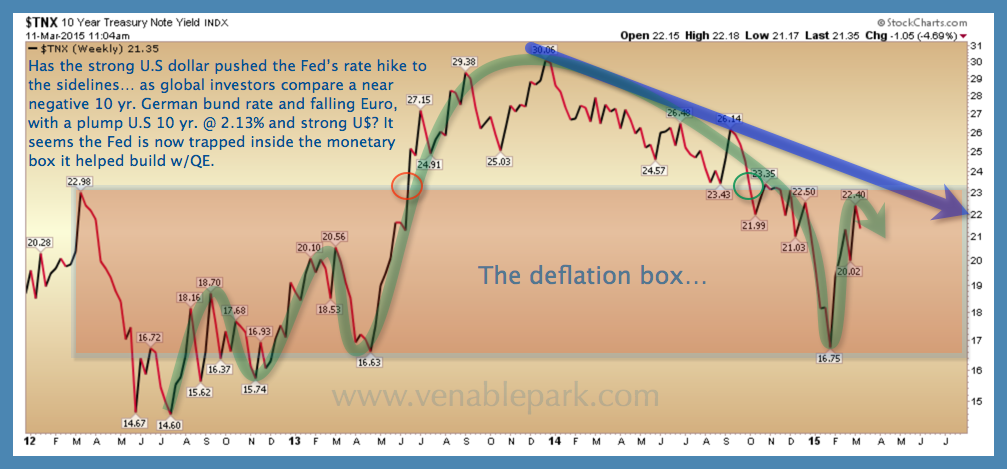
Price deflation is the natural outcome of mammoth excess capacity and shrinking demand from aging, indebted consumers.  Lower asset values are a key part of the cure needed to fix global imbalances and restore rational investment math and consumption ability once more for the middle class.

But for bankers…this is a nightmare of their own foolish, greedy design.  Rate-cutting powers now gone, and future consumption already spent as demand the past few years, the next global recession is advancing to force a much needed cleansing of reckless policies and players.  Couldn’t happen to a more deserving bunch of folks…
10 year deflation box

Posted in Main Page | Comments Off on Fed in deflation penalty box

When ‘stimulants’ are impotent

Two more rate cuts and more government stimulus efforts over the past 4 months, and still the Chinese economy–weighed by mind-boggling debt and inventory–continues to slow. This massive mean reversion phase has been well earned by the equally massive hyper-investment period that went before it, courtesy of the global debt bubble. We should now expect equal and opposite in the other direction. Slower growth is the new normal, not a phase. See, China: Industrial output, fixed investment, property sales and retail sales miss forecasts

Growth rates for industrial production, retail sales and investment in factories and other fixed assets in January and February came in significantly below economists’ expectations, while housing sales continued their swoon, according to government data released Wednesday. China releases combined data for January and February to limit distortions caused by the long Lunar New Year holiday, which falls within those months but on dates that vary from year to year.

Industrial production, which is seen as a proxy for the country’s economic growth, grew 6.8% in the first two months, its lowest level since the 2008 financial crisis. That is down from 7.9% in December and well-short of a median forecast of 7.6% from a Wall Street Journal survey of 14 economists. Factories were hit by overcapacity, high inventories and tight financing, economists said.

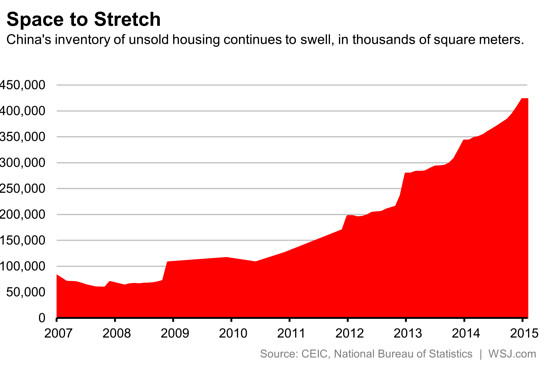
The overall weak performance so far in 2015 showed that the economy was still weighed down by a housing glut, debt and industrial overcapacity…

Chinese housing inventory swells

Posted in Main Page | Comments Off on When ‘stimulants’ are impotent