
Impossible debt stifling Greece and consumers the world over

One of the greatest costs of the credit bubble that has enveloped the world the past 15 years is that it has allowed the price of most assets and services to skyrocket. In a sustainable equilibrium, available capital to fund investment comes from savings. But when as now, the banking system is flooded with credit on credit from a recklessly levered financial sector, for a time it makes capital plentiful and therefore less valuable.  Since less valuable, capital is rewarded with lower and lower yields.

Using borrowed money, more people have the ability to buy, and hence the price of most services and assets rises with the demand. Until finally we reach the end point of borrowing capacity, the end of debt service ability (ie., no matter how low rates are, repayment ability is ultimately finite because it is tethered to one’s available cash flow collected through sales or wages). At the end point, credit slows and the inevitable payback period exacts its pound of flesh:  years of reduced consumption courtesy of servicing costs, defaults, write-downs, bankruptcies and of course, mean reverting prices for assets and services. All of a sudden, reality reveals that few people actually have liquid savings, and hence few can afford to be buyers. And if at all, only at much lower prices.

A present example of these forces at work, is in post-secondary education. Education costs have skyrocketed because students have been able to access seemingly endless credit and so schools have been able to dramatically jack up costs and still find customers. But the end point of this ‘virtuous cycle’ seems to upon us. Students are increasingly already in debt by the time they reach college (car loans and credit cards) and then even after graduating, many are not able to earn enough to payback their loans and start a household–for years–as the debt weight of past consumption stifles new.

Student loans continue to pile up, now totaling $1.16 trillion in outstanding balances, one of the main reasons researchers have cited for the low levels home ownership among young adults. Here is a direct video link.

But it’s not just students or Greeks who are now suffering the paralyzing effects of impossible debt levels. It’s worldwide:

Despite widespread talk of “deleveraging” after a global credit bubble burst in 2008, the world continues to pile on more debt. According to a new study by McKinsey, the world ended last year some $57 trillion deeper in debt than it was in 2007.

The total tab—owed by governments, companies and households—is now more than twice the value of the world’s total economic output.

The biggest chunk of new borrowing since 2007—some $25 trillion—has come from governments going deeper into hock. Of the nearly 50 countries included in the analysis, only five—Argentina, Egypt, Israel, Romania and Saudi Arabia—have paid down some of their debt.
Posted in Main Page | Comments Off on Impossible debt stifling Greece and consumers the world over

Truth getting out: “no acceleration in economic growth”

There is always something cathartic, when realism get some words in edgewise on financial-tainment. Steve Ricchiuto, Chief U.S. Economist at Mizuho Securities, managed to do it for a few moments on CNBC this week. 

“The deflation story is very, very critical but there’s also this wrong concept that I keep hearing over and over again in the financial press about this acceleration in economic growth. That isn’t happening. Last month we had a horrible retail sales number. We had a horrible durable goods number. We’re likely to have a very disappointing retail sales number coming forward. This month we’ve had a strong payroll number – we say everything’s great. It’s not great. It’s running where it’s been. It’s been the same thing for the last five years. There’s no improvement in the economy.”

Here is a direct video link.

Posted in Main Page | Comments Off on Truth getting out: “no acceleration in economic growth”

The Myth of Black Swan market events

Excellent article in the NYT this weekend from Mark Spitznagel, founder and chief investment officer of Universa Investments.  Spitznagel is elevated in both intelligence and wisdom– still a very rare combination in finance.

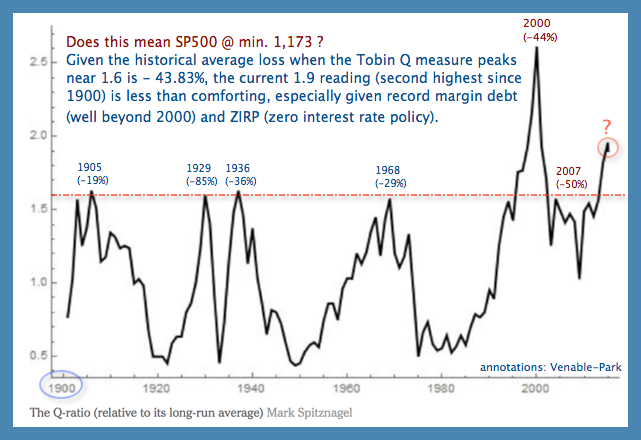
First he offers a chart of the Tobin Q ratio for the S&P 500 since 1900–here with annotation from my partner Cory–(the total aggregate value of publicly traded common shares in relation to the estimated aggregate replacement value of the stock of capital for those corporations (ie., machines, equipment, buildings, chairs, etc.).

Tobin Q since 1900As shown on this historically reliable metric (and many others!) stock prices today are the most over-valued in 115 years, but for the fleeting tech wreck top in 2000:


These elevated periods for the Q ratio are clearly unsustainable, because companies cannot borrow and buy back forever. So this highly unnatural mechanism has logical implications not for long-run economic investment and growth (as the Keynesians continue to hope), but instead for short-run stock prices. Complicated statistical analysis is not needed to confirm this.

Each of these high points in the Q ratio — in 1905, 1929, 1936, 1968, 2000 and 2007 — was followed in short order by stock market losses. The peak-to-valley (or the loss from the high price to the low price) subsequent to each high point was 19 percent, 85 percent, 36 percent, 29 percent, 44 percent, and 50 percent, respectively.

…The bear markets we saw following all of these periods were not dreaded “black swan” events at all. They were perfectly predictable, by economic logic alone, the same logic that says governments cannot manipulate market prices without creating distortions that will always, without exception, be counterproductive.

In the next stock market crash, we will be told that the fault was some surprising economic or geopolitical shock. Let’s remind ourselves now that this will be false, the proximate cause rather than the ultimate cause. The ultimate cause is the same ultimate cause that has been demonstrated to us for over a century: distorted and manipulated markets.

These markets are speaking to us yet again. This time around, we need to listen.

For useful historical context on the interventionist policies that have driven repeated periods of equity over-valuation and then collapse, read the whole article here:  The myth of Black Swan market events.

Posted in Main Page | Comments Off on The Myth of Black Swan market events



