Avazz petition: time to end too big to jail

People who value democracy, fairness and civil society, should care about breaking up the banking cartel.  The current state of anarchy there, threatens all of us.  Avazz captures the issues well in today’s petition:

Too big to jailHSBC helped the super-rich dodge taxes. We’d go to jail for this, but governments won’t prosecute them unless we demand it!

I’ve just signed a critical campaign to bring the tax dodgers to justice.

Join me by signing here.

HSBC bank has just been caught red-handed helping some of the world’s mega-rich dodge taxes! We’d go to prison for this, but governments are treating these powerful people like they’re too big to jail. Let’s show them they’re not.

Our governments are losing $3 trillion a year to tax dodging — enough to end extreme world poverty many times over! This leak is the biggest in banking history — if we don’t seize it now to get prosecutions, we may never get a chance like this again.

UK finance minister Osborne faces an imminent election, while US Attorney General Lynch is yet to be confirmed in her new job. They’re both very sensitive to the public right now, so our million-strong call, delivered via ads and with legislators, could get them to investigate, prosecute, and send the tax-dodging elite a powerful signal: no one is too big to jail!

The UK is HSBC’s home country, and the UK and US have jurisdiction over thousands of the tax-dodgers. If we get them to prosecute first, it could trigger a worldwide wave of accountability.

The mega-rich often cause damaging financial crises with wild speculation, get bailed out by taxpayers, then argue that public spending on schools and hospitals should be slashed to meet the resulting deficits — all while many of them fail to pay their legal share of taxes! This austerity-spiral is driving a rapid worldwide increase in inequality.

Just 85 billionaires have as much wealth as the poorest half of our planet — wealth they too often use to buy politicians and capture our democracies to keep the whole system going in their favour.

It’s time to stop this damaging downward spiral, and making the richest pay their taxes would be a massive step. Let’s make it happen:

Avaaz is all about the many gathering the power to stand up to the few. Law is a contract that links us all together, equally. Thousands of the world’s most powerful think they’re above it. For the sake of our democracies and our societies, let’s show them they’re not.

With hope and determination,

Alex, Bert, Laila, Ricken, Marie, Andrew, Nell and the whole Avaaz team

Posted in Main Page | Comments Off on Avazz petition: time to end too big to jail

When facts don’t support a ‘feel good’ thesis

CNBC says it is trying to tell the ‘good news’ about lower oil prices for the US economy today. As the host puts it: “The story we are trying to tell this hour Larry, is not some dire story, not bad news, the American economy is still doing great.”

Oops, this oil man was not helping their thesis…

Larry Oldham, Former President & CEO, Parallel Petroleum, discusses the impact of low oil prices on all segments of the Texas economy. Here is a direct video link.

Meanwhile, oil rigs shuttered to date, are not yet putting a damper on gushing supply in America.  This on top of record high inventories already.  Where in world to store it all?
Oil production and rig countChart courtesy of zerohedge.com

Posted in Main Page | Comments Off on When facts don’t support a ‘feel good’ thesis

A reality check on this Friday the 13th

The financial fabric of the world is in tatters. That much is clear. An appearance of liquidity to date, has been simulated through a toxic web of debt, debt derivatives, and misplaced confidence in central bank powers. This weekend a terrified and tortured Greece faces the end of its credit lines once more. And it seems that in the past few days, the Germans (who with France, are the largest holders of Greek bonds) may be softening their previous ‘no restructuring’ stance. After all the Germans have the most to lose financially if Greek bonds default and weak countries like it begin to exit the shared currency.

A rocket higher to a more Deutschmark-concentrated Euro would be a sharp adjustment for what has been the highly lucrative German export machine since its adoption of the common currency in 2002. But even if the Greeks do get to an emergency bridge loan (from the EU, or other potential lenders they have mentioned like China, Russia or America), math will not change: the Greeks cannot pay back what has already been piled onto their tab by lenders to date.  As shown here, 89% of all the ‘bail-out’ money advanced to Greece since 2010, actually was paid directly to its lenders in one scheme or another.

FT-chart-greek-debt-service-700What is needed is a debt write-down-off as well as structural reforms within Greece that focus on collecting reasonable levels of tax revenue, downsizing government expenses and getting Greek workers back to self-sustaining employment.  That almost certainly means no more extend and pretend schemes and a return to an independent, floating Drachma.

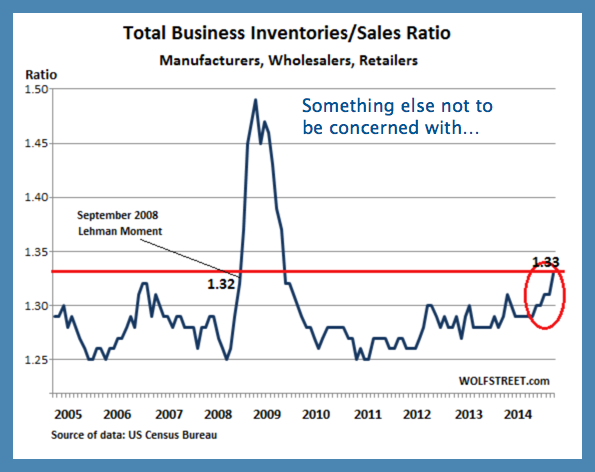
In the meantime, all the focus on band-aid negotiations in Europe and conflict resolution in Russia, are glossing over some larger issues with the global economy and financial markets as we move into 2015.  Demand is evaporating week over week, and supplies of pretty much everything are mounting at a remarkable rate.  The following chart of the business inventories to sales ratio, captures yet another in a long list of historically relevant indicators suggesting recessionary forces are afoot in America as we write, even as the talking heads prattle on about a US decoupling.  Most recently at 1.33, this ratio (as shown below) is now higher than in the opening months of the great financial crisis and bear market of 2008.

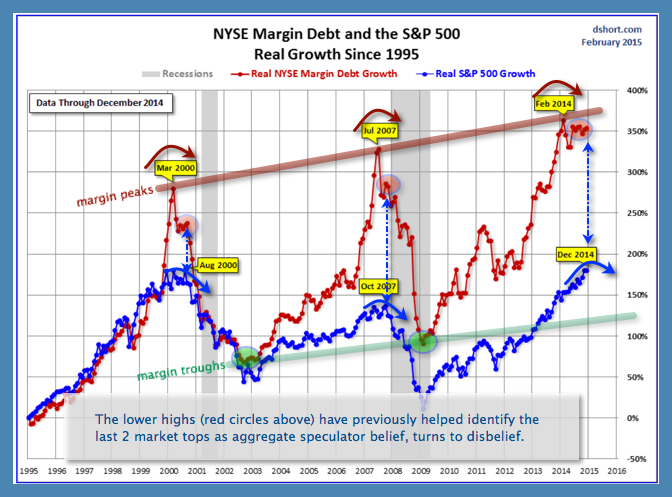
Total business inventoriesAt the same time, as shown below in red, reckless financial speculation on borrowed money (margin), that peaked in February 2014, has since been rolling over in the long overdue, yet inevitable, mean reversion that preceded the stock market collapse of both March 2000, July 2007, and every other speculative frenzy in market history.  There is no question the process has been elongated this time compared to other market tops.  Margin Feb 2015But as shown in blue at the bottom of the chart, the S&P 500–that has made no real (inflation-adjusted) gains since the tech peak in 2000 (when central bankers of the world went full nut bar promoting debt creation schemes)–is once more set up for (at least) a halving from here.  Sooner or later, facts must be faced, and mal-investment punished.

Posted in Main Page | Comments Off on A reality check on this Friday the 13th