
Assault on democracy: big banks controlling ‘journalists’

Peter Oborne is a proper journalist. He is the former chief political commentator of the Telegraph and reports for Channel 4’s Dispatches and Unreported World. He has written a number of books identifying the power structures that lurk behind political discourse, including The Triumph of the Political Class. He is a regular on BBC programmes, Any Questions and Question Time, and often presents Week in Westminster. He was voted Columnist of the Year at the Press Awards in 2013. He recently resigned from his position at the Telegraph, and yesterday went public to explain why.

Everyone who values democracy, fairness and civil society has to care that big banks have hijacked once trusted media outlets, both through ad revenue and outright ownership, and have been merrily spinning the content to serve their own best, and often illegal, interests.  See Oborne’s whole important article, Why I have resigned from the Telegraph:

After a lot of agony I have come to the conclusion that I have a duty to make all this public. There are two powerful reasons. The first concerns the future of the Telegraph under the Barclay Brothers. It might sound a pompous thing to say, but I believe the newspaper is a significant part of Britain’s civic architecture. It is the most important public voice of civilised, sceptical conservatism.

Telegraph readers are intelligent, sensible, well-informed people. They buy the newspaper because they feel that they can trust it. If advertising priorities are allowed to determine editorial judgments, how can readers continue to feel this trust? The Telegraph’s recent coverage of HSBC amounts to a form of fraud on its readers. It has been placing what it perceives to be the interests of a major international bank above its duty to bring the news to Telegraph readers. There is only one word to describe this situation: terrible. Imagine if the BBC—so often the object of Telegraph attack—had conducted itself in this way. The Telegraph would have been contemptuous. It would have insisted that heads should roll, and rightly so.

This brings me to a second and even more important point that bears not just on the fate of one newspaper but on public life as a whole. A free press is essential to a healthy democracy. There is a purpose to journalism, and it is not just to entertain. It is not to pander to political power, big corporations and rich men. Newspapers have what amounts in the end to a constitutional duty to tell their readers the truth.

It is not only the Telegraph that is at fault here. The past few years have seen the rise of shadowy executives who determine what truths can and what truths can’t be conveyed across the mainstream media…

From the start of 2013 onwards stories critical of HSBC were discouraged. HSBC suspended its advertising with the Telegraph. Its account, I have been told by an extremely well informed insider, was extremely valuable. HSBC, as one former Telegraph executive told me, is “the advertiser you literally cannot afford to offend”.

As you consume media from whatever platforms you do, it is critical to pay very close attention to who is sponsoring and advertising on the source. In most cases today, those same sponsors are heavily shaping the message. Responsible, independent journalism has been increasingly driven out of media. Just as the financial advice market has been mostly hijacked by the financial sales crowd. The outcome is predictably disastrous and a main reason why pensions, governments and individuals are massively underfunded and facing financial peril today.
Posted in Main Page | Comments Off on Assault on democracy: big banks controlling ‘journalists’

Dr copper diagnosis: global demand in poor health

Macroeconomic indicators of global demand and growth continue to pretty relentlessly tank week over week, and the 2015 earnings forecasts of S&P 500 companies (burgundy line bottom chart) are dropping along for the ride. This makes some sense.  Accounting gimmicks aside, nominal GDP and corporate revenue/sales have traditionally been reliably correlated.  After all, corporations can buy back their own shares to raise earnings for a while, but it’s much harder to fabricate sales and revenue in a world of falling demand.

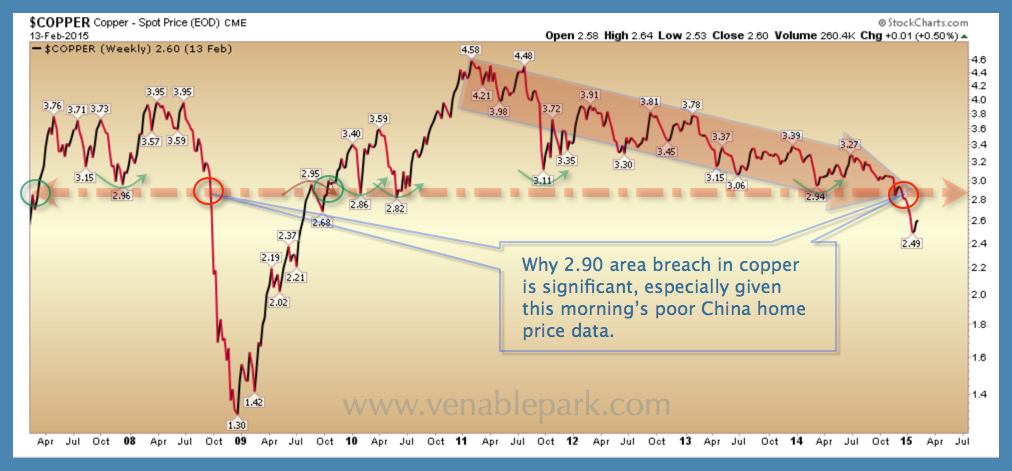
Another real world indicator, the price of copper has also offered an historically reliable read on global demand trends.  Since breaking below the 2.90 a pound level in December (dotted line below) which has proved key support in the past two market cycles, the diagnosis from Dr. copper:  global demand is weakening as it did moving into the Great Recession in 2008.

Copper Feb 17, 2015All of which makes still levitating large cap stocks, such as the S&P 500 (in green below), look positively suicidal.

US macro and S&P Feb 17 2015
Chart source: zerohedge.com

Posted in Main Page | Comments Off on Dr copper diagnosis: global demand in poor health

Impossible debt stifling Greece and consumers the world over

One of the greatest costs of the credit bubble that has enveloped the world the past 15 years is that it has allowed the price of most assets and services to skyrocket. In a sustainable equilibrium, available capital to fund investment comes from savings. But when as now, the banking system is flooded with credit on credit from a recklessly levered financial sector, for a time it makes capital plentiful and therefore less valuable.  Since less valuable, capital is rewarded with lower and lower yields.

Using borrowed money, more people have the ability to buy, and hence the price of most services and assets rises with the demand. Until finally we reach the end point of borrowing capacity, the end of debt service ability (ie., no matter how low rates are, repayment ability is ultimately finite because it is tethered to one’s available cash flow collected through sales or wages). At the end point, credit slows and the inevitable payback period exacts its pound of flesh:  years of reduced consumption courtesy of servicing costs, defaults, write-downs, bankruptcies and of course, mean reverting prices for assets and services. All of a sudden, reality reveals that few people actually have liquid savings, and hence few can afford to be buyers. And if at all, only at much lower prices.

A present example of these forces at work, is in post-secondary education. Education costs have skyrocketed because students have been able to access seemingly endless credit and so schools have been able to dramatically jack up costs and still find customers. But the end point of this ‘virtuous cycle’ seems to upon us. Students are increasingly already in debt by the time they reach college (car loans and credit cards) and then even after graduating, many are not able to earn enough to payback their loans and start a household–for years–as the debt weight of past consumption stifles new.

Student loans continue to pile up, now totaling $1.16 trillion in outstanding balances, one of the main reasons researchers have cited for the low levels home ownership among young adults. Here is a direct video link.

But it’s not just students or Greeks who are now suffering the paralyzing effects of impossible debt levels. It’s worldwide:

Despite widespread talk of “deleveraging” after a global credit bubble burst in 2008, the world continues to pile on more debt. According to a new study by McKinsey, the world ended last year some $57 trillion deeper in debt than it was in 2007.

The total tab—owed by governments, companies and households—is now more than twice the value of the world’s total economic output.

The biggest chunk of new borrowing since 2007—some $25 trillion—has come from governments going deeper into hock. Of the nearly 50 countries included in the analysis, only five—Argentina, Egypt, Israel, Romania and Saudi Arabia—have paid down some of their debt.

Posted in Main Page | Comments Off on Impossible debt stifling Greece and consumers the world over





