Gamblers who don’t expect to lose money

The trouble with being an equity investor today is that valuations make no sense.  For a current update see:  Market action suggests abrupt slowing in global economic activity. Here is the bottom line:

“With median valuations for the average stock higher now than in 2000 on the basis of price/revenue, price/earnings, and enterprise-value to EBITDA; with numerous historically reliable valuation measures more than double their pre-bubble historical norms; and with the S&P 500 now beyond the peak valuations of every market cycle on record (including 1929) except for the final quarters surrounding the 2000 bubble, understand that stocks are no longer an investment but a speculation.”

The facts are what they are and can’t be changed by hope or prayers.  So those buying and holding equities at current levels are doing so on some thesis over than ‘investing’.  Perhaps they believe that central bank interventions will succeed in perpetually maintaining animal spirits and lofty prices.  Perhaps they believe that big banks and HFT trading will maintain stocks at ‘permanently high plateaus’.

Whatever the thinking to justify participation, the activity is clearly gambling–betting on the luck of a win–not investing in assets that are valued for longer-term success.

Of course, it is widely known that– fleeting lucky runs notwithstanding–gambling is a losing game that eventually ends in capital destruction. But most gambling in equity markets today, are neither prepared nor expecting to lose money.  This is a multi-trillion dollar problem of mismatched speculative assets with real world expenses and liabilities that need to be paid.  This game cannot end well.

This 15 year chart of the NASDAQ composite since 2000, offers perspective on the rarefied bubble-highs today achieved for the second time in market history. Second time a charm or a nightmare? Depends on whether one is betting on permanent highs or mean reversion. We know which one the odds favour…
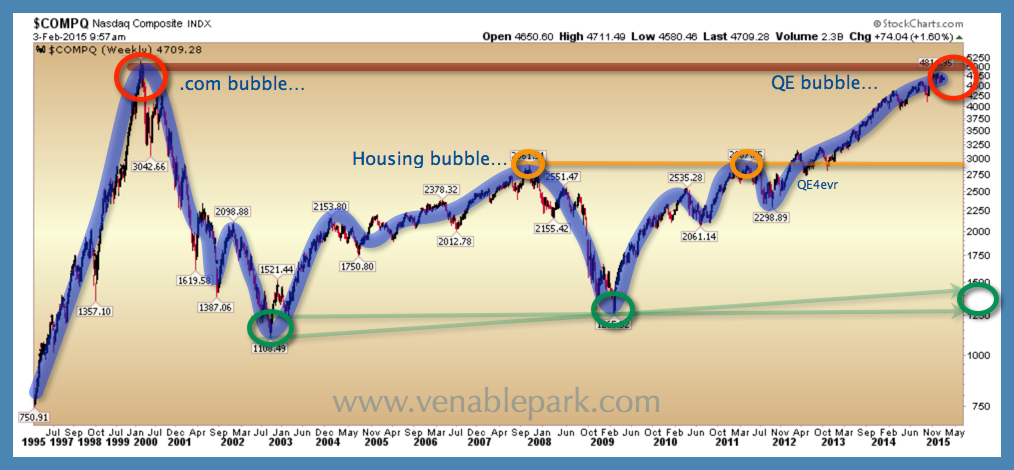
NASDAQ Feb 3 2015

Posted in Main Page | Comments Off on Gamblers who don’t expect to lose money

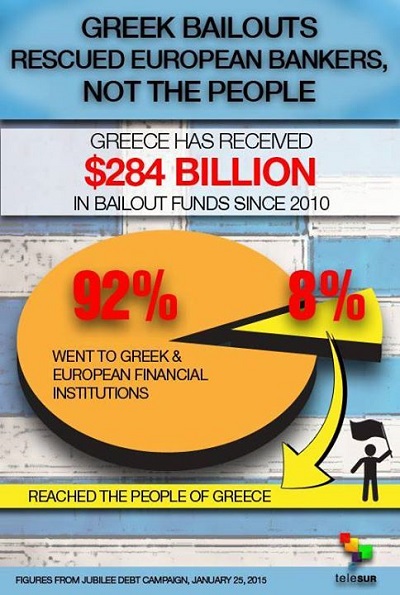
Ooops, the truth about Greek ‘bailouts’ is getting out

Don’t look now, but the bankers are losing control of the ‘Greeks are lazy spendthrifts’ narrative.   Excellent piece from Charlies Hugh Smith, see: Greece just blew up the Empire’s death star of debt:
greek-debt

Impaired debt and defaults result from imprudent underwriting and lender incompetence/ greed. Since when did it become accepted policy to reward imprudent lending, incompetence and greed?

Classical Capitalism is very clear on what should happen to lenders who ignored risk management; they get destroyed. As imprudently issued loans default, the losses pile up and the lender become insolvent. At that point, Capitalism kicks in and the management is fired, the stock goes to zero, the lender’s assets are auctioned off and the creditors are issued whatever remains after wages, taxes, accounts payable, etc. are paid.

There’s nothing complicated about it: Capitalism requires the discipline of losses being taken by those responsible, the firing of incompetents and the destruction of imprudent lenders….

Posted in Main Page | Comments Off on Ooops, the truth about Greek ‘bailouts’ is getting out

Healthy review of finance policies spreading

After more than a decade of extreme government and central bank interventions in financial markets and institutions all over the world, policies and actions are increasingly coming under a much needed scrutiny. This is a key step toward reigning in what has been a runaway finance sector and remind policy makers that their fiduciary duty as elected and appointed officials, is not owed to profit-maximizing banks, but to the taxpayers and citizens of the country.

The pendulum seems to be finally swinging back toward fiscal restraint, aversion to debt, and democratic accountability. Recent attention on the negotiations in Greece are one example. This interesting case in Canada, is another. See: The Canadian court case the mainstream media won’t cover.

In this recent case, Canadians sued the Bank of Canada and won. Here is a direct video link.

For more background on Canadian constitutional lawyer, Rocco Galati, who argued the case, see The Globe’s recent interview with him here: The lawyer who challenged the Harper Government and won.

Posted in Main Page | Comments Off on Healthy review of finance policies spreading