
Danielle was a guest today with Jim Goddard on Talk Digital Network talking about recent trends in the world economy and markets. You can listen to an audio clip of the segment here.
Follow






_________________________
Danielle was a guest today with Jim Goddard on Talk Digital Network talking about recent trends in the world economy and markets. You can listen to an audio clip of the segment here.
Investment banks have been instrumental in driving investor capital and leverage into the energy sector the past few years. For an excellent primer see: How Wall Street Drove the Oil & Gas Drilling Boom that’s Turning into a Disaster.
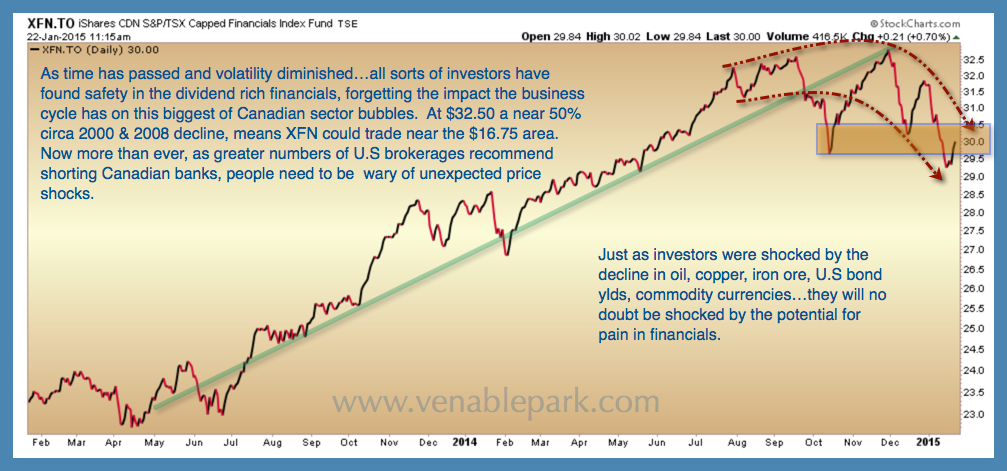
First it was the tech wreck in 2000, then it was the housing bust in 2007. Same players, similar tactics. Now the downside of all that reckless risk-selling looms large for over-indebted energy companies, but also for the banks (and their investors) who are holding toxic securities as prices plunge. This chart of the Canadian financial sector index (XFN) offers a glimpse of where the mean reversion cycle is so far. No doubt the losses compounding for bank investors will be just as violent and unexpected by the consensus intelligentsia, as the collapse in energy has been to date.
More ego-filled, empty promises and ‘good money after bad’ policies out of the ECB today. Starting in March, the Central Bank is planning to buy 60 billion euro ($70 billion) private and public bonds per month, until at least September 2016 which amounts to a total of €1.1 trillion. These are the same wrong-headed measures that have magnified financial risk and failed to ignite growth in other key economies like Japan and the US.
So long as the bankers who created the debt bubble are still in charge of monetary policy, then the world will continue to see more debt manipulation techniques rather than the necessary defaults and free market repricing needed to actually cleanse and reboot the system.
While algo machines trade stock futures higher on the news (so far), real economy barometers like lumber, crude and copper are weakening further. The US dollar and Treasuries are surging (sucking even more capital out of weaker economies). At the same time, QE cheerleaders are a shrinking pool. It is increasingly embarrassing for high profile commentators to speak in support of the debacle otherwise known as QE.
Former Bank of International Settlements Chief Economist, and current advisor to Angela Merkel, Bill White minced no words this week. See: Central bank prophet fears QE warfare pushing world financial system out of control.
“He said the global elastic has been stretched even further than it was in 2008 on the eve of the Great Recession. The excesses have reached almost every corner of the globe, and combined public/private debt is 20pc of GDP higher today. “We are holding a tiger by the tail,” he said.
He warned that QE in Europe is doomed to failure at this late stage and may instead draw the region into deeper difficulties. “Sovereign bond yields haven’t been so low since the ‘Black Plague’: how much more bang can you get for your buck?” he told The Telegraph before the World Economic Forum in Davos.
“QE is not going to help at all. Europe has far greater reliance than the US on small and medium-sized companies (SMEs) and they get their money from banks, not from the bond market”…
He deplores the rush to QE as an “unthinking fashion”. Those who argue that the US and the UK are growing faster than Europe because they carried out QE early are confusing “correlation with causality”. The Anglo-Saxon pioneers have yet to pay the price. “It ain’t over until the fat lady sings. There are serious side-effects building up and we don’t know what will happen when they try to reverse what they have done.”
The painful irony is that central banks may have brought about exactly what they most feared by trying to keep growth buoyant at all costs, he argues, and not allowing productivity gains to drive down prices gently as occurred in episodes of the 19th century. “They have created so much debt that they may have turned a good deflation into a bad deflation after all.”



