High yield bonds undermining stock jockey optimism

High yield bond prices historically trade in tandem with equity prices. Both are risky bets on the underlying corporations and market sentiment, at a given point in time. Contrary to the ‘long always’ prophets, the higher the price, the riskier and less attractive investments are to buy.

The chart below shows data from the St Louis Federal Reserve on the level of US Hi Yield spreads since 1996 (with Cory’s annotation) (ie., the extra yield that lower quality corporate bonds are paying holders when compared with similar dated government treasuries.)
Hi yield spreads widening Dec 2014Relevant is the fact that high yield spreads have gapped more than 5% above US Treasury yields, 4 times (pink boxes) in the past 18 years:  the Long Term Capital meltdown in 1998, the dot bomb implosion 2000-2003, the Great Financial Crisis  2007-2009, and the realization of a renewed global slowdown in 2011.  This fourth event spurred terrified central banks to throw every drop of liquidity and assurance they could muster at capital markets.  And as shown above, it worked for a while, as bond yields drifted lower again from late 2011 to mid- 2014.  Since then however, the trend is not encouraging.

Today back at 4.87%, high yield debt spreads are once more moving toward the 5% threshold that has marked the last 4 stock market shocks, when the revelation of capital loss woke deluded participants from complacent slumber.

Posted in Main Page | Comments Off on High yield bonds undermining stock jockey optimism

Debt defaults haunt lofty asset prices

The global theme continues to be that bad debts are compounding, particularly in previous ‘hot’ areas like energy companies, Venezuela and China, and this time around governments and central banks have insufficient reserves to back stop losses.

Slowing growth and plunging energy prices are putting pressure on heavily levered participants and priced for perfection assets.  Here is a direct video link.

Posted in Main Page | Comments Off on Debt defaults haunt lofty asset prices

Peak adviser optimism?

businessmansuccessarmsmi600-resize-600x338The most recent SEI Advisor Network survey reports that financial advisor optimism is at euphoric levels, with 96% either optimistic or excited about the year ahead.  85% say that they expect investment markets to be as good or better in 2015 than they have been in 2014.

See:  Advisors break out Champagne:  are bullish on 2015

Their much abused clients–not feeling quite so chipper:

“…the survey indicates that clients do not mirror their advisors’ level of enthusiasm. Nearly a quarter of advisors surveyed said their clients were generally more pessimistic and reactionary to market events than they were in 2013.

Perhaps that wall of worry is harder for ordinary investors to climb than advisors whose primary incomes derive from the ascent.

Indeed, in line with rising market expectations, advisors surveyed expected their own businesses to expand in 2015, with 72% expecting growth over 5% and a third of advisors anticipating very large expansion in the 10 to 15% range.

But handling that growth aroused greater anxiety among the otherwise upbeat group of respondents, with close to 40% identifying finding the right client as their biggest challenge.”

Good to see that the advising community remains most worried about growing their own fees and not silly things like how to protect their clients from life-changing capital losses… Of course, they do have a perfect record of being supremely bullish when assets are perilously over-priced and hopelessly bearish after prices have retraced to the most attractive levels.

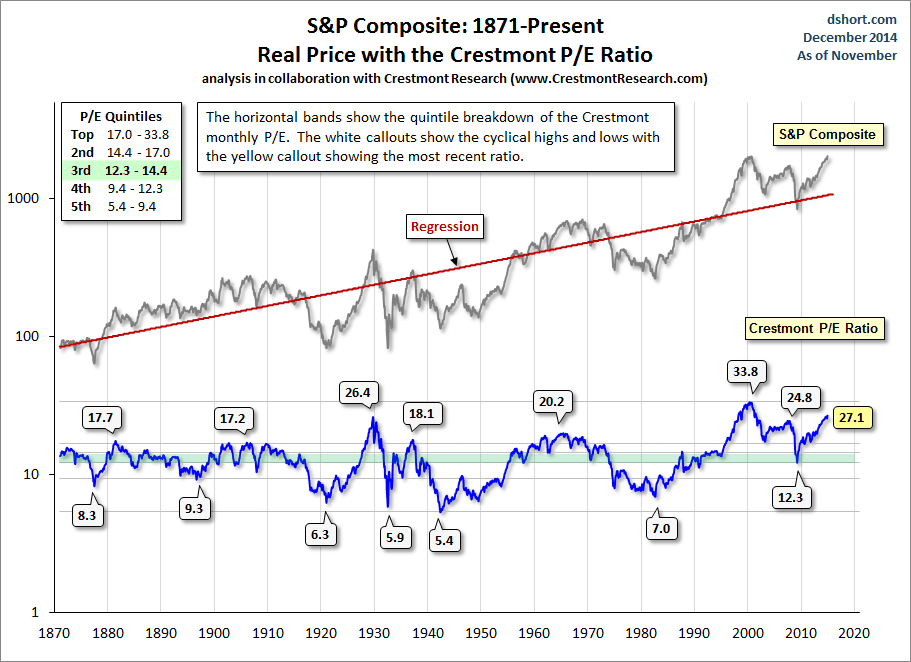
And as shown in the following chart, broad market stock valuations have only been less attractive and more perilous for holders once before in human history, and that was for a brief period in 2000 as the tech bubble collapsed.  Yup, capital risk is higher today than just before the Great Crash of 1929.  No wonder advisors are feeling so giddy!

Crestmont-PE-with-SP-Composite

Posted in Main Page | Comments Off on Peak adviser optimism?