
Cyclical destiny calls to ‘conservative’ laggards

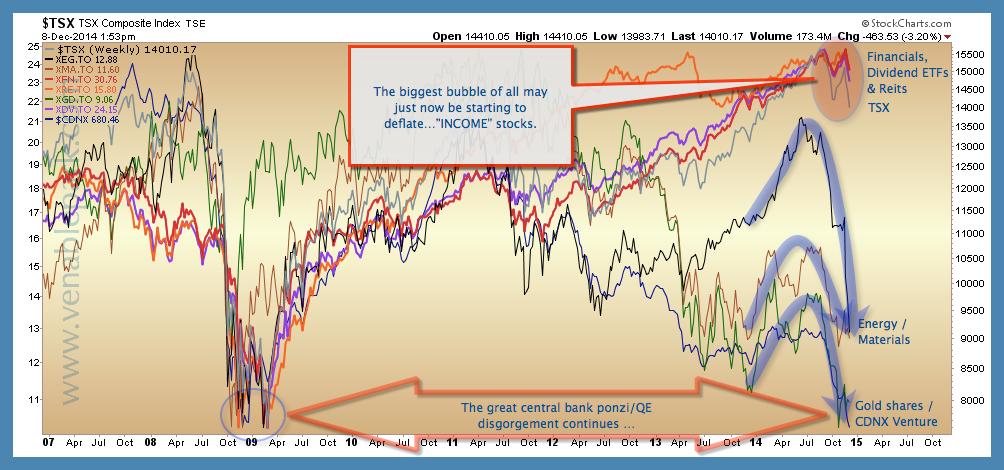
Points of reference to ponder:  the energy (21.6% weight) and finance (36% weight) sectors account for a combined 57% of the broad market TSX composite today.  Even with significant declines since June, the energy sector index still has a further 24%, and the financial sector index some 67% (which includes 90% of income trusts/REITS), of downside before returning to their 2009 cycle lows (see top lines on far right of chart below).  If you think that seems impossible, then you don’t appreciate the range bound dynamics that create market cycles within secular bears.

Having these 2 dominant sectors recouple with other key economic sectors that have already retraced near their 2009 lows, would knock the broad market TSX 29% lower –so from current 14000 to the 9900 range.  And that’s without any commensurate declines in other so called ‘conservative’ sectors like health care, utilities, consumer discretionary, telecom etc.  When likely weakness in these other areas is added, a retest of the 8000 area becomes quite plausible for the TSX before this full cycle completes.
TSX internals updateA similar magnitude decline for the correlated S&P 500 also makes cyclical sense–so greater than a 50% decline from present levels.  Sectors and broad markets often lag one another, but historically ‘decoupling’ is a finance myth.


Posted in Main Page | Comments Off on Cyclical destiny calls to ‘conservative’ laggards

A sober look at energy and finance-dependent TSX

As we have written frequently in the past, the Canadian stock market is precariously concentrated in its over-valued energy and finance sectors today. With both in a much deserved mean reversion phase, the TSX has completed a rapid round trip back to levels first achieved in early 2007–when the world actually believed commodity producers were invincible and Canadian banks were genius.  Goodness how things have changed.

Off 3% so far today, the TSX is now below the rebound peak it achieved in 2011 when some actually believed that central banks and ‘QE’ could paper over the world’s debt problems.  As reckless leverage and naive optimism recede, the truth is that the TSX may well have a difficult time holding at the QE-4ver uptrend (green below) that began in 2012.

TSX Dec 8 2014 If price support fails there, then a retest of the 2012 lows in the 11,200 to 11,500 level (shown at lower purple band), before QE-4evr beliefs began, seems a likely next test.

Posted in Main Page | Comments Off on A sober look at energy and finance-dependent TSX

Giving to get and building value: what extractive thinkers miss

Extending the dialogue from James Montier’s excellent article discussed here last week, The world’s dumbest idea., we reference the inspiring story of SAS as a worthy corporate leader that has built extraordinary value for all its stakeholders: customers, employees and their families/communities/taxpayers, and owners/shareholders–in that order.

It matters how we make money. The lure of quick bucks is the antithesis of long term value and strength. And yet it is the extractive, quick-bucks-and-then-destruct model that is widely recommended by investment bankers and their advisers all over the world. Time to value better leaders and behaviors.

“People want a life with money, not money and no life.” Jack Poll, a 28-year SAS employee and director of recreation and employee services. See: How SAS became the world’s best place to work

“If it’s crossed your mind that how SAS manages is blatantly obvious on its effects to inspire human performance in the workplace, you likely are wondering why more organizations don’t get on board. A big part of the reason, it seems, is because SAS has an advantage that many Fortune 500 companies do not. It’s a privately held company and not influenced by the short-term objectives of shareholders.

But what Wall Street, and all of corporate America, should realize, is that SAS has proven the effects of a far more abundant leadership model—one that greatly rewards all constituents. Employees are made happier, more engaged, and produce exceptional work. Customers are more loyal because products have fewer bugs, and their contacts at the firm rarely change. But company ownership is, perhaps, the most richly rewarded. According to Forbes, Goodnight is now the 47th richest man in America, with an estimated net worth of $7.3 billion.”

Similar principles are at work in Costco, see: Unselfishness- the world’s most ethical company and why collaboration works.

All of which stands in stark contrast to the culture of investment banking which has dominated and misdirected so much of the free world over the past 30 years. See: Business culture in banking industry favors dishonest behavior, study shows.

Posted in Main Page | Comments Off on Giving to get and building value: what extractive thinkers miss




