
Giving to get and building value: what extractive thinkers miss

Extending the dialogue from James Montier’s excellent article discussed here last week, The world’s dumbest idea., we reference the inspiring story of SAS as a worthy corporate leader that has built extraordinary value for all its stakeholders: customers, employees and their families/communities/taxpayers, and owners/shareholders–in that order.

It matters how we make money. The lure of quick bucks is the antithesis of long term value and strength. And yet it is the extractive, quick-bucks-and-then-destruct model that is widely recommended by investment bankers and their advisers all over the world. Time to value better leaders and behaviors.

“People want a life with money, not money and no life.” Jack Poll, a 28-year SAS employee and director of recreation and employee services. See: How SAS became the world’s best place to work

“If it’s crossed your mind that how SAS manages is blatantly obvious on its effects to inspire human performance in the workplace, you likely are wondering why more organizations don’t get on board. A big part of the reason, it seems, is because SAS has an advantage that many Fortune 500 companies do not. It’s a privately held company and not influenced by the short-term objectives of shareholders.

But what Wall Street, and all of corporate America, should realize, is that SAS has proven the effects of a far more abundant leadership model—one that greatly rewards all constituents. Employees are made happier, more engaged, and produce exceptional work. Customers are more loyal because products have fewer bugs, and their contacts at the firm rarely change. But company ownership is, perhaps, the most richly rewarded. According to Forbes, Goodnight is now the 47th richest man in America, with an estimated net worth of $7.3 billion.”

Similar principles are at work in Costco, see: Unselfishness- the world’s most ethical company and why collaboration works.

All of which stands in stark contrast to the culture of investment banking which has dominated and misdirected so much of the free world over the past 30 years. See: Business culture in banking industry favors dishonest behavior, study shows.

Posted in Main Page | Comments Off on Giving to get and building value: what extractive thinkers miss

Market internals giving up on the QE dream

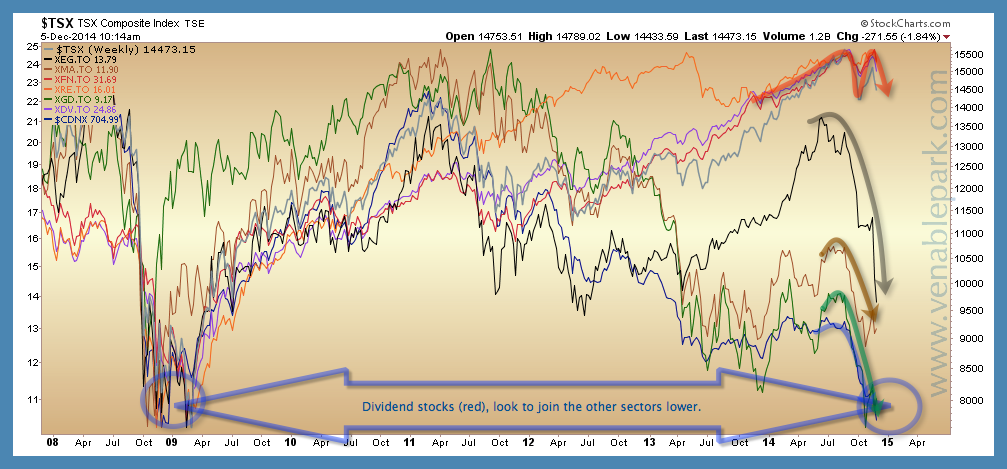
Energy investors have found themselves in a nightmare the past few months (black arrow below). It is the same nightmare that materials and mining investors (green, blue and brown arrows) have been living through since 2011 as global demand turned down, excess supply piled up and earnings evaporated.

Now the same nightmare is stalking the last late cycle sectors left hovering at hideous valuations: dividend paying (purple), REITs (orange) and financials (red lines shown below). As these sectors also finally give up on the dream that QE could prop up a sagging economy, the 2009 lows beckon prices, and the broad market TSX (grey line,) back to reality.

TSX internals Dec 5 2014

Posted in Main Page | Comments Off on Market internals giving up on the QE dream

Must read: The World’s Dumbest Idea

GMO’s James Montier slays the ‘shareholder value maximization’ (SVM) nonsense that is widely regurgitated as incontrovertible principles of finance today.

In 14 easy to read pages and charts, Montier examines the shift in corporate culture from an ‘era of managerialism’ (1940-1990) where businesses strove to serve customers, employees and communities and in so doing, build long-term value that delivered a ‘fair return’ to investors, to the present area of SVM (1990-2014) where companies follow the fallacious and destructive belief that they have a dominant duty to shareholders first, and that this duty is best served by increasing share prices as quickly as possible. He goes on to demonstrate that this short-term, extractive mentality has led to reckless use of debt and obscene executive compensation levels, as management has become largely paid with stock and options (especially in finance) while degrading the strength and stability of the host companies, the workforce and the economy itself.

Brilliantly and concisely presented. A must read, must understand. See: The World’s Dumbest Idea

Time to circle back to smarter incentives and practices focused on building long term, sustainable value for all stakeholders: customers, employees, taxpayers and investors–in that order.

Posted in Main Page | Comments Off on Must read: The World’s Dumbest Idea




