Oil catching down to global demand

West Texas Crude is today flirting with $80 a barrel, down 10% year to date, 24% since the QE-rebound into 2011 and 45% since the bubble mania of 2008.  Oil cos are taking a much deserved drubbing in the process (chart to left).

Oil down and supply up Oct 2014Global oil supply continues to overwhelm demand as technology advancements have bumped US production to levels not seen since the 1980’s.  Here’s a stat:  since 2004, U.S. oil production increased 56% while U.S. demand for gas and other fuels fell 8%.  See:  Global oil glut sends prices plunging.

The host of new tech-savvy competitors, brings increased competition to pricing that was previously ‘controlled’ by the OPEC cartel (mainly the Saudis).

Break-even pricing for many US shale producers is said to be in the $80 to $85 a barrel range, so at present prices, projects are quickly becoming uneconomic.  In the bigger picture it also presents fiscal problems for many exporters whose budgets have been based on higher prices to sustain their expenditures.

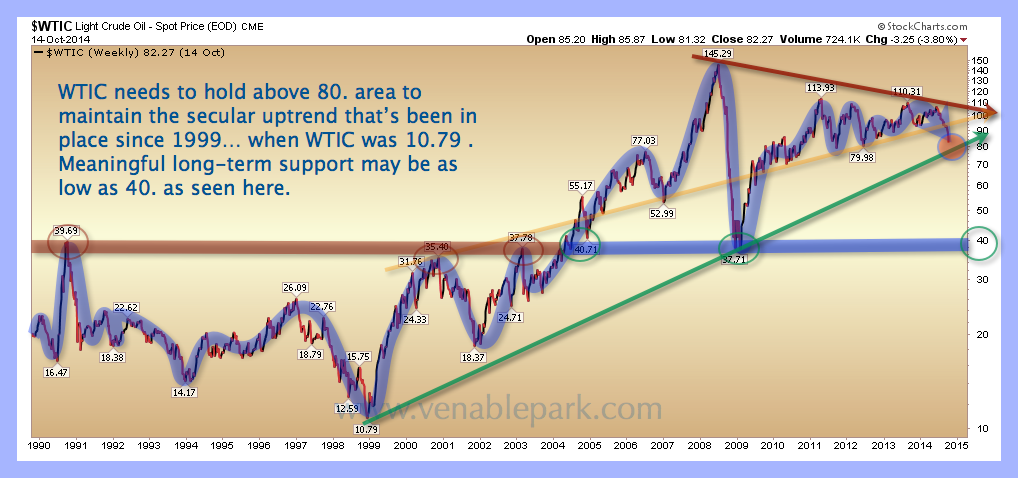
In previous recessions, as prices fell, the Saudis announced production cuts to help support pricing.  This time there is talk of their plan to maintain production in the hopes that falling prices will serve to wipe out some of the more recent global competitors and restore OPEC power in the longer run.  As the chart below shows, a decline below $80 for WTIC, would be a breach of the secular up trend that has held since 1999.  If the secular trend is broken, a decline to long-term support in the $40 a barrel range would be within the realm of technical probabilities.

On the fundamental side, we think that falling demand as the global economy again recesses, along with excess inventory and the proliferation of alternatives and more efficient energy usage, are all reasons for the secular bull that began for oil in 1999 to now end.WTIC Oct 14 2014
On the upside, the next economic ‘recovery’ is likely to be less about monetary tricks out of central banks and more about consumers finally rebuilding their personal balance sheets through increased savings and lower spending.  Lower energy prices will help households cut expenses as they continue to pay down debt.
Posted in Main Page | Comments Off on Oil catching down to global demand

Venture exchange signalling next global recession?

The resource-based Canadian Venture Index is today down another 2%.  Around 807, the index has taken out its previous 2013 low with no support now left between present levels and the 639 and 678 recession lows reached in 2001 and 2008.

This decline is what we thought was probable as the resource sector completed a secular peak in 2008/11 and has been mean-reverting ever since back to the lows from which the great consumer credit/China/commodity boom began in 2000.  I explained the factors driving all of this in this presentation I gave in January 2013, which is available here.

Financial analysis and risk management, in real time, are more art than a precise science. It takes a multitude of disciplines and humility to do the job well, and predicting exact turning points is highly unlikely. But if one can get general themes right and avoid losses, we have a good chance of protecting and growing capital over full market cycles no matter how treacherous the conditions may be. In doing so, we can end up miles ahead of the herd-following masses.

As I review this presentation today, the break down in general stock markets took about a full year longer than we thought likely. And the wait has been tedious. But the delay only means the downside is now likely to be all that much deeper.

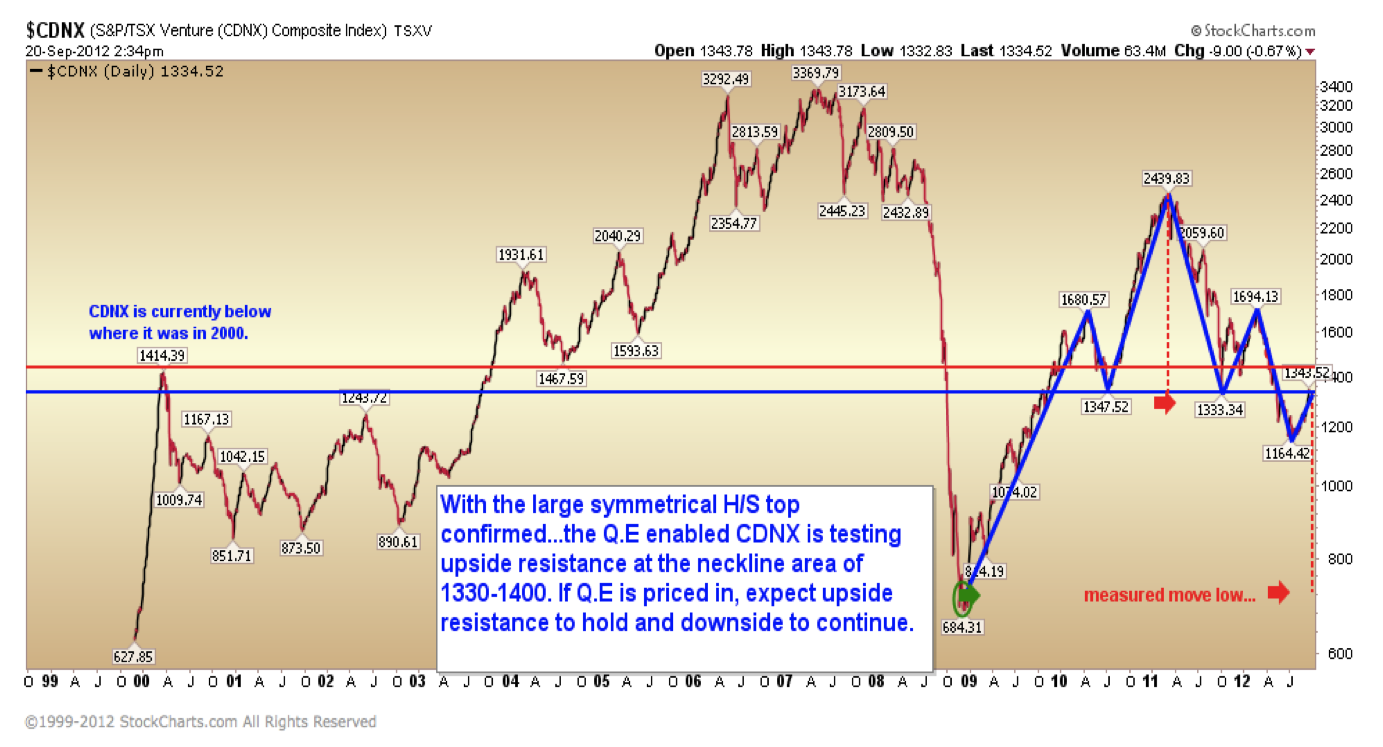
Here is a September 2012 version of my partner Cory’s secular chart of the Canadian Venture exchange that I refer to in the presentation. He noted the previous secular lows as the next cyclical test marked in red on the far right bottom. The question is will the resource sector hold here, or does full mean reversion require a move below prior support. Ironically QE mania and the capital misallocations it encouraged over the past 2 years, now make that scenario more likely.  Same goes for the lagging broad market stock indices.

Venture 2012 secular view

Posted in Main Page | Comments Off on Venture exchange signalling next global recession?

Correcting from the consumer credit/commodities bubble

Today the Canadian dollar continues to tumble, now down 16% from its QE-driven rebound peak in July 2011. At the same time, the Canadian stock market has officially delivered its first 10% ‘correction’ in 3 years. Foreigners who flooded into Canadian assets in search of relative fiscal strength following the 2008 recession, are not enjoying the mean reversion as their capital continues to fall. A migration toward the exits from Canada and other commodity-centric nations like Australia and New Zealand seems likely to continue this cycle. In fact we see many reasons to suggest that deflationary trends may be just getting started.

North American bonds seem to agree. As shown in this updated chart of the US 10-year Treasury yield, those believing that lax monetary policy would jump-start global growth and inflation seem to be losing the argument with those who have said paralyzing debt levels, aging demographics and commodity over-investment the past few years would lead to weak demand and asset deflation.
Deflation Oct 14 2014

Posted in Main Page | Comments Off on Correcting from the consumer credit/commodities bubble