
Venture exchange signalling next global recession?

The resource-based Canadian Venture Index is today down another 2%.  Around 807, the index has taken out its previous 2013 low with no support now left between present levels and the 639 and 678 recession lows reached in 2001 and 2008.

This decline is what we thought was probable as the resource sector completed a secular peak in 2008/11 and has been mean-reverting ever since back to the lows from which the great consumer credit/China/commodity boom began in 2000.  I explained the factors driving all of this in this presentation I gave in January 2013, which is available here.

Financial analysis and risk management, in real time, are more art than a precise science. It takes a multitude of disciplines and humility to do the job well, and predicting exact turning points is highly unlikely. But if one can get general themes right and avoid losses, we have a good chance of protecting and growing capital over full market cycles no matter how treacherous the conditions may be. In doing so, we can end up miles ahead of the herd-following masses.

As I review this presentation today, the break down in general stock markets took about a full year longer than we thought likely. And the wait has been tedious. But the delay only means the downside is now likely to be all that much deeper.

Here is a September 2012 version of my partner Cory’s secular chart of the Canadian Venture exchange that I refer to in the presentation. He noted the previous secular lows as the next cyclical test marked in red on the far right bottom. The question is will the resource sector hold here, or does full mean reversion require a move below prior support. Ironically QE mania and the capital misallocations it encouraged over the past 2 years, now make that scenario more likely.  Same goes for the lagging broad market stock indices.
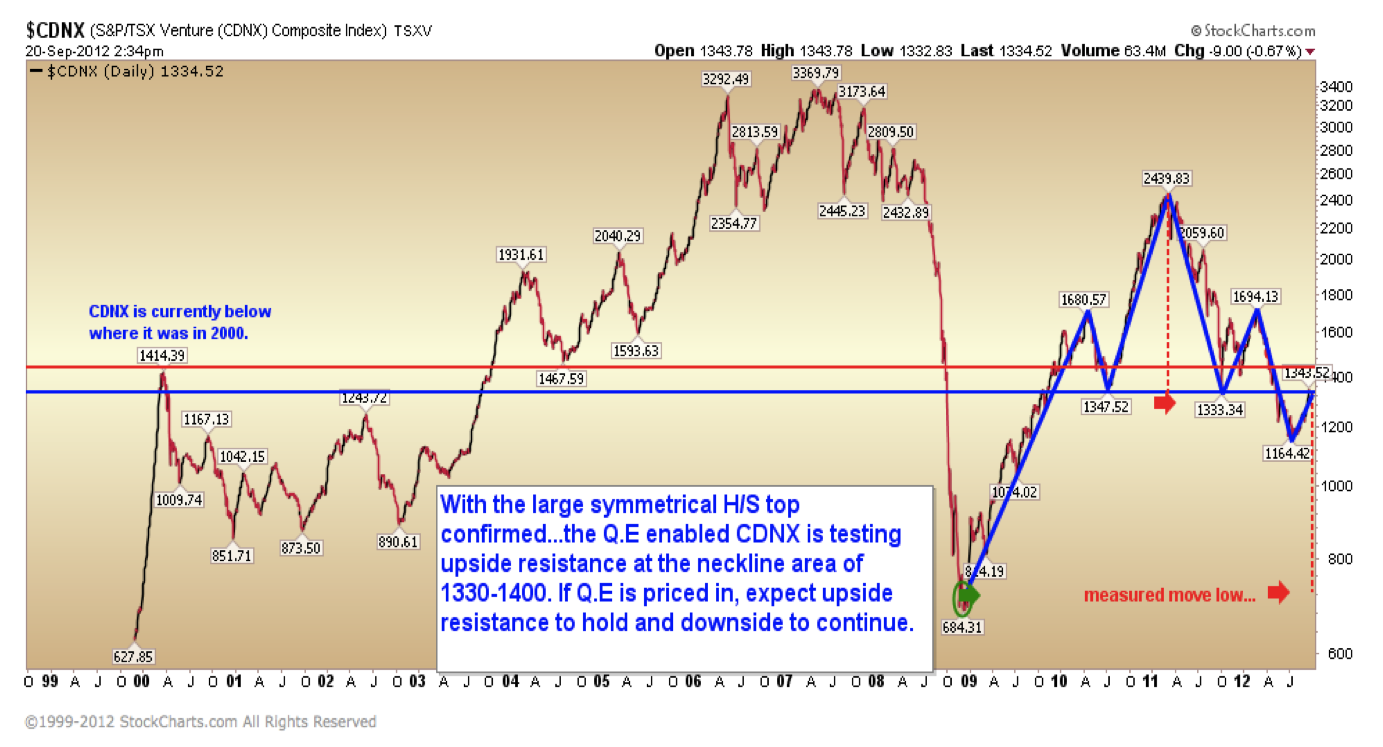
Venture 2012 secular view

Posted in Main Page | Comments Off on Venture exchange signalling next global recession?

Correcting from the consumer credit/commodities bubble

Today the Canadian dollar continues to tumble, now down 16% from its QE-driven rebound peak in July 2011. At the same time, the Canadian stock market has officially delivered its first 10% ‘correction’ in 3 years. Foreigners who flooded into Canadian assets in search of relative fiscal strength following the 2008 recession, are not enjoying the mean reversion as their capital continues to fall. A migration toward the exits from Canada and other commodity-centric nations like Australia and New Zealand seems likely to continue this cycle. In fact we see many reasons to suggest that deflationary trends may be just getting started.

North American bonds seem to agree. As shown in this updated chart of the US 10-year Treasury yield, those believing that lax monetary policy would jump-start global growth and inflation seem to be losing the argument with those who have said paralyzing debt levels, aging demographics and commodity over-investment the past few years would lead to weak demand and asset deflation.
Deflation Oct 14 2014

Posted in Main Page | Comments Off on Correcting from the consumer credit/commodities bubble

Canadian housing: desperately seeking ‘greater fools’

My family have started playing a car game as we drive around. When we drive past new property listings we each take a price guess while one of the passengers looks up the listing to name the winner. Even with an informed understanding of location and features we often under-estimate current asking prices by 20% or more. Even an hour north of Toronto, the most basic houses with a single car garage and 2 bathrooms are routinely listed in the $500 to 800K range. Those in older neighborhoods, that have been renovated, are commonly north of 1m. We have seen this movie in other countries the past 8 years and the outcome has always been eventual mean reversion of -25%+…Toronto’s condo market seems to be at the leading edge of ‘greater fools’:

“While Toronto’s housing boom rolls on, some of the housing itself is falling apart.

Canada’s biggest city has more than 100,000 units under construction as developers and investors seek to cash in on condo prices that are up 25.7 percent in the city over the past five years. The trouble is, many buildings are so poorly constructed that some residents fear that the money-spinners of today could become the slums of the future.”

Read more here: Canada condo boom rolls on as buildings fall apart

At the same time, U.S. luxury home builder Toll Brothers CEO Douglas Yearley, says his company considered expanding into Toronto’s condo market but was scared off by the high number of investors buying real estate in the city: 60 to 70% of condo buyers in a Toronto survey said that they didn’t plan to live in their homes: “We saw a lot of people buying with no intention of living there – they just planned to flip,” Mr. Yearley said. “When you have a lot of flippers, that’s when a bubble comes.” See:  ‘Flippers’ and bubble fears.

Posted in Main Page | Comments Off on Canadian housing: desperately seeking ‘greater fools’





