Reckless derivative speculation still backed by public purse

When we don’t learn, we are doomed to keep suffering…the investment banks are still backed by the public purse today and are now bigger and bolder in concentrated risk bets than ever before.

“In the past five years, the firm that took the largest U.S. bank bailout of the financial crisis increased the total amount of derivatives on its books by 69 percent, surpassing most U.S. peers and closing the gap with the market leader, JPMorgan Chase & Co. (JPM) At the end of June, Citigroup had $62 trillion of open contracts, up from $37 trillion in June 2009, company filings show. JPMorgan trimmed its holdings 14 percent to $68 trillion.

Citigroup is expanding as regulators try to rein in instruments that helped fuel the 2008 credit contraction. The third-largest U.S. lender has amassed the largest stockpile of interest-rate swaps, a type of derivative that can swing in value when central banks raise rates. More than 92 percent of the bank’s derivatives don’t trade on exchanges, making it harder for regulators to spot dangers in the market.”

See: Citigroup embraces derivatives as deals soar after crisis
Posted in Main Page | Comments Off on Reckless derivative speculation still backed by public purse

Scotland referendum: inside the Yes camp

The National travels in Scotland to get the pulse of the independence movement just a few days ahead of a historic vote to determine the country’s future course.

Those pushing for a Yes vote in Thursday’s referendum are motivated by a variety of reasons, she finds, and they are getting their message across in a number of creative ways.Here is a direct video link.


One overwhelmingly positive bonus of a “yes” win is that many of the financial rats that extorted billions in taxpayer bailouts over the past 6 years have promised to flee leave the country if Scotland secedes: “Royal Bank of Scotland, Lloyds of London and several other banks have already signaled they plan to move their headquarters if Scotland votes for independence.” Decentralized power is harder for bankers to control.

Posted in Main Page | Comments Off on Scotland referendum: inside the Yes camp

IMF warns investors taking “excessive risks” in markets

First we had the OECD warn on Monday that current market bullishness appeared “at odds” with the “intensification of several significant risks.”

This morning we have the International Monetary fund, the world’s watchdog for financial and economic stability, warning that the global economy faces a growing risk from highly levered financial market bets that could “abruptly” unravel on geopolitical disruptions or a shift in U.S. interest rate policy. (So a shift like the +450% increase in policy rates that the US Fed sees themselves making in the next 12 months?) See: IMF warns: investors are taking excessive risk in the markets

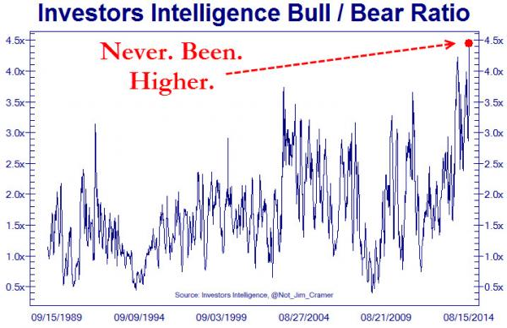
And yet, the number of financial ‘experts’ voicing concerns has never been lower. As shown below, there are far more bulls today than at the suicidal market peaks of 2007 or 2000. (For important perspective, note below how few bulls there were at the cyclical market bottoms in 2002 and 2009 when investment opportunities were the most attractive in decades).

Investor intelligence

The internet and multinational financial and media conglomerates have made for unprecedented global consensus building behind misguided beliefs around central bank powers and economic strategies today. The heads of all the major central banks and financial conglomerates went to the same schools and worked at the same sell side firms before moving into present positions of influence and leadership. Not surprisingly then, they have recommended and implemented the same disastrous policies and ideas all over the planet. This has made the scope and scale of the present financial bubble and coming bust, the largest and most devastating the world has ever faced to date. At the same time, for individuals who are in their later working years or retirement, the room for error has never been lower and the capital too lose never higher.

Posted in Main Page | Comments Off on IMF warns investors taking “excessive risks” in markets