Precious metals retracing on rising U$

From bubble-mania pricing in the summer of 2011, silver and gold have continued their mean reversion tumble as the US dollar has strengthened against all (well nearly all) forecasts.

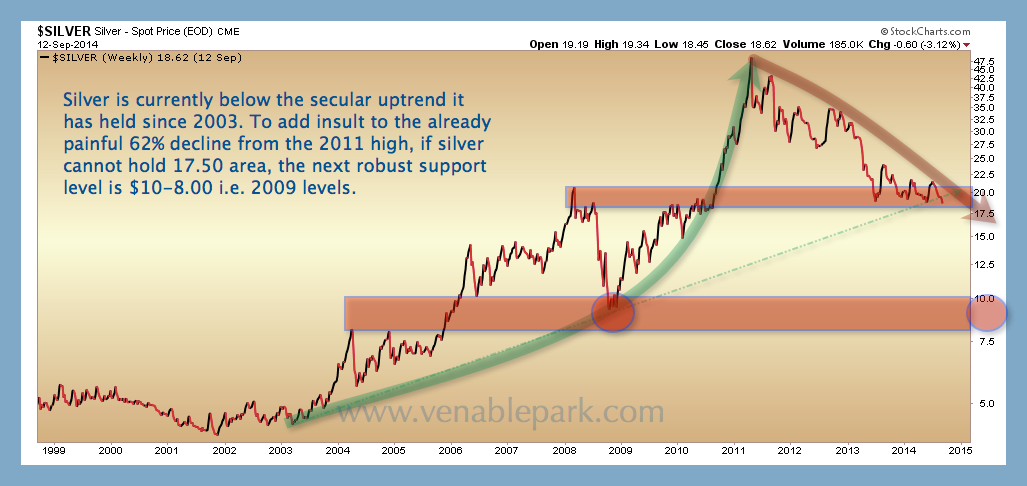
The following big picture charts of silver and then gold offer a glimpse of where secular support for each now lies.  After already falling 62% since 2011, silver could revisit the $8 to $10 range it held in the multi-asset meltdown of 2009.

Silver Sept 12 2014. png

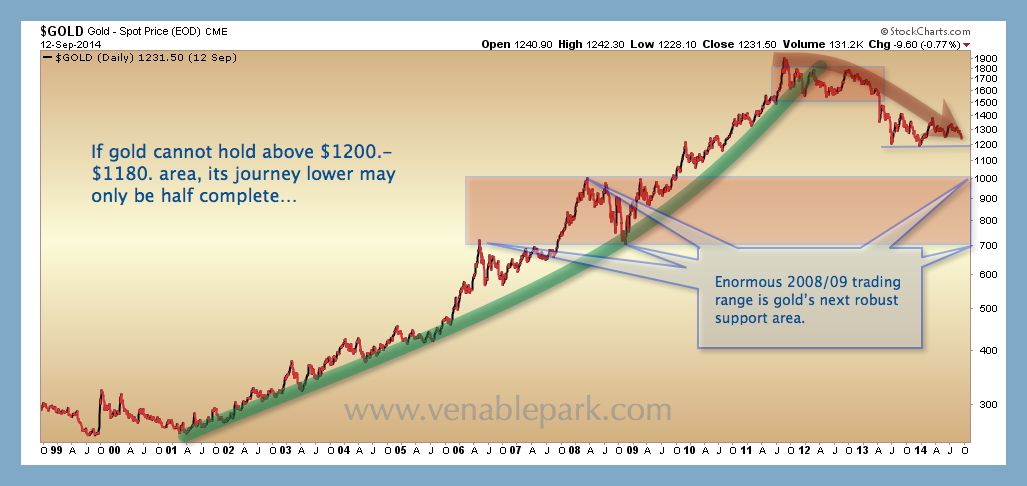
For gold, already down 35%, secular support range remains the $700 to $1000 range.
Gold Sept 12 2014

If prices can hold there, some value may present for longer-term investors. If not, then lower lows are likely to sicken even the most passionate believers. If previous historic, speculative episodes prove a guide, precious metals may disappoint for several years more to come.

Posted in Main Page | Comments Off on Precious metals retracing on rising U$

Financial unions and the debt chains that bind

The Scottish vote for independence this week can go either way, the polls are too close to call. But after the global debt bubble of 1996 to 2014, it makes perfect sense that people all over the world are today considering ways to reorganize and deconstruct into more independent fiscal arrangements– to cut the debt chains that have increasingly come to bind.

The trouble with larger groups is that they tend to move away from individual accountability and self-governance in favor of a few leaders and a majority of followers. This can work sometimes, for a while, where leaders are self-sacrificing, fiduciary and wise. It works very badly where they are not. It also tends to gradually emaciate the strength and self-control of followers. Case in point is the past decade of worldwide abdication of individual discipline in favor of collective debt, leverage and faith in the prestidigitation of bankers, accountants, big business and ‘high’ finance. Individuals have been complicit: they want to believe in an easy road to riches. Politicians and academics have been purchased to serve the cause. Layers of complexity have enabled deceit and extraction by a few amid the complacency of many.

As in corporate mergers, the coming together of disparate cultures can sound progressive and exciting: Greater efficiencies! More revenue! And yet, hundreds of studies attest that the overwhelming majority of corporate mergers fail in the end. By the time they do, the architects and executives who instigated them have usually cashed out and long gone.

The European Union sounded like a good idea on the surface: a united Europe was said less likely to war. Most of all a common currency made it easier for EU countries, companies, and households to borrow and spend. And they did both more than ever before. For a while those countries selling the most exports were delighted with the broader customer base. Germany profited handsomely. Those who collected up front on transaction volume made off like bandits. As debt levels soared, bankers extracted fortunes packaging debt and moving it “off book” into derivative products so that borrowers could borrow beyond reason. And they did. When the US consumer credit bubble inevitably burst in 2007, the great global unraveling began.

Since then governments around the world have been stepping in to absorb bad assets in exchange for commitments of fresh cash taken from taxpayer-co-signed lines of credit. This bought some more time for bad behavior and the past 6 years of continued self-destructive habits. It also spent future cash flow on past and present funding, leaving escalating deficits now and ahead.

In this next phase, the masses are becoming increasingly aware that the public purse has been decimated. As in divorce, the focus will now be on cutting the financial chains that had bound individual countries into union.

As Bank of England head Mark Carney warned last week, the case for a common currency is extremely weak where no sovereign union exists. Imagine being on the hook for your neighbor’s financial choices, with no power to direct them. In an effort to scare Scottish separatists, Carney admitted what his fellow banking colleagues had long denied: 15 years after the EU merger, their monetary union was always doomed.

During boom times, mergers are all the rage. In the give back phase, excesses are revealed, debt is abhorred and retrenchment predictable. Whatever the outcome in Scotland this week, the push to decentralize governments and untangle balance sheets has likely just begun. With global debt levels now tens of trillions higher than when the 2008 crisis first erupted into the light of day, more nations are likely to want their names removed from the shared credit facility of a common currency. While the process will be messy, the move back to personal accountability and financial self-governance is a necessary evolution in this healing process.

Posted in Main Page | Comments Off on Financial unions and the debt chains that bind

The big picture on low rates

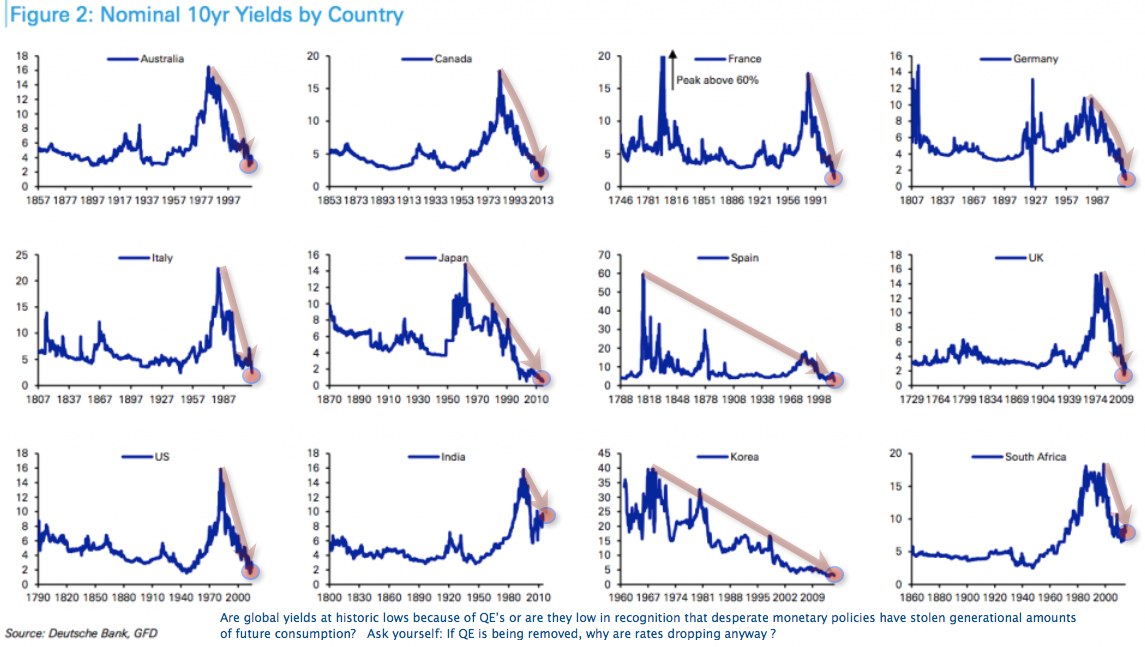
We know that we are living through an era of the lowest interest rates in our life time. But beyond that it is hard for most to get perspective on how the current rate environment compares with the past couple of centuries. The chart below offers help as it plots nominal 10-year treasury yields for 12 of the world’s largest economies for the past 200+ years. (click on picture for larger view)

Global yields big picture

What stands out is the fact that rates peaked in the western world in the early 1980’s as the bulk of the baby boomer generation (born 1946 to 1964) moved through their peak household formation and spending years. Where their parents had rented and lived with relatives to get started without debt, the baby boomers were inclined to borrow money to consume and spend faster. Like introducing steroids to previously natural cells, the magnified spending power of this massive population cohort initially drove demand for housing and goods to a previously unimaginable level. It also drove up the price of money (interest rates) in the process into 1980.

But once the bulk of the boomers were established with homes and cars and collectibles, demand for money began to fall, driving down inflation and interest rates for the next 30 years and counting. At the same time, falling rates made financed goods continually more affordable for everyone from students to boomers and pensioners. Modern finance, multinational corporations and technology all rose to the opportunity to create more and more complex ‘derivative’ debt products which allowed more people to consume more on debt than at any other time in human history. It seemed like a miracle stimulant for insatiable growth for a long time. But debt is future consumption denied and so each boom year left less demand ahead. By 2006 household consumption literally became paralyzed by its debt and demand plunged all over the world. The debt miracle had run into its inevitable demise.

Over the past 6 years, yearning for the boom years, central banks and governments have tried to restart another consumption frenzy by adding more leverage and more taxpayer-funded cash into the financial system. But their debt rescue boat has punctured leaks in itself. Now not just households, but governments and corporations too are stagnating in the debt and the slow growth era we have purchased in the process.

Interest rates have settled back to historic lows today not because of QE or other ‘free’ money policies, but because the free money elixir has run to the end of its efficacy. No one wants to borrow money, we are sick on debt. And the wealthiest consumers are now old and wanting to downsize. The world is awash in more non-productive goods than we can use. And those who are not, lack the discretionary income to buy them.

This suggests a few more years of weak demand, disinflation, deflation and low rates to come, as debt is slowly written off, paid down and moved out of our systems.

Posted in Main Page | Comments Off on The big picture on low rates