The deforming effects of zero rates

As Germany auctions 2 year bonds today with a negative yield, and the media counts down the seconds to the next pronouncement from central bank oracles, this article on the deforming effects of ‘free’ money policies is worth reading, see: Power of zero rates to distort markets should worry central bankers. Ultra-Loose Policy Storing Up Losses and Volatility for the Future.

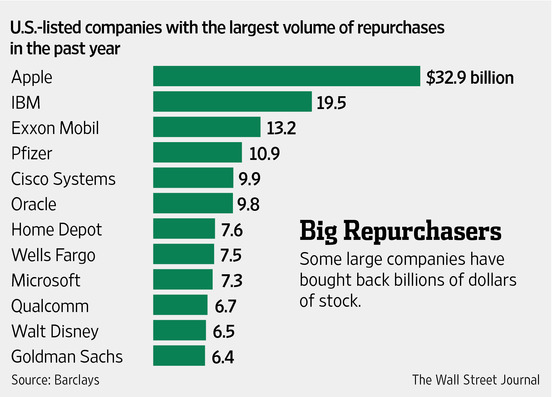
In a related outcome, corporations have continued to borrow record amounts at low rates to buy back their own shares at the highest stock valuations in 6 years. See: Companies’ Stock Buy-backs help buoy the market, even as trading volumes plunge and the liquidity pool grows ever shallower for those now in.
Stock-Buybacks-091614

Posted in Main Page | Comments Off on The deforming effects of zero rates

The economic drag of our polarized populace

About 9,000 U.S. taxpayers have each accumulated at least $5 million in individual retirement accounts, said the Government Accountability Office, raising questions about some investors’ tax-advantaged returns. Here is a direct video link.

Meanwhile CNBC reports on the drop in 401(k) balances among the majority of households nearing retirement. Here is a direct video link.

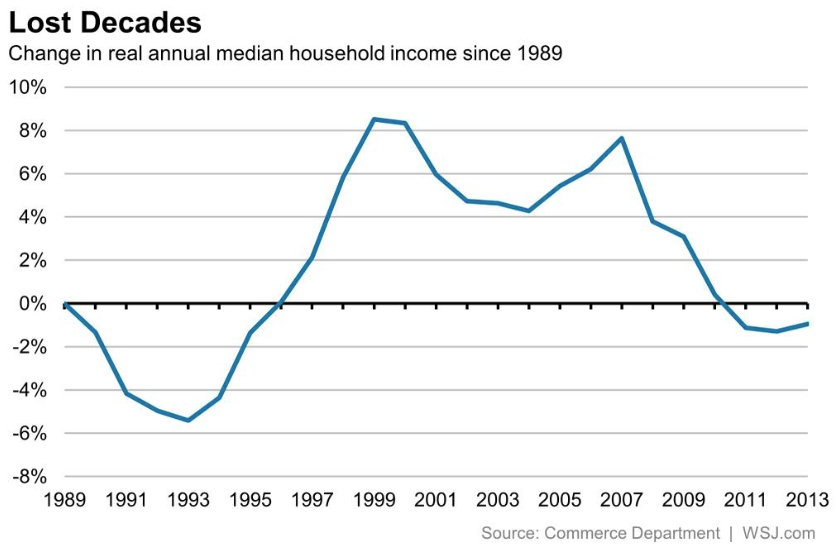
Yes some people work harder than others.  Yes some people save more than others.  But the real reason for the massive polarization between the top .1% today and everyone else has most to do with the level and type of income each is able to earn.  As shown below, most workers are paid in wages which have been falling since 1999 when Central Banks and governments decided to promote the financial-ization of the global economy and asset bubbles as a primary monetary tool.  Companies have responded to slowing revenues by slashing payroll costs in order to increase their earnings per share.
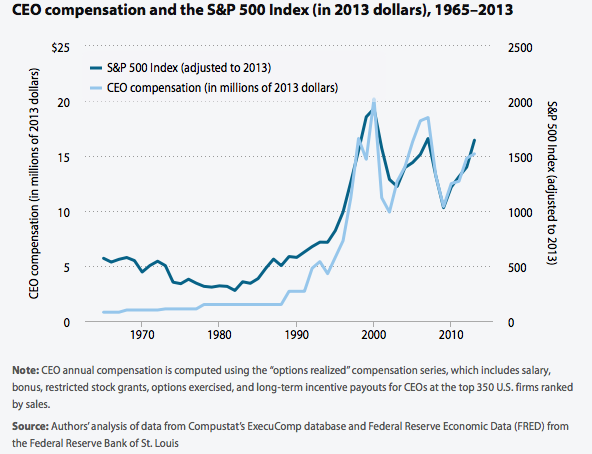
Real losses in household incomeAt the same time executive compensation has increasingly focused on stock options that have ballooned and crashed and ballooned with the S&P 500 over the past 18 years as shown below.  As the c-suite has become obsessively focused on their own share price to increase their compensation they have funneled corporate cash away from capital expenditures and investment in their business and into share buy backs as a sure fire way to goose their own pay.  As a result, executive pay that was 20 times the average worker in 1965, is today nearly 300 times the average worker.

CEO compensation and the S&PIt may all sound like good fun, but it is actually self-defeating:  it has made the entire economy weaker and vulnerable on the violent swings of a boom and bust crash course.  (Read:  Robert Frank’s “The High Beta Rich”,  for more on why that’s a problem for tax collection and budget planning).

When this present asset bubble bursts again, we will see once more how incredibly wasteful and misguided capital allocations have been the past few years. And the entire society (.1% and everyone else) will realize that we have fallen far behind in productive investment and policies needed to enable a progressive and sustainable economy.

Posted in Main Page | Comments Off on The economic drag of our polarized populace

Why asset bubbles are deadly

“…how do we know when irrational exuberance has unduly escalated asset values, which then become subject to unexpected and prolonged contractions as they have in Japan over the past decade?

— US Fed Chair, Alan Greenspan, in a televised speech “The Challenge of Central Banking in a Democratic Society”, on December 5, 1996.

I have been in this business a long time and pretty much seen it all.  Over the past 18 years since the Greenspan-led Fed first alluded to irrational exuberance in financial markets and then decided to embrace asset bubbles as a monetary tool rather than take proactive steps to help deflate them, we have lived through one after another spectacular boom and bust. Each time the real economy and median household wealth has fallen further behind.

There is no doubt that a few participants in each bubble have found themselves like lottery winners, holding the right asset at the right time, and able to cash out before collapses hit.  Most often these winners were early entrants and promoters who sold their story and holdings to others as prices spiked.  The vast majority of participants however have not found that kind of luck, and have ended up holding Ponzi-like assets as prices evaporated.

The commodities bust in 2011 was just the latest painful episode for many.  I well recall the buzz and lust for rare earth metals that swept the sector in early 2010. I took a look, did some math and quickly deduced that the valuations and risk/reward ratios made no sense. Many others took the bait.

“Back in 2010, rare earth elements were supposed to be the “can’t lose” investment of the decade. Rare earth elements are hard to mine and are used in a wide variety of consumer products like plasma TVs, magnets, and high-efficiency light bulbs.

But despite the seemingly obvious supply-demand dynamic driving up the price of rare earth elements, eventually the price bubble in these commodities got inflated quickly and deflated aggressively.

And now, Molycorp, one the largest rare earth mining companies, is teetering on the edge of penny stock status, while the price of rare earth elements has recovered just slightly.”

See: Remember the commodity bubble that exploded in 2011?

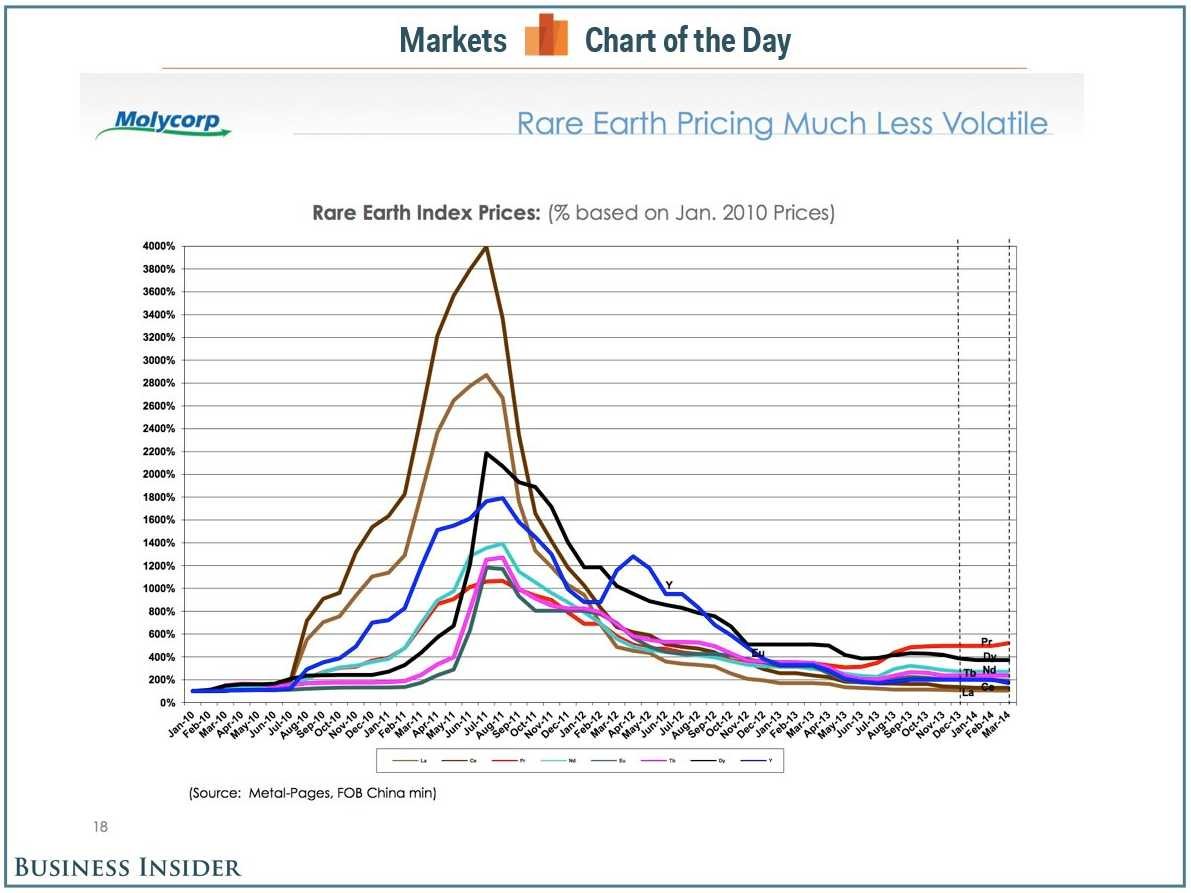
Here’s the chart.
Rare earth metals bubble

As we can see, anyone who was in early and sold into the frenzy of 2011 won big. Everyone else was decimated. Such is the very nature of asset bubbles. They are so extreme and irrational in their price moves that no one can predict how far they will go or when they will collapse. But collapse they always do. Unless one successfully wagers on the luck of an ideal entry and exit point, or uses insider trading or other illegal acts to reap timing advantage, asset bubbles are pretty consistently deadly.

Those buying and holding other bubbling assets today should ask themselves the question: what is my exit plan? which approach am I banking on? How much of my life savings am I wagering in the process? And how will my life be impacted in the overwhelming probability that I will not get out before the next collapse.

Posted in Main Page | Comments Off on Why asset bubbles are deadly