A client who is a grass farmer recommended “The Omnivore’s Dilemma” to me this week. This presentation by the author Michael Pollan gives an excellent overview of the material.
The UC Davis Mondavi Center presents bestselling author and UC Berkeley journalism professor Michael Pollan. He explores the ecology of eating to unveil why we consume what we consume in the twenty-first century. Michael Pollan is the author, most recently, of The Omnivore’s Dilemma: A Natural History of Four Meals. Here is a direct video link.
Posted inMain Page|Comments Off on Sustainable food and the power of ‘we’ consumers
Bloomberg’s Max Abelson recounts his conversation with former Countrywide Chief Executive Officer Angelo Mozilo as he reacts to plans by the U.S. government to sue him in a civil case over subprime loans. Here is a direct video link.
Sociopaths that make a half a billion dollars through the help and support of regulators and financial markets and the forbearance of prosecutors, have no reason to admit or acknowledge their predatory acts and harm inflicted. Mozilo is cocooned in a cozy club of bankers world wide who have made themselves mind-boggling sums at the expense of households, businesses, employees and taxpayers everywhere.
We, the people, continue to suffer and stagger under the weight of bad debts created in order for the financial executives to extract billions on to their personal balance sheets. Self-deluded to the end, the perpetrators have been allowed go free, keep the money and speak with indignation about the ‘unfair vilifying’ of the financial sector. Unless and until we are able to restore the rule of law on the banking sector we will continue to suffer the pain and cost of our largesse to them.
Posted inMain Page|Comments Off on Sociopathic bankers so far still keeping their plunder
Word to central planners everywhere: the path to sustainable economic growth is not ‘get rich quick schemes’, more debt and monetary tricks. The solution is found in equitable societies governed by the rule of law, equal opportunity and strong households buoyed by wage growth, falling debt and strong saving rates who then feel optimistic and healthy enough to have children.
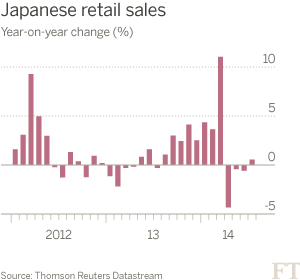
“Despite ebullient forecasts that seemed to shrug off the effect of Japan’s sales tax rise, July’s economic figures from Tokyo have showed that the Japanese economy is continuing to struggle.”Most analysts expected a strong rebound in retail sales and household spending as stockpiles collected before the tax hike should have run out, but no such reality emerged. Instead, retails sales fell 0.5%, and household spending dropped 0.2%. Reevaluation of the data now shows that Japan is in an odd conundrum—inflation is both too high and too low. It is too high because the tax hike have had a legitimate curbing effect on household buying power, and too low, because at 1.3%, real inflation is still too weak to convincingly keep Japan out of a deflationary cycle. Wages have not risen along with this real and “imposed” inflation, so the bulk of Japanese are much worse off than when Abenomics started in April 2013. Part of the issue is that Japanese exports have not risen alongside the weakening of the Yen.
After 15 months, Japan seems essentially no better off than before its major stimulus. It is anyone’s guess how the dynamic duo of Abe and Kuroda will handle this situation.”
“An explosive critique about the investment industry: provocative and well worth reading.”
Financial Post
“Juggling Dynamite, #1 pick for best new books about money and markets.”
Money Sense
“Park manages to not only explain finances well for the average person, she also manages to entertain and educate while cutting through the clutter of information she knows every investor faces.”
Toronto Sun

 A client who is a grass farmer recommended “The Omnivore’s Dilemma” to me this week. This presentation by the author Michael Pollan gives an excellent overview of the material.