
Stark facts on the nonsense of “too big to fail” safeguards

Today Senator Elizabeth Warren pointed out Chairwoman Yellen’s nonsensical assurances that ‘too big to fail’ tax-payer-backed banks have been reigned within manageable risk limits. Au contraire… Here is a direct video link. Glass Steagall-like break ups remain the only reasonable course.

Gary Shilling’s July (subscription) letter this month offers a detailed update on the US banking sector: “Big Banks shift to lower gear” and points out that bank CEO pay is linked to size much more than performance and so CEO’s resist dismemberment and constantly plan to grow even bigger!

On the much over-praised and overpaid Jamie Dimon of JP Morgan, Shilling offers the following historical context:

“Interestingly, Dimon had been fired at Citigroup in 1998 by his former mentor, Sandy Weill. He then became CEO at Chicago’s Bank One, which was troubled after a series of large acquisitions. He returned to New York when JP Morgan bought Bank One and ascended to the top. It’s interesting that a small group of people rotate among big banks’ senior positions, and getting into trouble at one institution is no impediment to becoming CEO at another.

Furthermore, the London Whale fiasco has not hindered Dimon’s compensation, although he suffered a pay cut at the time. In January 2014, the JP Morgan board raised his pay 74% to $20 million for 2013, a year which the bank agreed to more than $20 billion in fines and other legal payouts and suffered its first quarterly loss in nine years.”

Lest anyone forget, the Citigroup from which Dimon was fired by Weill was the same National City Bank that was found to be a major contributor to the pump and dumps that led to the crash of 1929 and the Great Depression. The same National City Bank who’s activities revealed by the Precora Commission led to The Glass Stegall Act of 1932 which broke up the tyranny of the mega-banks. In addition Citi CEO Sandy Weill was the same guy that worked so tirelessly lobbying politicians and instigating the demise of Glass Steagall which was finally killed by Bill Clinton in 1999. The same Citi that blew up and was bailed out by the US government in 2008. Sandy Weill, the same now retired CEO who today says he was wrong and big banks are a menace, and we need to break them up again to protect taxpayers and the economy from the next big meltdown. See: The untold story of the Bailout of Citigroup for more.

It would be hard to believe such an incredible story, if it were not tragically true. And still our society applauds and reveres the banksters. The mind boggles.

Posted in Main Page | Comments Off on Stark facts on the nonsense of “too big to fail” safeguards

TSX: Back to the past

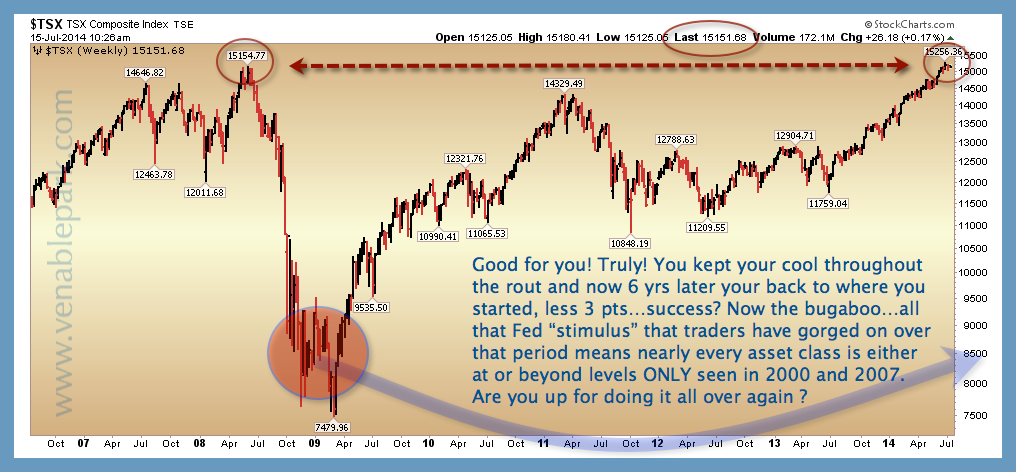
Michael J Fox in Back to the FutureHere we are July 2014 and as shown below, the Canadian TSX has manged to get “Back to the past” now within a stone’s throw of the level it last reached 6 years ago at the commodities cycle peak in June 2008. Of course that was just before the world realized that too much debt and financial leverage were toxic for families, banks, consumption, stability and economies.
TSX July 15 2014
But wait, the world now has tens of trillions more debt than it had in 2008. Global debt to GDP has now topped $260 trillion, some 430% of global GDP (without counting many forms of additional financial leverage and derivatives), and too big to bail banks are bigger and more concentrated than ever before….hmmmmm. Not to worry, surely this time will be different…

Posted in Main Page | Comments Off on TSX: Back to the past

Overcoming the student debt problem

When I was in secondary school, I knew that there was no family funding for my university studies. This helped me to become very focused. I maintained a couple of part-time jobs and began taking senior year credits in my junior years so that by the time I reached the last year of high school I only needed one semester to complete rather than a year. This left me 9 months of full time work waiting tables to save money before starting university. I also took out some government loans which were interest free during my studies and then reverted to market rates on graduation. Market rates were 11% when I graduated law school in 1991. Interest costs serve as a healthy prod where it keeps one motivated to pay down rather than continue to lever up. It helped me to focus on continuing to work while I studied and to keep the debt as low as possible and then repaid as quickly as possible after graduation. In retrospect it was a lot of work. There were no cars or cell phones or trips abroad. But investment for the future, requires present consumption denied, and there can be no doubt that investment in a meaningful education provides life long dividends.

Later on when my husband and I had two kids under 2 and were both working full time, I resumed my studies for three years to complete the CFA on nights and weekends. My husband began his post-graduate degree at the same time. It was an incredibly busy time. At that point, I realized that my previous student life while busy, had been a cake walk in terms of a luxury of time and focus compared with the concurrent demands of parenting, working, maintaining a home, volunteer hours and a pretty intense program of study.

The point is not what I did; the point is that we humans are so much more capable than we often imagine. Context is everything. If we train by running on flat ground, we find subsequent hills difficult. If we train on hills, we are capable of duration on the most challenging terrain.

Easy credit and low rates have enabled less output and efficiency. Many people and governments have come to think in an unduly entitled manner. They have been able to use credit rather than curtail spending or sacrifice present consumption for future strength. They have trained on lowlands and their sense of capability has flat-lined as well. At the same time, cheap credit has enabled for-profit schools to become bloated and inefficient with resources. Their costs have escalated and fees soared. Education costs and student debt levels have now reached crippling levels and new leaner, more resourceful thinking is required across the board. Yes we can.

Denver has come up with a new approach that allows high school students to start college early with no cost other than the investment of time, initiative and effort.

When it comes to student debt in the United States, the numbers are truly staggering – in 2012, 71 percent of new bachelor’s degree graduates had debt, averaging over $29,000. Over the last ten years, student debt has quadrupled – topping $1 trillion.

Congress crafted legislation last month that would have allowed for refinancing of student loans at a lower rate, but it went nowhere – and President Obama’s recent executive action doesn’t full solve the problem.

Here is a direct video link.

Posted in Main Page | Comments Off on Overcoming the student debt problem





