Must read: The Pitchforks are coming

Billionaire entrepreneur Nick Hanauer offers rare clarity to the many who emotionally cluster around far right and far left political ideologies today. This article offers some of the best reasoning ever penned.

“…the problem isn’t that we have inequality. Some inequality is intrinsic to any high-functioning capitalist economy. The problem is that inequality is at historically high levels and getting worse every day. Our country is rapidly becoming less a capitalist society and more a feudal society. Unless our policies change dramatically, the middle class will disappear, and we will be back to late 18th-century France. Before the revolution.

And so I have a message for my fellow filthy rich, for all of us who live in our gated bubble worlds: Wake up, people. It won’t last.

If we don’t do something to fix the glaring inequities in this economy, the pitchforks are going to come for us. No society can sustain this kind of rising inequality. In fact, there is no example in human history where wealth accumulated like this and the pitchforks didn’t eventually come out. You show me a highly unequal society, and I will show you a police state. Or an uprising. There are no counterexamples. None. It’s not if, it’s when.

…The thing about us businesspeople is that we love our customers rich and our employees poor. So for as long as there has been capitalism, capitalists have said the same thing about any effort to raise wages. We’ve had 75 years of complaints from big business—when the minimum wage was instituted, when women had to be paid equitable amounts, when child labor laws were created. Every time the capitalists said exactly the same thing in the same way: We’re all going to go bankrupt. I’ll have to close. I’ll have to lay everyone off. It hasn’t happened. In fact, the data show that when workers are better treated, business gets better. The naysayers are just wrong.

…a thriving middle class is the source of American prosperity, not a consequence of it. The middle class creates us rich people, not the other way around.”

Read the whole article here:  The Pitchforks are coming, for some refreshing and unusually honest insight.
Posted in Main Page | Comments Off on Must read: The Pitchforks are coming

Chinese over-investment haunting global economy

China’s consumption of metals and materials the past decade was awesome to behold. Its joining of the World Trade Organization in 2001 happened to align perfectly with the first leg of the US Fed’s aggressive monetary interventions following the stock market implosion of 2001. As interest rates were held down at 1%, the resulting western credit bubble was the demand that kept growing for cheap Chinese exports. In typical human exuberance, Chinese investment ramped up capacity to serve what was touted as an insatiable need for more and more consumer goods. Those selling the China story, marketed the “Chinese growth miracle” as the natural product of 1.3 billion Chinese people all striving for western-style comforts.

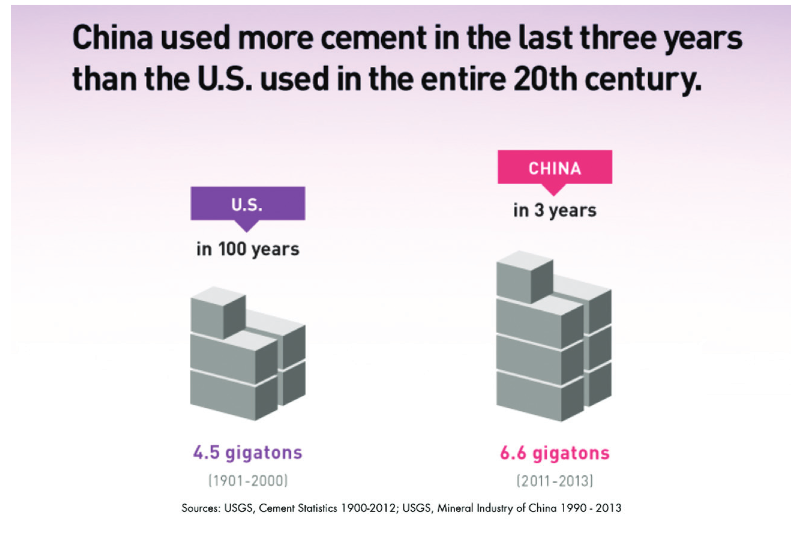
Except that was wrong. The Chinese growth miracle from 2001 to 2008 was born of the largest ever consumer debt bubble in the west. When the debt bubble imploded in 2008, Chinese officials decided to invest capital reserves into keeping their workers busy. The theory was “build it and they will come back”: if they could keep demand steady and build up capacity and infrastructure at home for a year or two, they imagined the west would bounce back and torrid growth could continue. Over the past now 6 years, the Chinese government has prostrated itself, re-pledging its assets over and over, waiting and watching for that delirious western demand to resume at any moment.  The below chart of their demand for cement the past 3 years, gives some perspective on how intense their infrastructure and development over-investment has been.
China cement use psat 3 years

Except western demand has not bounced back. Western consumers continue to hobble under weak employment, stagnant wages, low equity and still heavy debt loads. Americans now have an aversion to debt. They dream of garage sales and storage wars, of spending less and building up savings. And there is an increasing new interest in buying American grown goods and services where possible. As is so often the case, this reversal of fortunes the past 6 years has been a great surprise to the unsuspecting China perma-bulls. This new report on China’s ghost towns, reminds of the scope and scale of the excess capacity and mal-investment now wasting idly away in China. Better luck next cycle…

China’s own Big Apple may be rotting from the core. A new central business district modeled after New York City is going up in Tianjin…but the nation’s slowing economy is exacerbating the risks from its unprecedented credit binge…and that’s putting China’s Manhattan project in jeopardy. Here is a direct video link.


(All of which reminds me of some embarrassing assertions made by Dundee’s Ned Goodman on an investment panel I did with him in 2013 (clip is here) where he was saying the Fed would never tapper QE in his life time (at 1:30 min) while talking up insatiable Chinese growth and confidently assuring the audience that there were no such thing as Chinese ghost towns (see our exchange starting at 6:58)…hmmmm).

Posted in Main Page | Comments Off on Chinese over-investment haunting global economy

Financial crisis and bear markets are foreseeable

Contrary to officially myopic central bankers and “no one can see bear markets coming” financial commentators, effective risk management for real life people requires us to anticipate big picture trends and make our own decisions independent of the herd. I have often said that being a prudent risk manager in the financial sector is like being the only sober member in a family of drug addicts, where the rest of the family keeps insisting that they are healthy and normal and you are the problem. Until they implode of course…This clip offers a worthwhile overview of our current cycle.

Current best practices in risk management work only when correlations are stable. At turning points historical relationships between assets break down. The only way to effectively anticipate future risk factors is by understanding root macroeconomic causes. Here is a direct video link.

Posted in Main Page | Comments Off on Financial crisis and bear markets are foreseeable