Margin tide receding once more

In the spring of 2011, global growth began weakening from the cyclical recovery that had begun in early 2009, and stock and commodity markets turned lower once more. All over the world, Central Banks responded with trillions of monetary injections designed to arrest the contraction and encourage belief in a more extended economic recovery. Risk markets stopped falling in response, but it took nearly 2 years of sideways action, and seemingly endless promises and liquidity programs, before stocks were finally able to recover and break higher in the final quarter of 2012.

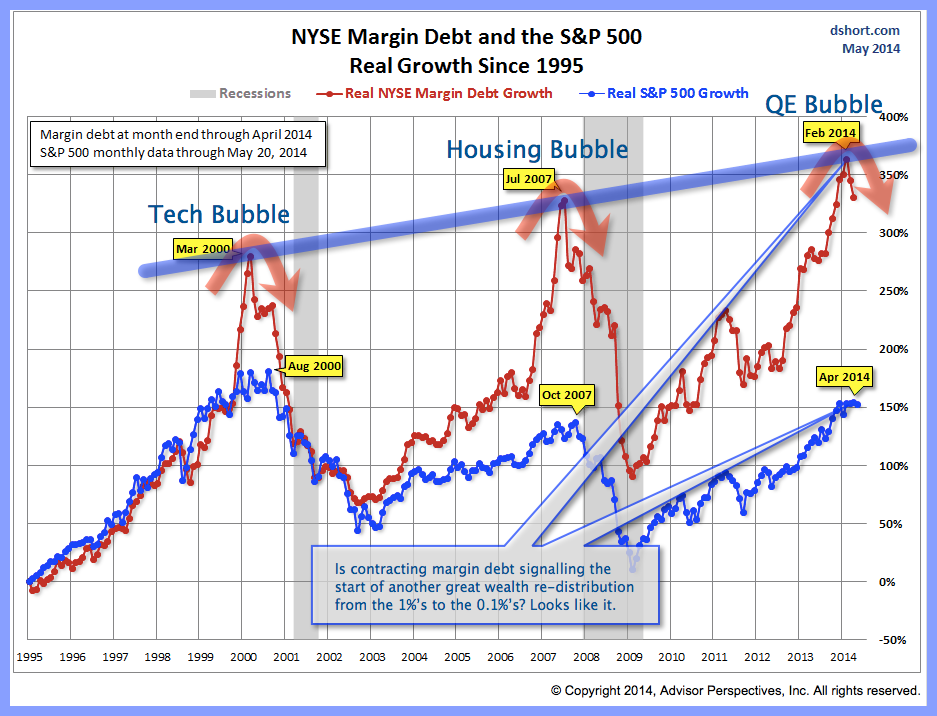
As shown in this remarkable chart below, levered risk-taking–borrowing to buy on margin (red line)–began turning lower in 2011 (as it had done at prior market peaks in both 2000 and late 2007), but then re-surged with QE inspired speculation into February 2014. Since then, the margin tide has been receding once more. It looks like Central Banks are going to need some bigger, better gimmicks to turn this mean reversion process around, because historically, as margin falls, so do stock prices (S&P in blue).
S&P margin June 17 2014

Posted in Main Page | Comments Off on Margin tide receding once more

Senate hearings this morning on high speed scamming

The Senate hearing into HFT this morning is long overdue and hopefully will reveal how widespread, indefensible and outrageous these practices have become. Carl Levin’s opening comments are off to a good start… You can see a video of testimony here.

Posted in Main Page | Comments Off on Senate hearings this morning on high speed scamming

New study confirms: insider trading common and largely unprosecuted

No surprise here. A detailed new study out of the Stern Business School and McGill University, examining hundreds of stock option transactions from 1996 through the end of 2012 finds that 25% of all public deals may involve some kind of insider trading:

The professors examined stock option movements — when an investor buys an option to acquire a stock in the future at a set price — as a way of determining whether unusual activity took place in the 30 days before a deal’s announcement.

The results are persuasive and disturbing, suggesting that law enforcement is woefully behind — or perhaps is so overwhelmed that it simply looks for the most egregious examples of insider trading, or for prominent targets who can attract headlines.

The professors are so confident in their findings of pervasive insider trading that they determined statistically that the odds of the trading “arising out of chance” were “about three in a trillion.” (It’s easier, in other words, to hit the lottery.)

Meanwhile the financial firm directed SEC, the study notes, only litigated “about 4.7 percent of the 1,859 M.&A. deals included in our sample.”  See: Study asserts startling numbers of insider trading rogues.

Posted in Main Page | Comments Off on New study confirms: insider trading common and largely unprosecuted