Beware of accountants offering harmful investment advice

I had a contact this morning from a long-time blog reader, who is in her 70’s and was recently advised by her accountant, that she could “make a lot more income in stocks” than her current ladder of guaranteed deposit certificates at the bank.  This, oh so helpful, accountant then provided her client with the names of two investment sales reps that she recommended the woman consult for financial ‘advice’.

Unfortunately, these type of overly-confident, harmful suggestions are handed out by clueless accountants every day. (The same crowd tells people not to sell stocks that have gone up in value a lot in order to avoid triggering tax- Nortel anyone?) Perhaps most mean well; perhaps some are collecting referral fees. But the net effect of such ignorant, risk-blind recommendations regularly does harm to trusting souls who act on them.

Contrary to mainstream cliches, risk is only likely to be longer-term rewarding when assets are selling at significant discounts (not all-time highs!), and even then, unbiased rules and care in allocation and product selection in light of an individual’s risk-tolerance and needs are paramount.

An investor-beware warning list from UK asset manager Tim Price yesterday, offers a very valuable antidote to the dumb, marketing mantras that so routinely pass as financial advice today.  This list should be printed out, posted on your bulletin board, and passed around to those you care about:

1. For many investors, capital preservation in real terms should be more important than capital growth in notional ones.

2. Investors – as humans – are typically loss-averse. We feel the emotional impact of equivalent gains and losses disproportionately. This does not mean we should avoid considered risks, but to invest dispassionately.

3. Investing dispassionately is difficult when most of the investment media comprise the participants in a 24/7 circus. If the business of investing is either entertaining or exciting, you’re doing it wrong.

4. The answer is obvious: turn off CNBC. (Judging by their viewing figures, plenty of investors already have.)

5. True diversification remains the last free lunch in finance.

6. Having fatally tainted monetary policy, the dismal science of economics has wrought damage across investment theory as well: ‘homo economicus’ does not actually exist, and markets will never be wholly efficient until all people are, too.

7. “The investor’s chief problem – and even his worst enemy – is likely to be himself.” (Benjamin Graham)

8. The general principles of investing are not arcane. They should begin with the avoidance of loss.

9. Starting valuation is the most important characteristic of any investment.

10. Risk is poorly defined as volatility. It is better defined as the possibility of a permanent loss of capital….

See:  “I’ve been investing since January, and I’ve never seen anything like it”, for the entire excellent 21 point list.
Posted in Main Page | Comments Off on Beware of accountants offering harmful investment advice

Consumer demand falls with household incomes

Now that the ‘borrow your brains’ out credit cycle is in retreat, aspirational wealth products and services have a problem: household incomes for all but the top 1% have declined back to 1999 levels. Here are some of the latest stats, see, US consumers languish in the trap of luxury:

    • The bottom 20% of households in the US earned $20,599 in 2012, a remarkable 9.7% lower in real terms than 8 years ago in 2006.
    • The median household income fell 7.1% to $51,017 over the same period.
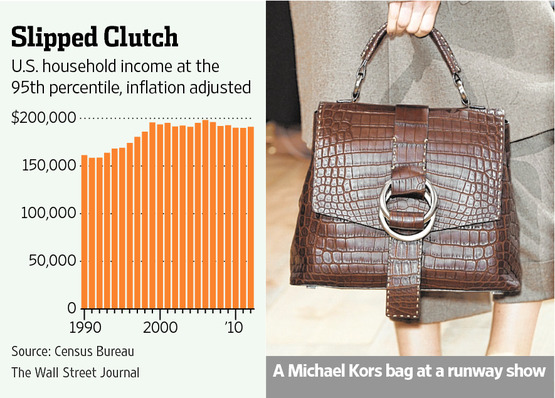
    • Even the top 95th percentile households–those earnings more than everyone but the top 5%–were earning $191,156 in 2012 about 3.5% less than their real income in 2006, and as shown in this chart.

US incomes flatlineThe buying power of those under 34 has fallen even more with the majority under-employed and/or heavily indebted, a down-shift in material acquisitions and aspirations is inevitable. It is quite typical for young people to now put off marriage, household formation and child-bearing well into their 30’s and even beyond. This is also showing up in reduced demand in most things, from expensive activities like golf (as explained here) to life insurance. Cash-strapped singles are understandably not buying health and life insurance products or mutual funds, see: Death plans delayed by Millennials, pressuring insurers.

Food for thought in reflection on ways to better share the wealth and rebuild the weakened 99% of households today. Elizabeth Warren offered some perspective in her senate speech on the minimum wage legislation in April.

Like it or not, companies that are celebrating lower labor costs and record profit levels today, can either figure out ways to share the wealth with their employees more or continue battling each other over a smaller and smaller pie of consumers and sales.

Senator Warren spoke on the Senate floor on April 30, 2014, after a vote to advance minimum wage legislation was blocked by Republicans.Here is a direct video link.

Posted in Main Page | Comments Off on Consumer demand falls with household incomes

Bond yields continue south

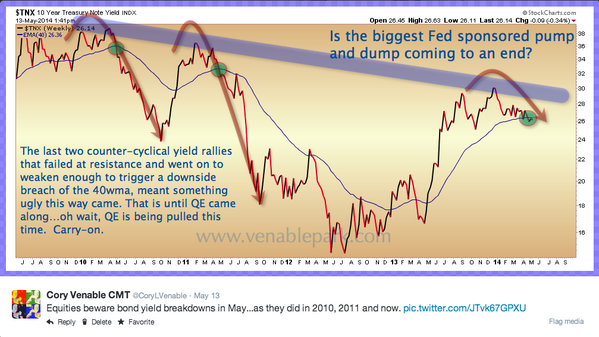
The mongrel hoard keeps insisting that “everyone” got the yield call wrong this year, and “no one” saw bond prices rising. Nope. A few of us that are free to see big picture trends rather than perpetually sell risk, said growth was slowing and bond yields were likely to fall. Here is my partner Cory’s most recent technical work on US 10 year Treasury yields:
10 year yield May 13 2014
You see without inflation in the offing, stocks at silly valuation highs are impossible to justify. Will the Fed be able to roll out yet another magical mystery tour to stop the weight of an aging, over-indebted population from pulling in consumption and forcing yields lower? Not likely. But impossible odds have not stopped them from repeatedly rolling out kamikaze missions the past 4 years…

Posted in Main Page | Comments Off on Bond yields continue south