Buy and hold Buffett necessarily perpetually bullish

Dear folksy Warren Buffett has a secret routinely overlooked by the throng of media worshipers today: over the years as his fund and notoriety grew, Warren became a multi-billionare and his investment company became a mammoth buy and hold fund that has tracked the S&P 500 both in price action and volatility during the past 11 years of this secular bear. Buffett likes to talk about his internal book value gains, but the actual returns for his investors are found in the price experience of the publicly traded shares they hold, shown in this chart of the S&P 500 and Berkshire A shares since 2003.
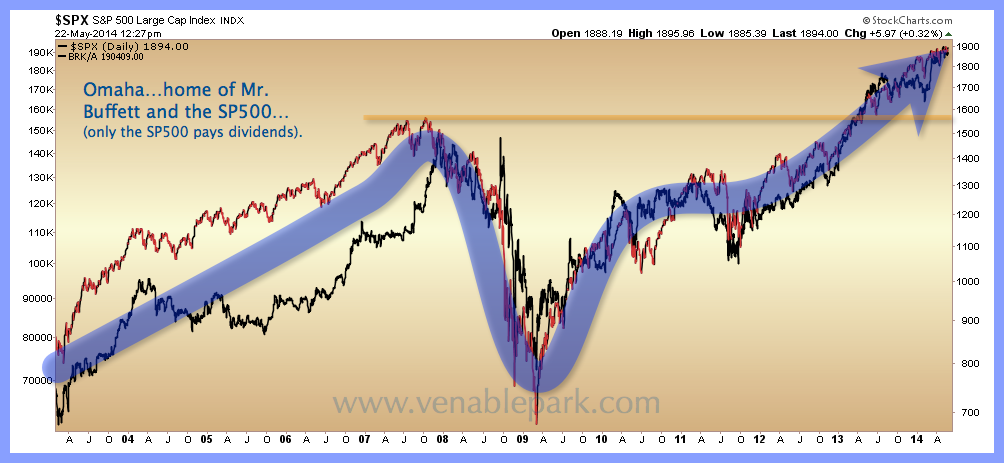
BRK.A and S&P
Actually thanks to the tiny 2% annual dividend of the S&P 500 over this time frame, Berkshire shares have underperformed the index on a total return basis. What is most important to real life investors however is the fact that “The Buffett Way” has provided no meaningful risk management or protection for capital invested over this entire period. This matters because, having lost half of their market value along with the S&P in 2008, Berkshire shares spent the next 5 years just getting back to 2008 levels once more; and it has only been over the past 15 months of HFT and QE-mania that Berkshire shares have begun to make net gains again. Over the past year or so, Warren has been taking his victory laps once more.

The problem now of course, is that this market cycle is long in the tooth and valuations are more over-stretched today than they were at the 2007 and even the 2000 peak in most indicators. After both of those manic tops, Berkshire shares plunged with the broader markets giving away 12 years of apparent gains in 15 months. Since Berkshire is an equity fund with too-big-to-move concentrated positions, it now follows a buy and hold approach. Not surprising then that Buffett says he doesn’t sweat about the economy or market moves; he doesn’t worry about market rigging or HFT front-running, he just buys businesses he likes. Nice but, how does any of that help real people with finite life spans and time horizons. After all, 99.999% of the world’s population are not billionaires Warren. For most of us, years spent making back losses are years we simply can’t afford.

This doesn’t make Buffett a bad man or anything, but not exactly an investment savior either…

Posted in Main Page | Comments Off on Buy and hold Buffett necessarily perpetually bullish

What current bulls were saying in December 2007

This blast from the past Bloomberg Business Week article from December 2007 “What the Pros are saying”, offers some useful insight into the forecasting abilities of some of today’s widely quoted market bulls. The usual suspects and still some of today’s favorites include:

Ralph Acampora— in December 2007 was expecting a 10% to 20% sell-off in the first half of 2008, followed by a rebound in the second half of the year “as economic growth, fueled in part by election year pump-priming, accelerates”. Acampora’s advice to investors in December 2007: “stick with the large-cap growth stocks that are currently in favor.”

Laslo Birinyi: in December 2007 said that the bull market that started in 2002 was still very much intact. “He expects the current economic expansion to continue, with 5% corporate earnings growth helping to propel the Dow to 15,000 by the end of 2008. The signs of a market top, which include speculative fervor and rising stock valuations, “really aren’t present,” he adds. At 15 to 18 times estimated earnings—the exact number depends on how you measure earnings—stock market values are neither cheap nor expensive.”

Elaine Garzarelli: in December 2007 was expecting “a 20% gain on the Dow and the S&P 500 stock index” in 2008. “While most analysts are worried about negative earnings surprises, Garzarelli is betting that earnings will hold up: She says they will rise some 7%, as lower interest rates reduce the cost of borrowing for corporations and a weak dollar fuels strong export growth. Of the 14 indicators Garzarelli follows, which measure everything from investor sentiment to stock valuations, most are flashing favorable signals. “Our models show the S&P 500 is undervalued by 25%.”

“Blue chip” dividend paying stocks proceeded to fall an average of 50% over the following 15 months.

Others like Bob Arnott, GMO’s Ben Inkler, and myself (here on BNN in August 2008 when the TSX was at all time highs) were recommending low stock exposure with defensive positions in cash and high quality bonds, and we are again today…food for thought.

Posted in Main Page | Comments Off on What current bulls were saying in December 2007

ECRI: Fed or not, US GDP stalling

Good reminder on why the Fed-led “brilliance” of constantly dragging future demand forward through short-term credit incentives is long-term counterproductive: the future keeps arriving with demand already spent:

“What is being gradually acknowledged – without any publicity or fanfare – is that long-term U.S. GDP trend growth, already estimated at around 2% to 2¼%, is converging towards its 2% stall speed. If so, almost every time GDP growth experiences a slowdown that carries it below trend, it will also fall below the recessionary stall speed.

In this context, a strategy of “pulling demand forward” makes little sense, whether in the context of fiscal or monetary policy. Such a plan requires sufficient potential demand from the future that could be pulled into the present.

Indeed, if there is a long-term pattern of falling trend growth, as we asserted nearly six years ago (August 2008), a “pulling forward” policy becomes increasingly untenable. As we noted last fall, this pattern of weaker recoveries, which Larry Summers referred to as “secular stagnation,” “dooms a policy of indefinitely bringing forward consumption, since demand will fall short when the future arrives” (November 2013).”

See today’s: Burying the Lede for a worthwhile update.

Posted in Main Page | Comments Off on ECRI: Fed or not, US GDP stalling