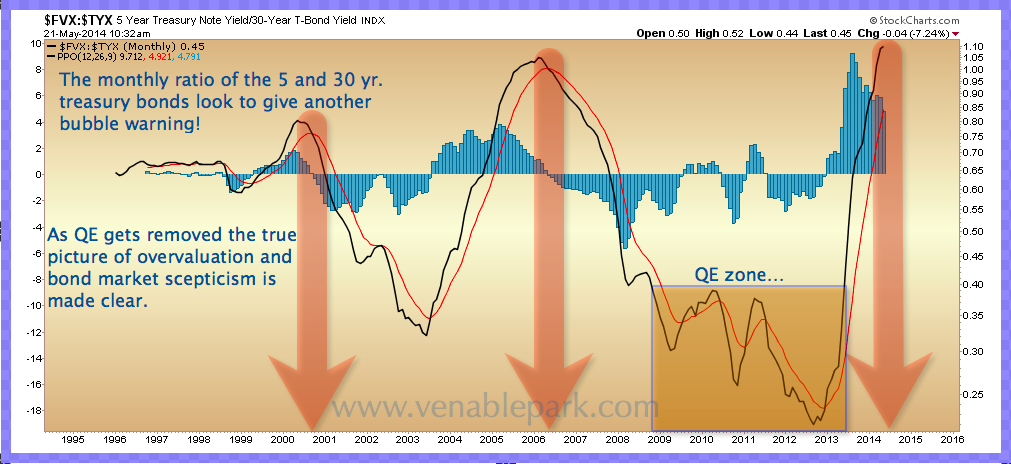
If the bond market believed the almost unanimously bullish economists today, then capital would not be moving from 5-year Treasuries (yields rising as prices decline) into 30 year Treasuries (yields falling as prices rise), but as shown in the chart below, this is precisely what is happening. As we can see, the same ‘bearish of long-term growth prospects, the Fed won’t be able to raise rates as growth plummets’ warning sign emerged at the stock market peak in both 2000 and 2007…
Posted inMain Page|Comments Off on Bonds calling bull$@#! on bullish forecasts
This is the kind of stuff that should send chills up the spine of anyone looking at business television for investment ideas…
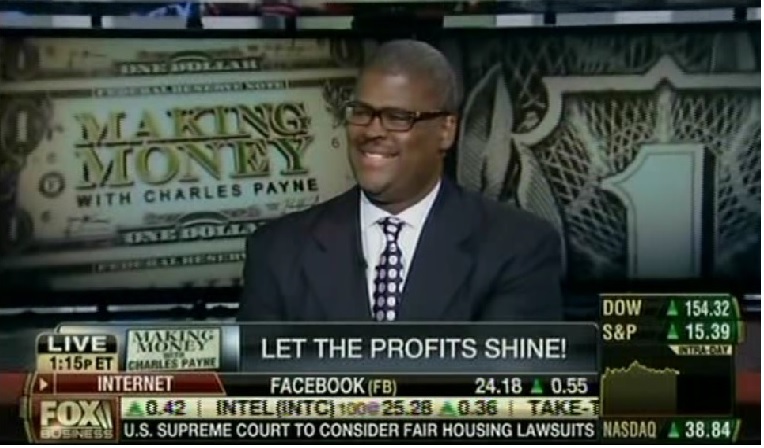
“Financial analyst and Fox Business contributor Charles Payne, who has been fined by the Securities and Exchange Commission (SEC), been paid to promote now virtually worthless penny stocks, and smeared the poor as “indebted servants” to the government who are too “comfortable” living in poverty, is being rewarded with his own show, the network announced today.
Fox Business said the show, Making Money with Charles Payne, will debut on June 2 in the evening. FBN executive vice president Kevin Magee praised Payne as having “an incredible talent for identifying growth sectors in the markets and we’re excited to launch a new show dedicated to helping viewers spot these emerging investment prospects.”
In today’s “Single Best Chart,” Bloomberg’s Scarlet Fu displays the rising level of college debt for the class of 2014 compared to their earnings potential coming out of school. Here is a direct video link.
Government-backed education loans may sound like a good thing. But once we realize that schools have been able to escalate education costs the past decade by surreal amounts only because students were able to pay by taking on student loans, we see the self-defeating circle for young people and for our economy as a whole.
Without easy access to endless student loans, schools would not have enough customers who can afford to pay their current fee levels. This would be the natural free market factor that would reorder education costs to a manageable level. Without that free-market constraint, schools and their management teams have been able to extract ridiculous fees for their product over the past few years. In the end however, the path is unsustainable, because costs have risen so much and students are now so encumbered with debt when they graduate that outcomes are bleak: best case is that they are enslaved to their repayments for many years which means they are less able to consume–get married, start families and buy homes. Or worse case they are not able to find employment sufficient to repay the debts and simply don’t, leaving a debt which cannot be extinguished in bankruptcy hanging endlessly over their heads like a life sentence. Such hopeless situations for the masses have historically led to anarchy and social unrest.
Several people have been calling for a “bail-out” for students the way governments bailed out banks over the past few years. And I am all for an intelligent restructuring of loans that can never be repaid. But simply writing off the debt will not solve the larger problem which is unaffordable education in America. Meaningful reforms must include a restoration of free-market pricing to education costs. On-line study will continue to be an increasingly attractive option for students who are seeking a more cost-feasible education. But we all have an interest in a more educated populace, and making it possible for young people to pursue higher learning is a foundation of every progressive, strong nation. After the credit bubble, there is every reason for schools to admit they have grown into garish cathedrals of fees and reform themselves to a new affordable pricing structure, similar to what US housing did once its price bubble burst from 2006 to 2009. Ironically endless government underwriting of loans has become a menace to prosperity in education just as it was in the housing bubble.
“While just a few of our national political leaders — such as Rep. Karen Bass and Sen. Elizabeth Warren — have spoken out on the issue of student loan debt, and none of our leaders in higher education have said much of anything, grassroots activists have taken the lead. This should not be a surprise — it’s always been the case that change is driven by the people, not by their reputed leaders.
If we the people have been forced to bail out the banks, why can’t we exert our political will to demand that Congress and the President to do the same for students who are required to repay their student loans in the midst of what seems to be a perennially sluggish job market? In a horrible irony, the very banks we bailed out reaped profits from student loans, and now it is the federal government that is profiting, even as unemployment benefits have been cut.”
“An explosive critique about the investment industry: provocative and well worth reading.”
Financial Post
“Juggling Dynamite, #1 pick for best new books about money and markets.”
Money Sense
“Park manages to not only explain finances well for the average person, she also manages to entertain and educate while cutting through the clutter of information she knows every investor faces.”
Toronto Sun