
A new reason to care about ill-health epidemic: “too fat to fight”

Apparently epidemics of heart disease, diabetes, cancer, impaired fertility, sick children, suffering animals and environmental degradation are not enough reasons for many people and policy makers to move away from the typical processed, dead animal based, western diet, but here is a new reason that may get some attention: military leaders are sounding the alarm bells about a generation who is increasingly now “too fat to fight”.

Maybe the military complex will be able to wrangle some concessions out of the big-food complex calling the shots in America today. Each group will have to get their highly funded lobbyists to battle it out… hopefully sanity and common sense can inadvertently win a few rounds in the process.

We think of the military as getting more high-tech, but soldiers on the ground will still play a key role in fighting. CNBC’s Allison Linn explains why military leaders are worried that there won’t be enough physically fit recruits to serve the U.S. in the future.  Here is a direct video link.
Posted in Main Page | Comments Off on A new reason to care about ill-health epidemic: “too fat to fight”

Spoiler alert: 2014 is no 1994

Good discussion of current market conditions. Carter Worth, chief market technician at Sterne Agee, says the stall in the U.S. stock market “foreshadows trouble ahead” because the technicals are “not good.” Here is a direct video link.

We agree with Worth that the present period has little to liken itself to 1994. Some of the important differences in our view:

        • 1994 was year 12 of a secular bull market (1982 to 2000).  2014 is year 14 of a secular bear market (2000 to 2017??).
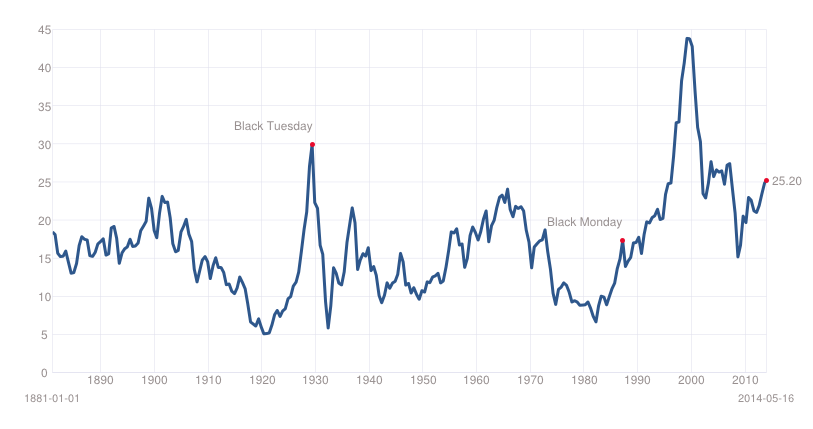
        • stock valuations (Shiller PE) in 1994 were less than 20 versus more than 25 today.

Shiller PE

      • in 1994 the leading edge of the baby boomers were 48 and just coming into their peak spending years.  In 2014, the leading edge boomers are 68 and firmly into downsizing mode.
      • US GDP annual growth rates were averaging 3.6% in 1994, today they are averaging less than 2%.
      • in 1994 US households average debt to GDP was at 60%, compared with today more than 80% in the US and more than 90% in Canada.
      • in 1994, home prices had been relatively flat for more than a decade and most families had positive equity.  Today home prices remain at relatively high valuations in most areas and more than 20% of owners owe more than their home is worth.
      • in 1994 20 and 30-somethings were coming into the work force with little to no personal debt, today they are heavily encumbered with consumer and student loans.
      • in 1994 the average household savings rate was above 7%, today it is below 4%
      • in 1994, the executives of public corporations had not yet reached the zenith of God-complex, and were then extracting an average income of 90 x the average worker versus the garish and destructive 300x the average worker’s pay today.
      • in 1994 taxation rates, regulation and interest rates had all been higher and were in the midst of a major move lower from 1982 to 2007.  Having hit generational lows leading up to the 2008 crisis, these key policy areas are all necessarily in a multi-year process of mean reverting higher.
      • in 1994 the Central Banks had relative strength with modest “normal” balance sheets, today they have already blown their fire power having swapped liquidity for trillions of lower quality debts from investment banks via QE.

Posted in Main Page | Comments Off on Spoiler alert: 2014 is no 1994

Two sides of the bank bailout story

If you happened to catch Former Treasury Secretary and Obama financial adviser Tim Geithner on Charlie Rose last night, you may have been impressed by his carefully constructed version of events. He is an articulate, though in my view smarmy, speaker and his revisionist take on what mistakes he made personally, was a particular masterpiece of delusion as seen here in this clip from last night. Here is a direct video link.

Glaringly absent from this mockery of mea cupla is any acceptance of his personal complicity in aiding and abetting the financial crisis as the head of the NY Federal Reserve during the incendiary investment-banks-run-wild period from 2003 to 2009. Mr. Geithner has admitted in Congressional testimony that he never saw himself as a regulator of the banks as head of the NY Fed. This is no doubt a convenient absolution to his way of thinking, but in reality it was a major failure of key duties. If Geithner and others in important positions of oversight and public trust had done their job diligently, the financial crisis would never have hit “like a firestorm”, as he has put it.

When it did, he then helped design a precedent that funneled trillions of public funds into investment banks without any punitive terms or penalties over the past 6 years. Mr Geithner says he is very proud and confident in his decisions. Must be nice to live in a world where you ignore the role you played in starting a firestorm and then take victory laps for spreading it about. In reality, Geithner is one of several key actors who have ensured that necessary financial reforms were delayed and the next wave of the financial crisis lies yet ahead.

Former TARP Inspector General Neil Barofsky (who dared to criticize the merit and method behind Geithner and Paulson’s Bank handouts under TARP) offers a less complimentary take on Former Treasury Secretary Tim Geithner’s handling of the financial crisis in this video clip.

Posted in Main Page | Comments Off on Two sides of the bank bailout story




