Local lending: ideas on cutting bankers out of the equation

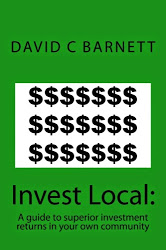
Invest local BookCoverImageBusiness evaluator and private finance investor David Barnett recently sent me his new book Invest Local: A guide to superior investment returns in your own local community.

By taking readers through his real life examples and numbers in local small business financing, private lending and leasing, Barnett offers some straightforward, actionable ideas that individuals can consider doing with a controlled portion of their investment savings.

In an era where unethical, sneaky, unfair practices have made modern banks the frequent enemy of honest, hard-working people everywhere, putting the old-fashioned trust, and personal accountability (the three C’s of credit: character, capital and capacity) back into the borrowing and lending relationship is a refreshing idea. As Barnett puts it (p.148):

“Bringing financial service relationships back between individuals is important for building stronger local economies and communities. Banks and other financial institutions take millions of dollars out of our towns and cities each year in the form of interest and fees. By doing your own deals, you can keep some of that money in your community. When those profits are in your pocket and you spend the money locally, everyone around you benefits through job creation and increased job security.”

In my own lifetime I have borrowed and lent privately, bought and sold cars and real estate privately as well as been a landlord at different times to both residential and commercial tenants. In my experience, the best opportunities are always fairly-priced and offer good value to both sides of the transactions.

Of course there is capital risk in everything and private deals take some work, worry and care. It is not for those who are not interested in details and ongoing management. As in any investing, there is no free lunch and every venture comes with risk. But for those who are open to eye to eye dealings with people and are willing to do some work, the book offers some well-reasoned, practical ideas to consider.

On the other hand, a wise man once said “neither a borrower nor a lender be.” Each person must find solutions that suit their own temperament and risk tolerance.


Posted in Main Page | Comments Off on Local lending: ideas on cutting bankers out of the equation

Weak Q1 way beyond bad weather

The economy’s leading indexes were pointing to a slowdown before bad weather hit earlier this year — but there is much more to the economy’s weakness than weather. Co-Founder and COO of the Economic Cycle Research Institute Lakshman Achuthan discusses with WSJ Live.Here is a direct video link.


Is the U.S. Heading Toward a Deeper Downturn? by WSJ_Live

As many pundits were celebrating the headline pick up last week in US Average Hourly Earnings (AHE) the ECRI pointed out that the pick up was not because of rising earnings but because growth in hours worked had fallen faster than pay growth. This is therefore actually negative for income growth and not a credible sign of wage inflation. Here is their chart.
Average hourly earnings

 
…the commonly-touted “upturn” in earnings growth is largely illusory, and does not really point to a healing in the labor market, or necessarily imply a welcome rise in inflation, as some claim. It is risky to presume, based on AHE, that policy action has effectively achieved its goals of boosting inflation and healing the labor market. This is even more troubling in the context of the “yo-yo years” environment of weakening trend growth and more frequent recessions than most expect.” See: Earnings growth upturn masks labor market weakness.

Posted in Main Page | Comments Off on Weak Q1 way beyond bad weather

Lifestyle and diet key to slashing health care costs

“Dr. Dean Ornish has a solution for lowering the nation’s skyrocketing health care costs: Lifestyle medicine. Ornish’s 37 years of clinical research show that chronic diseases such as severe coronary heart disease, Type 2 diabetes and early-stage prostate cancer can be reversed or prevented by changing one’s diet and daily lifestyle habits. The best-selling author of six books including “Eat More, Weigh Less” and “The Spectrum,” and founder of the nonprofit Preventative Medicine Research Institute, tells The Daily Ticker that “limitations to high-tech approaches are becoming clear.” Randomized studies have determined that traditional treatments do not prolong life or prevent heart attacks, he notes, and lowering blood sugar with drugs “doesn’t work nearly enough as it does by getting it down with lifestyle…

Three-quarters of the $2.8 trillion that we spent on health care costs last year were predominately ‘sick care’ costs,” says Ornish. “If we can treat the underlying causes, which to a large degree are the lifestyle choices we make each day, we can make better care available to more people at lower costs, and the only side effects are good ones.” Here is a direct video link.

Posted in Main Page | Comments Off on Lifestyle and diet key to slashing health care costs