Fed leading charge to comp bank execs in bonds

At last a sensible change is being considered by the Fed. The banks will lobby their butts off against it, but yes Virgina this should happen. And not just for bank execs, but for all publicly traded companies to force management away from their OCD-short-term fixation with leveraging up to increase shares prices (and their own personal fortunes) at the expense of the long-term stability and productivity of the business.

“The Federal Reserve is considering a requirement that the biggest banks add their bonds to pay packages for top executives.

The goal would be to align bankers’ compensation more closely with their institutions’ financial stability. Stock awards provide incentives to boost profits, while bonds would decline in value if a bank takes too much risk.

The concept has support from other regulators who are growing impatient with continued abuses on Wall Street.

“When you are talking about encouraging proper behavior,” incentives are “very important, and certainly compensation is a huge factor on how people conduct themselves,” Thomas Curry, the comptroller of the currency, said in an interview.

During the global financial crisis, “some risks were taken that may not have been in the best long-term interest of the banking organization, its shareholders or the deposit-insurance fund that backs it all up,” added Curry, whose agency supervises 1,212 national banks with $9.4 trillion in assets.” See: Fed Citing Wall Street lapses leads drive on bonds as pay.

Next crucial step: get investment bank divisions separated away from the deposit insured backing of taxpayers.
Posted in Main Page | Comments Off on Fed leading charge to comp bank execs in bonds

Equity investors under-allocated? no, no and ah, nope

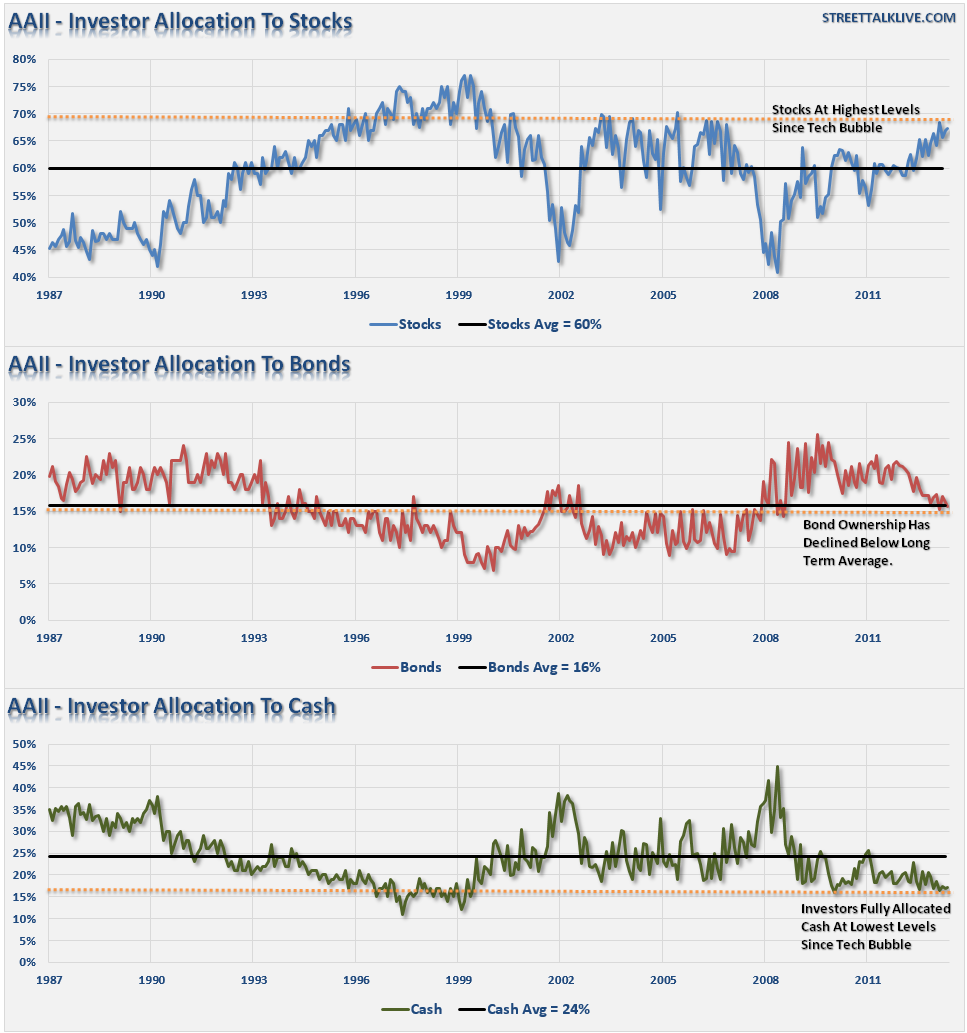
Great triptych chart courtesy of Lance Roberts today that answers three misleading statements heavily asserted by the risk-selling hoards: 1. that investors are afraid and under-allocated to equities, 2. that investors are afraid and over-allocated to bonds, 3. that investors are afraid and holding an overweight in cash. The answers as shown below are clearly: no, no and no.
AAII-Asset-Allocation-041614

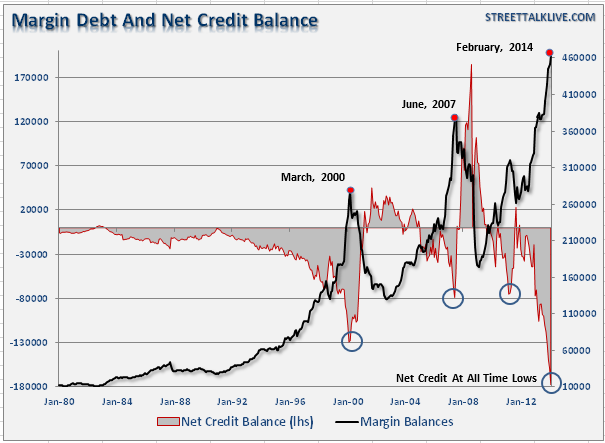
In fact equity market participants (well at least the small percentage who are not just HFT pingers but actually hold positions for not just microseconds, but overnight and longer!) have never been more risk-exposed and confident that prices can only higher as expressed by the highest margin use and lowest ability to hold through any price declines ever on record, as shown here.
MarginDebt-NetCredit-040814-2

Posted in Main Page | Comments Off on Equity investors under-allocated? no, no and ah, nope

Customers must demand change

While brokers and dealers were enjoying the cloak of complexity and customer ignorance, in the past few weeks since the “Flash Boys” release, they are being inundated with annoying requests from their customers about what incentives they are collecting from exchanges, High Frequency Traders and dark pools.  Customers are saying they would rather not serve as sacrificial lambs to slaughter thank you very much and are requesting that their orders be routed through the new non-HFT exhange:  IEX.  The next step is to force brokers to stop selling their client order flow to the highest bidders. So far, some brokers are agreeing to add the new IEX exchange as an option, others are trying to resist. See: Fidelity, Scottrade deny clients anti-HFT choice.

“The popular brokerage firms Fidelity Investments and Scottrade have sent letters to clients declining to route stock trades through IEX, the new trading platform featured in Michael Lewis’ book “Flash Boys” as the antidote to high-speed trading, according to documents reviewed by CNBC.

The letters reviewed by CNBC came in response to written requests from the clients to route their trades to IEX. In their responses, Fidelity and Scottrade offered different reasoning but both declined to route all of a customer’s trades to IEX. In the case of Scottrade, the brokerage wrote that it was unable to comply with the client’s request because it does not have a relationship with IEX.”

Posted in Main Page | Comments Off on Customers must demand change