
Taibbi: American justice likes the sound of money

Reports that Credit Suisse (CS) and BNP Paribas (BNPQY) may be hit with criminal charges stunned Wall Street Wednesday as it potentially marks a dramatic shift in how Federal prosecutors look at the financial services industry.

Since the 2008 crisis and up to and including JPMorgan’s (JPM) settlement for enabling Bernie Madoff earlier this year, U.S. regulators have typically sought to settle cases of alleged misdeeds rather than pursue criminal charges. Typically, the big banks pay a fine without having to admit to any wrongdoing and no senior executives have suffered anything more than, perhaps, deferred bonuses.

In his latest book, The Divide, Matt Taibbi set out to examine why Wall Street has been largely immune from prosecution since the 2008 crisis; that’s in contrast to the S&L crisis of the 1980s — when over 800 bankers went to jail — and the accounting scandals of the early 2000s, when high profile CEOs like Enron’s Jeffrey Skilling, WorldCom’s Bernie Ebbers, Tyco’s Dennis Kozlowski and Adelphia’s John Rigas went to jail for various crimes. Here is a direct video link.

See also: Everything is going wrong on Wall Street for a good summary of the latest criminal antics of the ‘cut a cheque and get away with everything’ banksters.
Posted in Main Page | Comments Off on Taibbi: American justice likes the sound of money

Fed leading charge to comp bank execs in bonds

At last a sensible change is being considered by the Fed. The banks will lobby their butts off against it, but yes Virgina this should happen. And not just for bank execs, but for all publicly traded companies to force management away from their OCD-short-term fixation with leveraging up to increase shares prices (and their own personal fortunes) at the expense of the long-term stability and productivity of the business.

“The Federal Reserve is considering a requirement that the biggest banks add their bonds to pay packages for top executives.

The goal would be to align bankers’ compensation more closely with their institutions’ financial stability. Stock awards provide incentives to boost profits, while bonds would decline in value if a bank takes too much risk.

The concept has support from other regulators who are growing impatient with continued abuses on Wall Street.

“When you are talking about encouraging proper behavior,” incentives are “very important, and certainly compensation is a huge factor on how people conduct themselves,” Thomas Curry, the comptroller of the currency, said in an interview.

During the global financial crisis, “some risks were taken that may not have been in the best long-term interest of the banking organization, its shareholders or the deposit-insurance fund that backs it all up,” added Curry, whose agency supervises 1,212 national banks with $9.4 trillion in assets.” See: Fed Citing Wall Street lapses leads drive on bonds as pay.

Next crucial step: get investment bank divisions separated away from the deposit insured backing of taxpayers.

Posted in Main Page | Comments Off on Fed leading charge to comp bank execs in bonds

Equity investors under-allocated? no, no and ah, nope

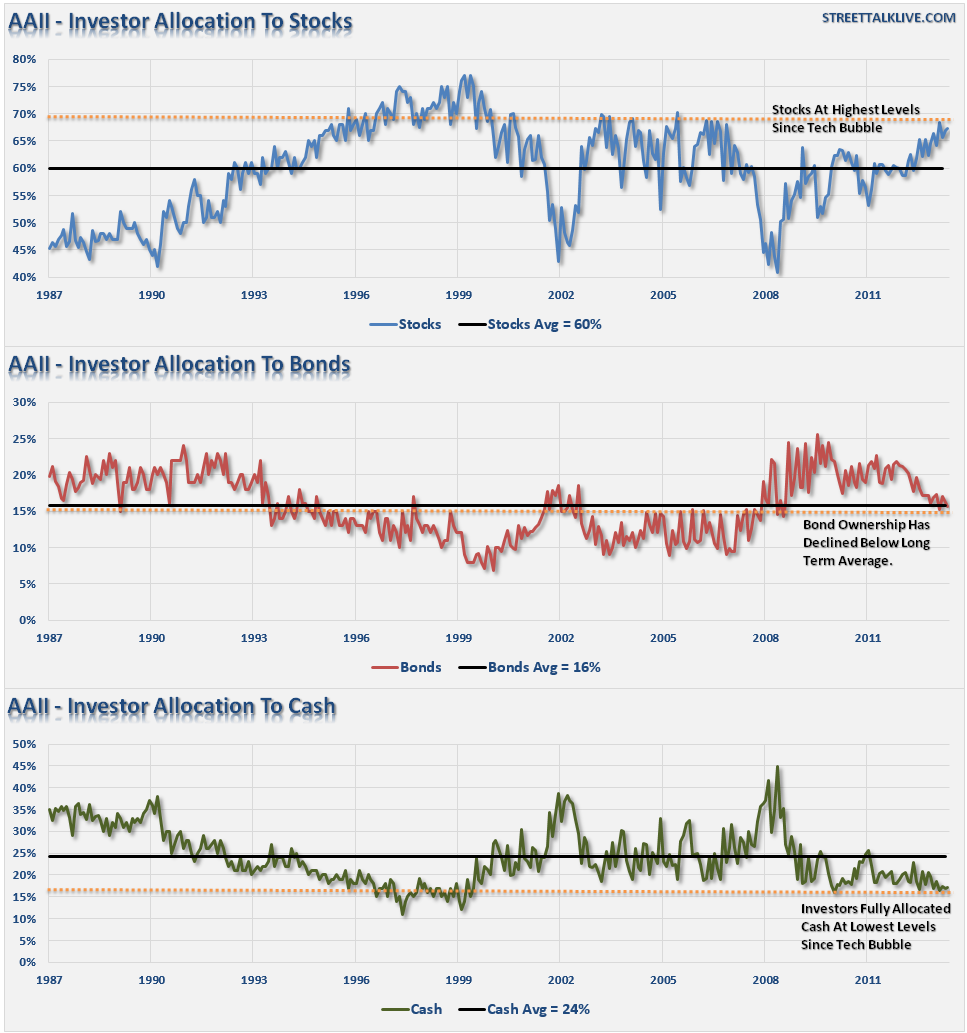
Great triptych chart courtesy of Lance Roberts today that answers three misleading statements heavily asserted by the risk-selling hoards: 1. that investors are afraid and under-allocated to equities, 2. that investors are afraid and over-allocated to bonds, 3. that investors are afraid and holding an overweight in cash. The answers as shown below are clearly: no, no and no.
AAII-Asset-Allocation-041614

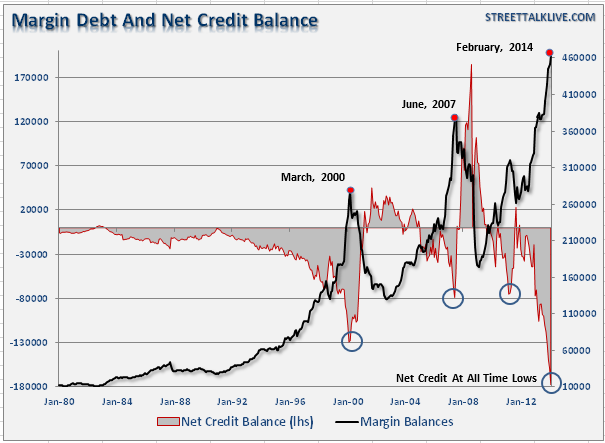
In fact equity market participants (well at least the small percentage who are not just HFT pingers but actually hold positions for not just microseconds, but overnight and longer!) have never been more risk-exposed and confident that prices can only higher as expressed by the highest margin use and lowest ability to hold through any price declines ever on record, as shown here.
MarginDebt-NetCredit-040814-2

Posted in Main Page | Comments Off on Equity investors under-allocated? no, no and ah, nope





