QE asset recovery. Great, now what?

With stock markets off to a rough start for the year, long-always prophets have been prominently featured assuring ‘little folks’ that all is well and the financial wizards have capital risk all under control. Valuations off the charts? Dividends pathetic? Business cycle long in the tooth? Volumes low? Volatility picking up? Never us worry… the best time to buy is every time we have any cash to give our sage and savvy financial managers, right? Why even Warren Buffett says he is finding attractive value don’t you know.

Time to sober up. The chart below casts light on the truth about dear old, folksy, Warren. His fund Berkshire Hathaway has long been much too large and US focused to be anything other than a broad market buy and hold, bell weather. Sure he loves to talk about his internal book value gains, but the fact is that investors in Berkshire aren’t holding a private fund that will redeem their investment when they wish to cash out. Berkshire investors hold publicly traded shares that move in near perfect correlation with the S&P 500. This means Berkshire holders have lost 50% of their investment value twice with the S&P since the secular bear began in 2000.

Berkshire and S&P March 17 2014

No wonder Warren praises the Bernank and says QE was a smart idea. Before QE, Buffett (and the other long-always masters) had their investment “genius” dilapidated twice as their followers rode wild volatility over a decade of flat to negative returns. The QE reflation trade has literally saved their investment reputations over the past two years. As valuations traded back to cyclical highs, Warren’s own net worth enjoyed a huge pop since 2011, now ranking him once more within the top 2 wealthiest people in the world. QE has been a wonderful recovery of billions!

But now the plot thickens. Since Buffett’s fund virtually is the S&P Index, and since Buffett can’t sell the majority of his market-moving positions even if he wanted to, his followers should be asking “what now?” With stock valuations back at notorious record highs, how do we protect our capital from the next bear market swipe? QE has been good to Buffett and company, no question. But investment genius? Give us a break.

Posted in Main Page | Comments Off on QE asset recovery. Great, now what?

Has the last sucker been sucked in?

Levered algo traders have had enjoyed a lucrative business model over the past 2 years as QE belief swept the world: ramp it (risk prices) and they (a gullible public) will be sucked in. With FX traders dumping the Yen overnight, computerized programs are madly ramping the carry trade with stocks skyward once more out of the gate this morning. Business news are trying to justify the move on “better than expected” US industrial production in March. But such blind optimism overlooks that the upside beat was largely thanks to a surge in motor vehicle and parts production, which will only add to excess auto inventories that were already sitting at the highs seen in the Great Recession depths in 2008-09.

Driving by our local Ford dealership last week, I noticed a prominent billboard: “Ask us about our off-sight inventory of new cars and trucks!” Car dealers are drowning in inventory forced on them by the manufacturers while able and willing buyers have been thinning once more. Everyone with a pulse has already bought a new car on zero down, zero interest, over 97 months!! Car loans are this cycle’s sub-prime boil waiting to burst.

Meanwhile, as attentions are fixed on Crimea and missing planes, overnight we have quiet news of the next Chinese debt default now in process. See: China Developer with $567 million in debt said to collapse. This new trend of Chinese bond defaults is being increasingly recognized as the thin edge of a massive wedge. See, The Chinese Emperor has no clothes for an excellent summary:

What gave the markets the shivers last week was a statement from Li that a series of defaults were inevitable as the government tries to rationalize. A default by Haixin Steel, a relatively small operation but with ties to coal and iron ore companies was what gave rise to international concern. It also reflects what industry sources believe is a growing collapse with half of the country’s steel mills losing money. A week earlier China experienced its first bond default when Chaori Solar, a small privately owned solar panel maker, was unable to meet interest on Rmb1bn ($163 million) of bonds sold only two years ago.

In the past, the government has always picked up defaulting companies. If that policy is now to be abandoned, it is unclear just how big the debacle will be and whether it could lead to panic. Already world copper and iron prices fell sharply under the pressure of Chinese speculators retreating from their bets on a continued high level of metals production…

This prelude to a cataclysmic readjustment of the Chinese economy is arriving at a time when Western economists and businessmen have had to abandon a long-cherished hope that continued rapid Chinese [and Indian] development would prop up the world economy. But their disillusionment on this aspect is likely to pale into insignificance as the effects of the Chinese slowdown impacts further on commodity producers in Africa, Latin America and Australia.

[and of course Canada, American commentators nearly always forget about little old Canada in these comments….]

Commodity producers and currencies are all closely connected to the deflation of the Chinese [debt] miracle. This next chart maps the topping pattern in copper and the Canadian dollar today that resembles a similar break down heading into the 2008 recession.
Copper and C$ Mar 16 2014

Posted in Main Page | Comments Off on Has the last sucker been sucked in?

Gold carts, derivatives, copper and China

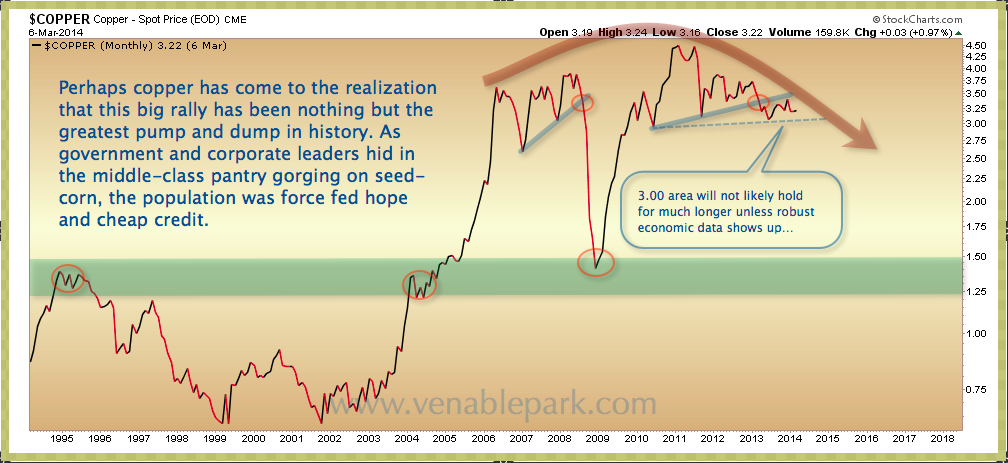
The double and triple pledging of a multitude of metal deposits the past few years reminds me of the gold cart fraud in US banks in the 1800’s. In order to control loan growth, banks were required to maintain a fixed ratio of physical bullion as backing in their basement vaults. This was meant to stop them from becoming too greedy and over-levered. Not to let a little thing like responsible restraints on their growth get in the way, the banks ingeniously devised a gold cart on wheels that could be moved from vault to vault ahead of the auditors. In this way they were able to side side step lending controls and fraudulently pledge the same gold base multiple times over among the group. The result was predictable..rapid growth in loans and profits and then–yet another spectacular financial collapse that shuttered banks and evaporated customer deposits. In the 2000’s, this same multiple pledging model became the back bone of the derivatives market that blew up the global banking system. But since the banks were bailed out by governments and central banks everywhere the past 5 years, they were of course able to go right back at it, levering on leverage. China has been a poster-child for this excess leverage model; and now the inevitable unwind has begun.   Copper is leading the way lower, having fallen through the trend line at 3.00 this week, long term support marked below is the 1.50 area.

copper spot March 10 2014

CNBC’s Steve Liesman and Michelle Caruso-Cabrera provide insight into the sell-off in copper, and the impact of a weaker Chinese economy on the U.S. economy. Here is a direct video link.


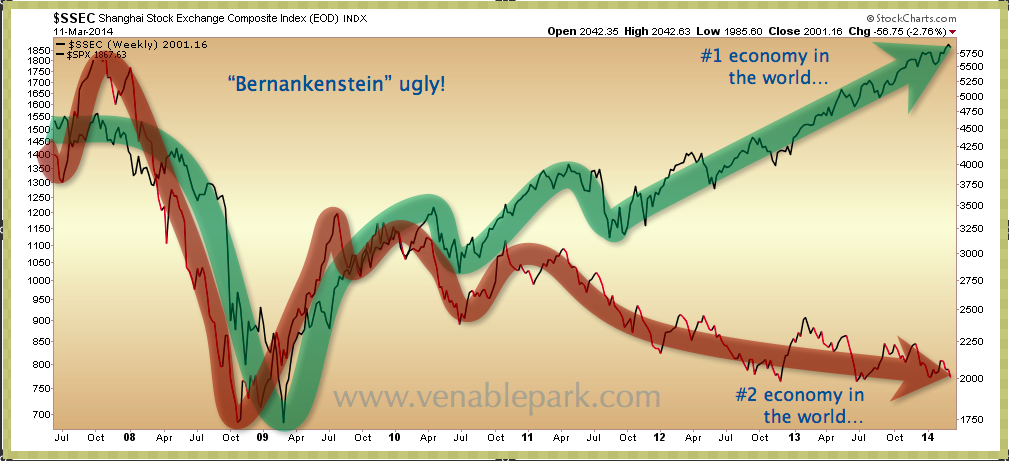
All of which underlines the garish disconnect today between the stock market of the world’s second largest economy, China, fathoming its 2009 lows once more, and the S&P 500 at all time highs…Extreme capital risk anyone?
Bernankenstein China vs US stocks

Posted in Main Page | Comments Off on Gold carts, derivatives, copper and China