Perspective on global income

Based on our own peer group we tend to have a limited perspective on the reality of global wealth dispersion. Some stats from World Bank economist Branko Milanovic’s book “The Haves and Have-Nots” offer some perspective on the world’s 7+ billion citizens:

-the top 50% of global income earners make $1,225 a year
-the top 20% bring home $5,000 a year
-the top 10% earns $12,000 a year
-never mind the top 1%…to make into the top 0.1% of global earners requires income of just $70,000 a year.

Now for a further reality check. Earning 70K a year while working may seem modest to some in the west, but in order to earn that same $70,000 a year in retirement (before tax!), in the current low rate, low yield environment, one would need to have more than $3 million in capital saved (outside your house and other non-productive assets).

For those who don’t like this math and wish to force their capital into riskier assets in order to extract more passive income, the truth is that dividend paying stocks and “high-yield” debt today are so over-valued, that even if one were to put 100% of their life savings into these riskier asset classes, they would still have a difficult time sustaining more than 3% a year in income withdrawals, even while facing a greater than 80% probability of losing chunks of their capital over every time period within the next 10 years. Nevertheless this is the bright idea, recommended by nearly every financial planner and asset manager in the world today. Good plan for whom?

We don’t get to pick the valuations and market conditions we are living through today, but we do get to pick our response and risk exposure to them. Our behavior and willingness to understand math drives the bulk of investment outcomes.

Posted in Main Page | Comments Off on Perspective on global income

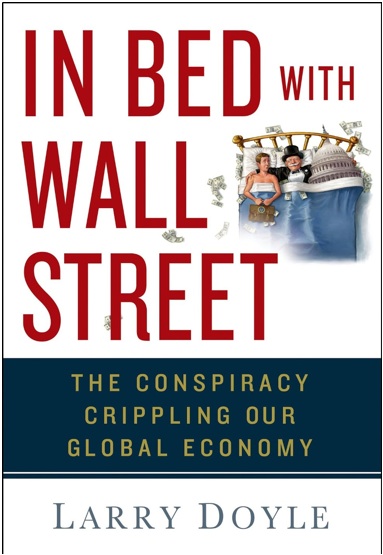
Recommended read: In Bed with Wall Street

In Bed with Wall StreetI just finished reading this book. I think everyone should.  At least those who are interested in understanding the events, trends and players that have undermined democracy, fairness, the rule of law, global financial stability and the middle class.

Author Larry Doyle does an excellent job of laying out the complex web of conflicts, complicity and deceit enabled by the revolving door between the banking cartel, the regulators and legislators. He patiently and eloquently details the evidence that so few people understand today even after everything that has happened since the financial crisis first erupted.

Importantly the book does not only name culprits, but also some of the few characters that have proven themselves worthy leaders for reform in this area.  He also outlines some actionable ideas in order to force the scourge of financial anarchy and systemic fraud back into the bottle once more. In the process, Doyle effectively reminds of the simple truth that until we admit what is wrong, the free world will never be able to repent, reform and recover. I am going to interview Larry for the blog to talk about his research and findings next week. Stay tuned. You can order or download the book here on Amazon.

The Wall Street meltdown in 2008 brought the country to its knees, and spawned nationwide protests against the lack of regulation and oversight facing Wall Street. But the average American still fails to fully grasp what was—and still is—happening: that the inmates continue to run the asylum. Doyle has been tracking this story for years through his blog Sense on Cents, and exposes here how Wall Street, our politicians, and the regulators themselves have conspired for personal and industry-wide gains while failing to protect investors, consumers, and the American taxpayer. He details the corrupt nature of Wall Street’s financial police, who are little more than meter maids imposing fines that amount to nothing more than a slap on the wrist. He exposes the revolving door of Wall Street, wherein the regulators are all former or future employees of the very firms they’re tasked with overseeing, and how they routinely serve the interests of the industry itself rather than protecting investors and markets. Recent bombshells—such as multi-billion dollar trading losses at JP Morgan Chase, the manipulation of interest rates via the LIBOR scandal, and money laundering with North American drug cartels and rogue nations such as Iran—are symptomatic of this corrosive culture and the lack of trust and confidence in the system. As the big banks fight tooth and nail to avoid real reforms that would protect the economy, this book is a timely, important, and shocking look inside the Washington-Wall Street conspiracy crippling America and the global economy.

Posted in Main Page | Comments Off on Recommended read: In Bed with Wall Street

Grantham on Tesla, the energy revolution and why QE can’t get blood from stones

GMO’s February letter is a must read for anyone interesting in an update on the energy revolution now sweeping the world. Yup, this is happening. Thanks to the persistence, wisdom and intelligence of some brave leaders, the naysayers are succumbing to irrelevance and deserved dinosaur status once more. He also looks at why US GDP has slowed, the vain attempts of QE and why “false optimism leads to very poor investment decisions.”  See:  Possible Peak Oil Demand, Fracking Frictions and the Great Fertilizer War of 2037. The second part, Ben Inker’s article “Divesting when discomfited”, on the challenges to value investors over the past three years of QE mis-allocation, is also worth reading.

Posted in Main Page | Comments Off on Grantham on Tesla, the energy revolution and why QE can’t get blood from stones