
60 Minutes: 100,000 homes for the homeless

Giving apartments to homeless people who’ve been on the streets for years before they’ve received treatment for drug or alcohol problems or mental illness may not sound like a wise idea. But that’s what’s being done in cities across America in an approach that targets those who’ve been homeless the longest and are believed to be at greatest risk of dying, especially with all of this cold weather.

They’re people who once might have been viewed as unreachable. But cities and counties affiliated with a movement known as the 100,000 Homes Campaign have so far managed to get 80,000 of them off the streets. Local governments and non-profit groups do most of the work. The money comes mostly from existing federal programs and private donations, and there’s evidence that this approach saves taxpayers money. Here is a direct video link.
Also see: Anderson Cooper: how I see homeless people now

Posted in Main Page | Comments Off on 60 Minutes: 100,000 homes for the homeless

With monetary “easing” like QE who needs tightening?

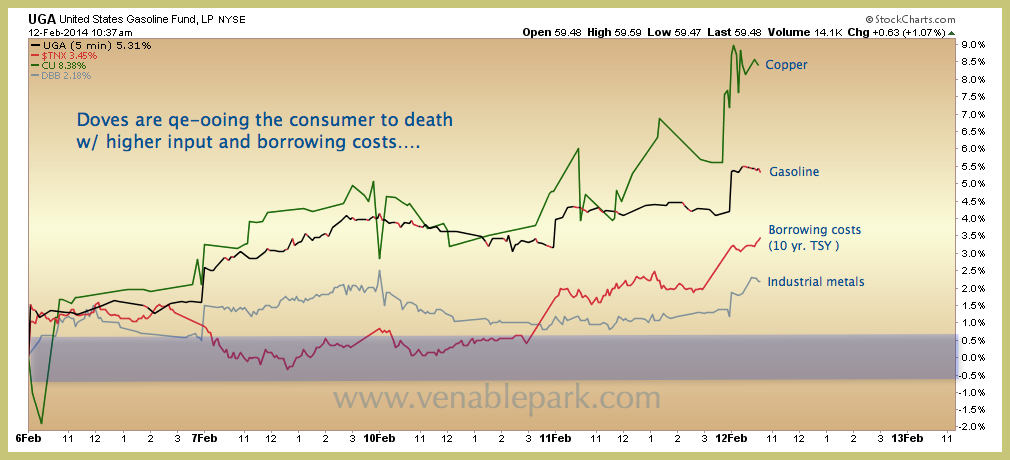
All the talk, talk, talk, about Central Banks “saving” the economy and consumers getting stronger and “taper isn’t tighter”…one might easily get the impression that consumer spending constraints have been loosening the past year. And yet incomes have continued to stagnate, savings are stuck near nil, debt levels remain peaked and daily consumption (food, gas, borrowing costs) have all spiked higher once more on QE’ternity. Gee with “help” like this, who needs enemies?
Consumer inputs up

Posted in Main Page | Comments Off on With monetary “easing” like QE who needs tightening?

Perspective on global income

Based on our own peer group we tend to have a limited perspective on the reality of global wealth dispersion. Some stats from World Bank economist Branko Milanovic’s book “The Haves and Have-Nots” offer some perspective on the world’s 7+ billion citizens:

-the top 50% of global income earners make $1,225 a year
-the top 20% bring home $5,000 a year
-the top 10% earns $12,000 a year
-never mind the top 1%…to make into the top 0.1% of global earners requires income of just $70,000 a year.

Now for a further reality check. Earning 70K a year while working may seem modest to some in the west, but in order to earn that same $70,000 a year in retirement (before tax!), in the current low rate, low yield environment, one would need to have more than $3 million in capital saved (outside your house and other non-productive assets).

For those who don’t like this math and wish to force their capital into riskier assets in order to extract more passive income, the truth is that dividend paying stocks and “high-yield” debt today are so over-valued, that even if one were to put 100% of their life savings into these riskier asset classes, they would still have a difficult time sustaining more than 3% a year in income withdrawals, even while facing a greater than 80% probability of losing chunks of their capital over every time period within the next 10 years. Nevertheless this is the bright idea, recommended by nearly every financial planner and asset manager in the world today. Good plan for whom?

We don’t get to pick the valuations and market conditions we are living through today, but we do get to pick our response and risk exposure to them. Our behavior and willingness to understand math drives the bulk of investment outcomes.

Posted in Main Page | Comments Off on Perspective on global income





